
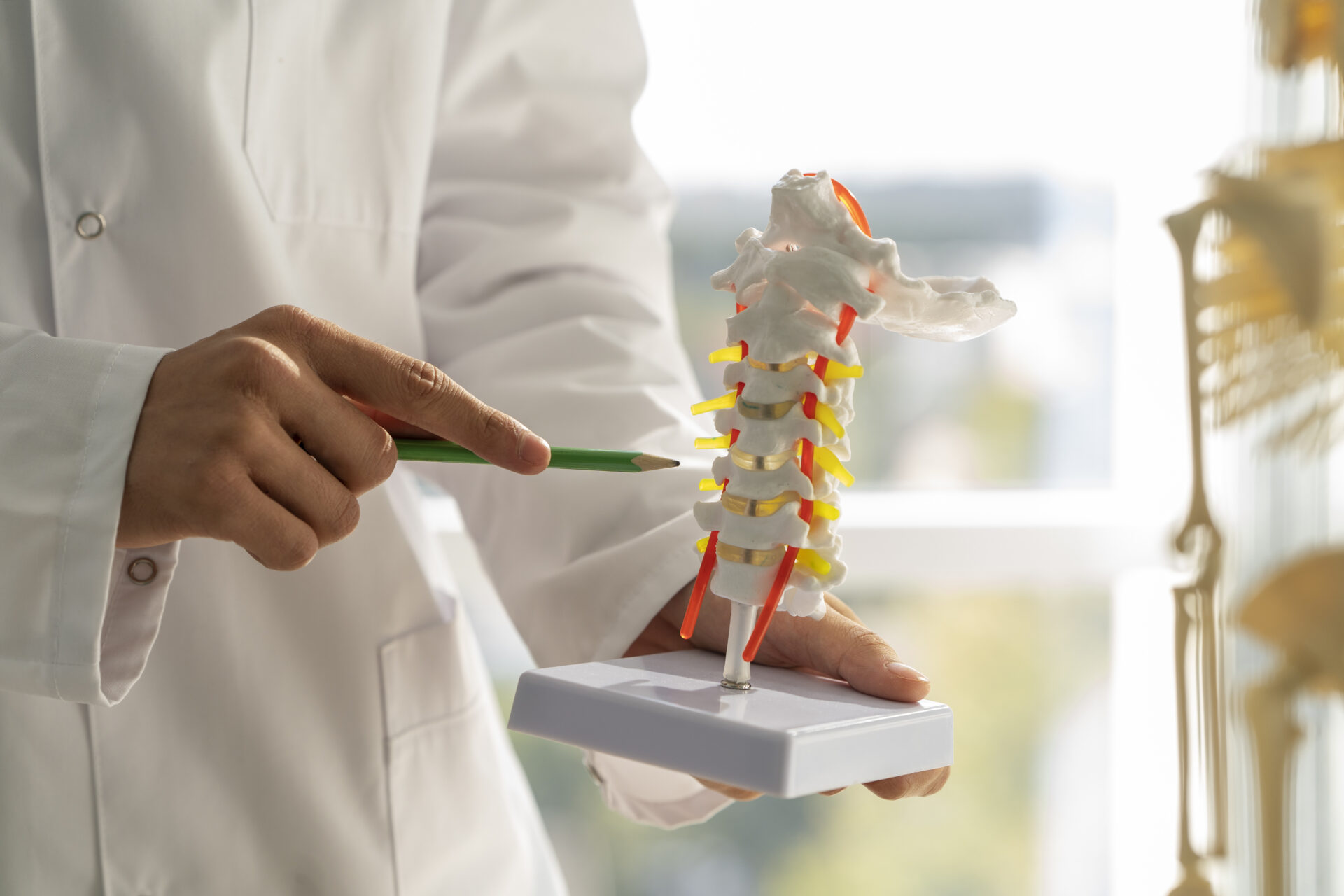
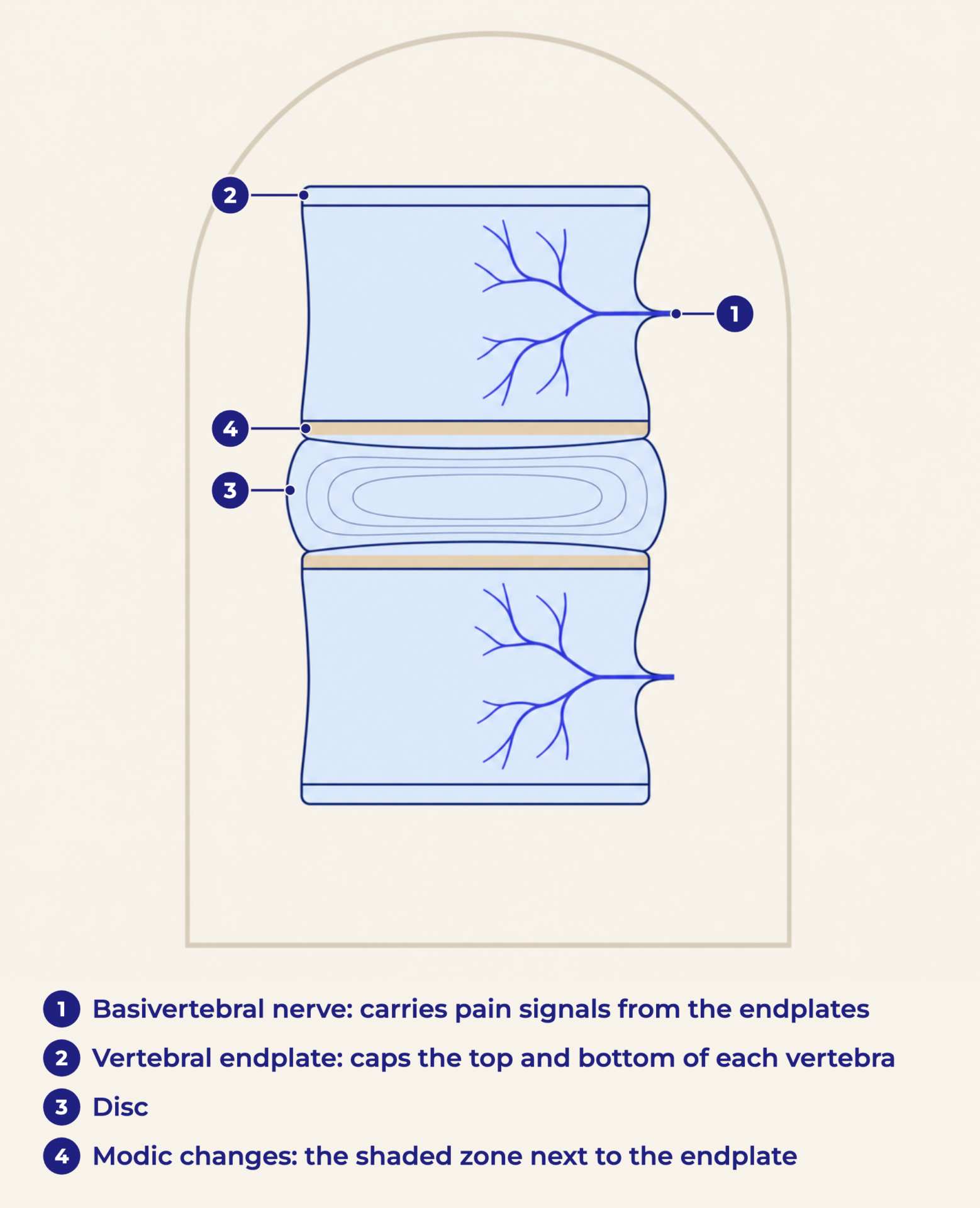
Vertebrogenic back pain is chronic low back pain that comes from the vertebral endplates (the thin layers of bone and cartilage that cap each vertebra where it meets the disc) and the basivertebral nerve, which carries pain signals from inside the vertebra. “Vertebrogenic” means arising from the vertebra, as opposed to “discogenic”, from the disc. On an MRI it is linked to Modic changes, signal changes in the bone marrow next to the endplate.
Guidance from the American Society of Pain and Neuroscience (ASPN) and the International Society for the Advancement of Spine Surgery (ISASS) describes the typical pattern as a deep, aching, midline low back pain, worse with sitting, bending forward and standing up from a chair. It may also spread beside the spine or, less often, into the buttocks. However, in the 2022 review of the trial populations, no participant reported pain below the knee.
This matters because the pain source was long folded into “degenerative disc disease”, and the usual injections aim elsewhere, at the nerve roots or the facet joints. Still, first-line care is the same as for any chronic back pain. For people who fit a specific picture, a targeted radiofrequency procedure on the basivertebral nerve has been tested in two randomized trials funded by the device manufacturer. Against a sham procedure, disability improved more with the procedure only in the analysis that left out people whose nerve was not reached; in everyone randomized, the difference was not statistically significant. In contrast, against continued standard care, in an open-label trial with no sham, pain and disability improved more.
What is established, and what is not settled
What is established is the nerve supply and the link to pain; what is not settled is whether a Modic change explains yours, since Modic changes also appear in people with no back pain.
Key takeaways
- Vertebrogenic pain comes from the vertebral endplates and the nerve inside the vertebra, not the disc itself or the facet joints, though disc and endplate pain can occur together.
- The typical pattern: months of a deep, midline low back ache, worse with sitting, bending forward and getting up from a chair; in the trial populations it did not travel below the knee.
- Modic type 1 or 2 changes on an MRI support the diagnosis but don’t make it, and no diagnostic block confirms it the way medial branch blocks confirm facet pain.
- First-line care is the same as for other chronic back pain. Basivertebral nerve ablation is a targeted option for people who fit the trial picture; in the trials a minority later had another treatment at the same level.
- The evidence is promising but not settled: manufacturer-funded, with a sham group that also improved and no comparison group after the first year.
- Call 911 for the red flags under “When does back pain need urgent or prompt care?”
In this article
- What it is and where it comes from
- Modic changes: what they mean
- Diagnosis, and the three look-alikes
- Treatment options
- The evidence for the nerve procedure
- Candidacy and risks
- How Dr. Preet Patel approaches it
- When to seek urgent or prompt care
- The bottom line
What is vertebrogenic back pain, and where does it come from?
A vertebra is one of the stacked bones of the spine. Between each pair sits a disc. Between disc and bone sits the endplate, a thin plate of cartilage and bone. The vertebra also has its own nerve. In studies of human vertebrae, the basivertebral nerve enters through an opening at the back of the vertebral body and branches toward the endplates. In addition, staining studies confirmed that these fibers sense pain. Endplates can also crack and wear. Damaged endplates grow more of these pain-sensing fibers, and not every damaged endplate shows up on an MRI.
How the disc and endplate work as one unit
The disc and endplate work as one unit and can hurt together. However, endplate pain travels along the basivertebral nerve and disc pain along a different nerve. Some people have mostly endplate pain, others both. However, no reliable figure says how often they overlap (2022 review, in a journal supplement sponsored by the device manufacturer). If both are contributing, a procedure aimed at the endplate nerve may address only part of the pain, which is one reason to work out the source first.
What are Modic changes on an MRI, and do they mean this is the cause of my pain?
Modic changes are MRI signal changes in the bone marrow on either side of an endplate. They come in three types: type 1 looks like inflammation and swelling in the marrow, type 2 is marrow replaced by fat, and type 3 is hardened, sclerotic bone. Types 1 and 2 are the ones studied in relation to pain. Both randomized trials of the nerve procedure required one of them, so they are the entry point for that option.
However, a Modic change on your report is not, by itself, the diagnosis. In a 2008 systematic review of 82 study samples, a median of 6% of people without back pain and 43% of people with low back pain or sciatica had Modic changes. The link is real but uneven. In a 2018 meta-analysis of 31 studies, type 1 was not clearly more strongly linked to pain than type 2. These are observational findings, so Modic changes are linked to pain rather than proven to cause it. So the scan supports the diagnosis. But it does not make it.
How is vertebrogenic pain diagnosed, and how is it told apart from disc, facet or sacroiliac pain?
There is no single test. The diagnosis rests on the pain pattern, an MRI showing Modic type 1 or 2 changes at the levels that match the pain, at least 6 months of pain despite conservative care, and an examination that rules out other sources. The ASPN guideline calls typical features plus Modic type 1 or 2 changes “highly diagnostic”. However, that is a consensus judgment, not a validated test. Unlike facet pain, there is no confirmatory nerve block.
Three other sources of back-dominant pain
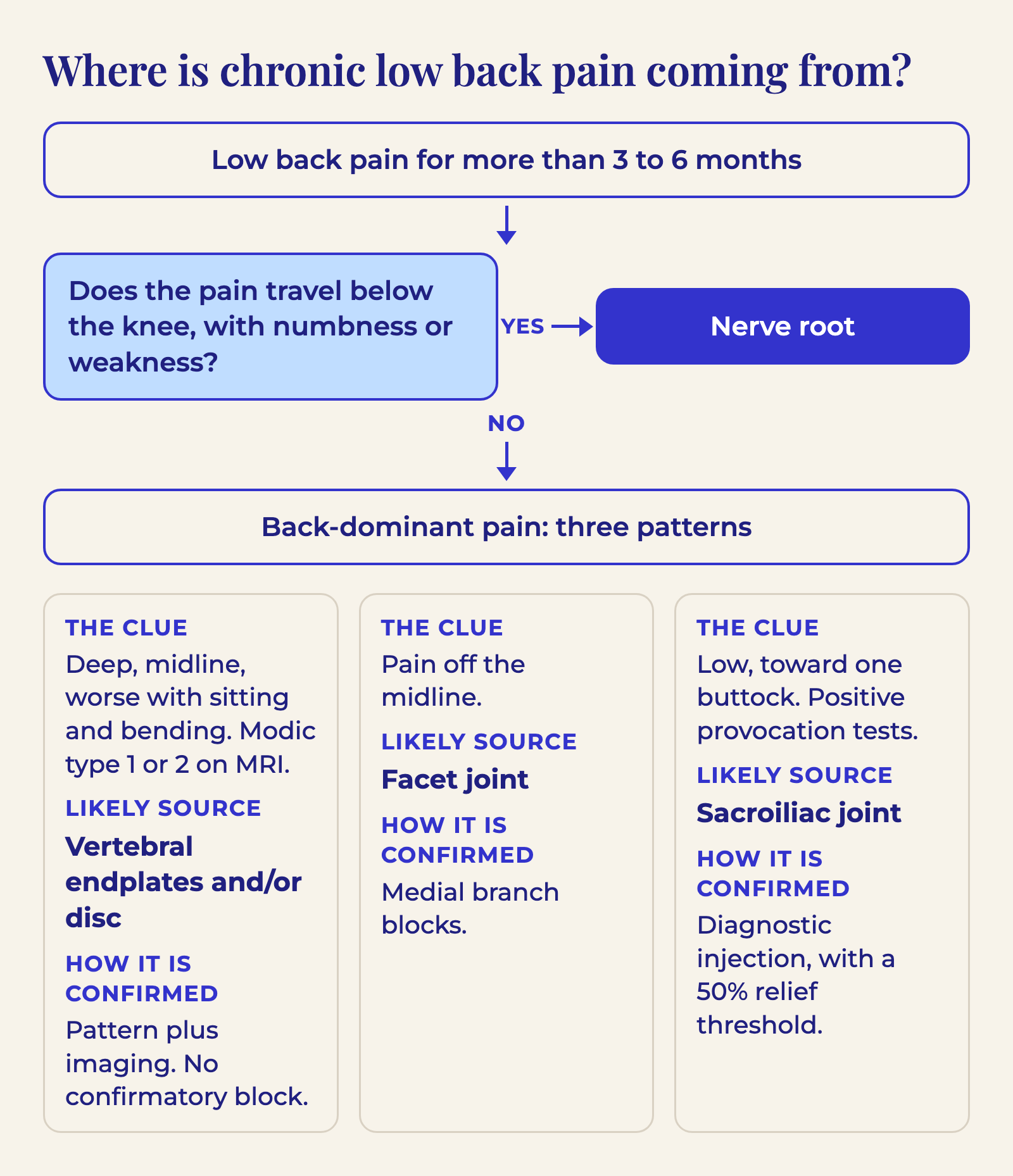
Three other sources produce chronic back-dominant (“axial”) low back pain, and each needs a different test to confirm it.
Disc (discogenic) pain can feel the same, and because disc and endplate are neighbors the two are not always separable.
Facet joint pain comes from the small joints at the back of the spine. A multi-society consensus guideline found no history or exam finding that reliably identifies it, though pain that is not mainly in the midline has a weak association with it. The test is a medial branch block, numbing the small nerves to the joint to see whether the pain stops. When blocks are positive, radiofrequency ablation of those nerves may help well-selected people.
Finally, sacroiliac joint pain sits low, toward one buttock, where the spine meets the pelvis. A 2025 international consensus guideline describes physical provocation tests confirmed by a diagnostic injection into the joint, with 50% relief counting as positive.
Why earlier injections may not have helped
This is also why earlier injections may not have helped. Epidural steroid injections aim at inflamed nerve roots, and facet injections at the facet joints. Neither targets the endplate. Instead, each is the right tool for a different source, and ruling those sources out is part of reaching this diagnosis.
Example (illustrative): a 52-year-old who flies weekly has two years of a deep, central ache after long days of sitting, two epidurals that did not help, and an MRI report noting Modic type 1 changes at one level. The pattern plus the scan raise the question. Whether the facet or sacroiliac joints are contributing still has to be ruled out. So the report alone does not settle it.
Pain that travels below the knee
Pain that travels below the knee, or numbness or weakness in the leg, points to a nerve root, which is a different problem from the one this article covers.
What are the treatment options for vertebrogenic back pain?
Staying active, exercise and physical therapy
The American College of Physicians recommends starting chronic low back pain care with non-drug treatment such as exercise and multidisciplinary rehabilitation. The benefit is modest: the evidence review behind that guideline found small to moderate, mostly short-term effects on pain. Every other option adds to this foundation and does not replace it.
Medication
The same guideline lists anti-inflammatories as the usual first medication. Even so, its review of medicines found small to moderate, mainly short-term effects. That conversation belongs with the physician who prescribes for you; Gramercy is an opioid-free practice and does not manage medication.
Injections aimed at other structures
Epidural steroid injections, facet joint injections and medial branch radiofrequency ablation help when the nerve roots or facet joints are the source, and they remain part of working out where the pain comes from.
Basivertebral nerve ablation
A single outpatient procedure under sedation or general anesthesia with X-ray guidance. In the trial methods, a thin probe is passed through the pedicle (the bony bridge at the back of the vertebra) into the vertebral body, and radiofrequency heat is applied to the basivertebral nerve so that it stops carrying pain signals from the endplate. A 2026 review describes a short recovery, but the trial reports reviewed for this article do not give return-to-activity timing. The evidence and the risks follow below.
Spinal fusion
An option sometimes considered for chronic back-dominant pain attributed to worn disc levels after prolonged conservative care. Two randomized trials, however, found little or no clear advantage for fusion over rehabilitation programs. In addition, the smaller one reported an 18% surgical complication rate. Still, fusion is major surgery: sometimes necessary, sometimes uncertain, sometimes not the best choice. No trial compares it head to head with basivertebral nerve ablation, so this article makes no comparison.
Research only: antibiotics
A 2013 trial reported benefit for Modic type 1 changes. However, the larger 2019 AIM trial found no clinically important benefit, so antibiotics are not standard care.
What does the evidence say about basivertebral nerve ablation, and how long does relief last?
In short: for people who fit the trial criteria, the evidence is promising but not settled. It is strongest in the first year. In contrast, relief reported through 5 years comes from treated people followed without a comparison group. Specifically, two randomized trials, both sponsored by the device manufacturer, are the core of that evidence. Both measured disability on the Oswestry Disability Index (ODI, a questionnaire scored 0 to 100), counted a 10-point change as meaningful, and measured pain on a 0 to 10 scale.
The sham-controlled trial (SMART)
225 adults with chronic low back pain and Modic type 1 or 2 changes were randomized to the procedure (147) or a sham (78), a simulated procedure, so that neither participants nor assessors knew who was treated. At 3 months, in everyone randomized, disability improved 19.0 points with the procedure versus 15.4 with sham, a difference that was not statistically significant. However, in the analysis the trial emphasized, which left out people whose nerve was not successfully targeted, it was 20.5 versus 15.2, a difference that was significant. In fact, the sham group improved substantially: 55% of the sham group reached a meaningful improvement, against 76% of treated people in that analysis.
In plain terms: against a convincing sham, the procedure’s difference at 3 months was about 4 to 5 points on the 100-point disability scale, and it reached statistical significance only after people whose nerve was missed were set aside. Follow-up at 2 years and at 5 years covered treated people only, because most of the sham group went on to receive the procedure.
The open-label trial
The open-label trial (everyone knew who had the procedure). The trial randomized 140 adults to the procedure (66) or continued standard care (74), with no sham. At 3 months, in the 104 participants included in that analysis, disability fell 25.3 points with the procedure versus 4.4 with standard care, and 75% versus 33% reached a meaningful improvement. In plain terms: the gap was large, but without a sham, no one can separate expectation effects from the treatment effect. At 24 months, 58 of the 66 assigned to the procedure were followed; 72% reported at least 50% pain reduction, and 8% had another procedure or surgery at the same level.
Longer follow-up
None of this follow-up has a comparison group. A pooled 5-year analysis of the two trials plus one single-arm study followed 249 of 322 treated people: 66% of those followed had at least 50% pain reduction. A 2022 systematic review of 414 treated people pooled results at 6 and 12 months, and a 2026 real-world cohort of 60 people found 49% with that much relief at 12 months, a smaller share than in the trials. The pooled analysis and the review had manufacturer support, and both compare treated people with their own starting point.
Society positions
The ASPN guideline gave the procedure its highest grade, Level A, with “high certainty that the net benefit is substantial in appropriately selected individuals”. A guideline grade is a society’s judgment, and it sits beside the sham-trial result rather than replacing it. Several of the guideline’s authors disclosed manufacturer grants or fees during the work. The neurosurgical societies said in a 2022 comment letter that their ability to endorse another society’s draft policy on the procedure was limited, citing its tone, its broad indications, and data they called “contradictory”.
Even so, relief lasting through 5 years in the people followed is not a promise that pain will not return. Results vary, and not everyone is a candidate.
Who is a candidate for basivertebral nerve ablation, and what are the risks?
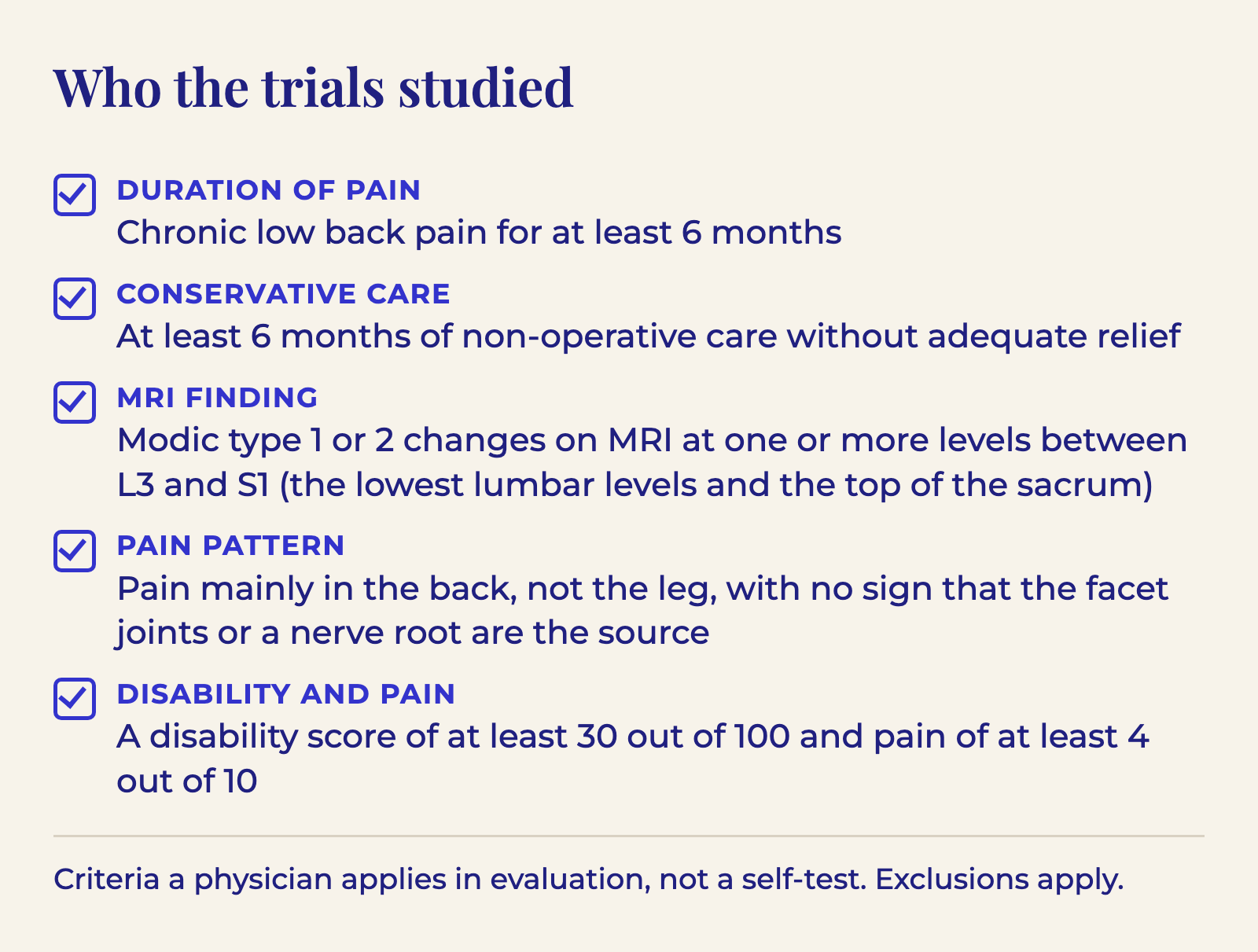
The evidence applies to the people the trials studied. These are the criteria from the sham-controlled trial and the open-label trial, which a physician applies in an evaluation. However, they are not a self-test:
- chronic low back pain for at least 6 months
- at least 6 months of non-operative care without adequate relief
- Modic type 1 or 2 changes on MRI at one or more levels between L3 and S1 (the lowest lumbar levels and the top of the sacrum)
- pain mainly in the back, not the leg, with no sign that the facet joints or a nerve root are the source
- a disability score of at least 30 out of 100 and pain of at least 4 out of 10
The trials excluded people with any of the following, among other criteria, and the physician checks each of these:
- leg-dominant nerve pain
- symptomatic spinal stenosis
- diagnosed osteoporosis or a vertebral fracture
- previous lumbar spine surgery
- a disc herniation over 5 mm, or vertebral slippage (spondylolisthesis) over 2 mm
- a BMI over 40
Risks in the trials
In the sham-controlled trial, eight procedure-related events occurred in six of 225 people (2.7%, including two people in the sham group), including one nerve root injury and four temporary changes in leg strength or sensation. During the 2-year follow-up, one person with thin bone had a vertebral compression fracture after treatment. It then healed within 8 weeks. In the open-label trial, 11% of the 127 people treated, including standard-care participants who later received the procedure, had temporary leg pain after the procedure, almost always from the probe passing too close to the nerve; it resolved in a median of about 7 weeks.
Risks outside the trials
Reports to a US government device-safety database most often describe vertebral compression fracture, increased back pain and bleeding behind the abdominal cavity, and they also include two anesthesia-related deaths. The database collects reports from manufacturers, clinicians and others without a denominator. So its reports show what can happen, not how often.
The chance of no meaningful improvement
About 1 in 4 treated people did not reach the disability threshold at 3 months (in the sham-controlled trial, among those whose nerve was reached; in the open-label trial, among the 104 analyzed). Similarly, about 1 in 3 did not reach 50% pain relief at 12 months in the 2022 pooled review. Also, about half did not in the 2026 real-world cohort. By 5 years, 13% in the pooled analysis had another treatment at the same level, including 6% a fusion.
How Dr. Preet Patel approaches vertebrogenic back pain
Dr. Preet Patel’s approach to low back pain starts with a full diagnostic consultation, not a five-minute triage. He reviews your records and imaging before you arrive, including whether the MRI shows Modic changes at the levels that match where you hurt, and he examines you in the room.
He works out the source first. Where the picture is unclear, he uses the diagnostic injections described above, medial branch blocks for the facet joints and sacroiliac joint injections for the sacroiliac joint, to confirm or rule out other sources before anyone decides on a targeted procedure. If the source is a nerve root or the facet joints, the right treatment is different, and he says so.
He is direct with clients about candidacy: whether you fit the picture the trials studied, what the evidence does and does not show, and what the alternatives are, including continuing conservative care or a surgical opinion. When surgery is the right answer, he refers you to an excellent surgeon.
Gramercy Center offers basivertebral nerve ablation, along with the diagnostic injections described above. It also offers epidural steroid injections, facet joint injections and radiofrequency ablation for when the nerve roots or facet joints are the source.
Time and travel
On time and travel: Dr. Preet Patel will let you know at the consultation whether basivertebral nerve ablation would need a separate appointment. The trial reports reviewed for this article do not give return-to-activity timing, so he sets those expectations with you individually and gives you a specific return-to-activity plan, often coordinated with your trainer or physical therapist. Virtual consultations, with the same review of records and imaging, are available if your schedule or travel makes that easier, so you can discuss whether your picture fits before you travel.
Gramercy is an opioid-free practice, and every consultation is with Dr. Preet Patel, a physician specialist, never a physician assistant or nurse practitioner.
When does back pain need urgent or prompt care?
If you have loss of bladder or bowel control, numbness in the groin or saddle area, sudden or worsening weakness, fever with back pain, pain after a major fall or accident, chest pain, or a sudden, severe headache, call 911 or go to the nearest emergency room right away.
MedlinePlus advises contacting a clinician for severe back pain that does not go away, and contacting one right away for numbness, weakness, loss of movement, or bowel or bladder changes. So new numbness or tingling in a leg calls for a same-day call to a physician, and an emergency room visit if it spreads, gets worse, or comes with weakness or loss of bladder or bowel control.
See a physician within the week, rather than waiting for a routine slot, for any of these:
- back pain with unexplained weight loss or a history of cancer, two of the most commonly cited warning signs in a review of 16 national guidelines
- pain that wakes you at night or does not ease at rest, also on that list
- pain that is not improving at all after about 4 weeks of care, the point at which an overview of 15 guidelines recommends specialist referral
These signs do not mean something serious is present. They mean it should be checked.
What’s the bottom line on vertebrogenic back pain?
Vertebrogenic back pain is a source of chronic low back pain that was long folded into “degenerative disc disease”. It comes from the vertebral endplates and the nerve inside the vertebra. It also has a recognizable pattern, and Modic type 1 or 2 changes on an MRI support it. First-line care is the same as for other back pain. For a defined group who have tried that for at least 6 months without enough relief, basivertebral nerve ablation is a targeted option performed as a single procedure, and spinal fusion remains a surgical option with its own evidence and risks.
What stays uncertain: the scan alone is not the diagnosis, there is no confirmatory test, endplate and disc pain can overlap, the strongest evidence for the nerve procedure is manufacturer-funded and strongest in the first year, and in the trials a minority later had another treatment at the same level.
So the practical next step is to bring your MRI report and your pain pattern to a physician who treats spine pain and ask three questions. Does my picture fit? Have the other sources been ruled out? What does the evidence mean for someone like me?
Schedule a consultation with Dr. Preet Patel. Or call (310) 439-8009.
Sources
First part of the sources
- Best Practice Guidelines on the Diagnosis and Treatment of Vertebrogenic Pain with Basivertebral Nerve Ablation from the American Society of Pain and Neuroscience. Journal of Pain Research. 2022. https://pubmed.ncbi.nlm.nih.gov/36128549/
- ISASS Policy Statement 2022: Literature Review of Intraosseous Basivertebral Nerve Ablation. International Journal of Spine Surgery. 2022. https://pubmed.ncbi.nlm.nih.gov/36266051/
- Vertebrogenic Pain: A Paradigm Shift in Diagnosis and Treatment of Axial Low Back Pain. Pain Medicine (supplement sponsored by the device manufacturer). 2022. https://pubmed.ncbi.nlm.nih.gov/35856329/
- Intraosseous basivertebral nerve ablation for the treatment of chronic low back pain: a prospective randomized double-blind sham-controlled multi-center study (SMART). European Spine Journal. 2018. https://pubmed.ncbi.nlm.nih.gov/29423885/
- A prospective, randomized, multicenter study of intraosseous basivertebral nerve ablation for the treatment of chronic low back pain. The Spine Journal. 2019. https://pubmed.ncbi.nlm.nih.gov/31229663/
- Vertebral endplate signal changes (Modic change): a systematic literature review of prevalence and association with non-specific low back pain. European Spine Journal. 2008. https://pubmed.ncbi.nlm.nih.gov/18787845/
- Innervation of the human vertebral body: a histologic study. Journal of Spinal Disorders. 1998. https://pubmed.ncbi.nlm.nih.gov/9884299/
- Innervation patterns of PGP 9.5-positive nerve fibers within the human lumbar vertebra. Journal of Anatomy. 2011. https://pubmed.ncbi.nlm.nih.gov/21223256/
- Innervation of pathologies in the lumbar vertebral end plate and intervertebral disc. The Spine Journal. 2014. https://pubmed.ncbi.nlm.nih.gov/24139753/
Second part of the sources
- Degenerative disk disease: assessment of changes in vertebral body marrow with MR imaging. Radiology. 1988. https://pubmed.ncbi.nlm.nih.gov/3336678/
- Modic changes—Their associations with low back pain and activity limitation: A systematic literature review and meta-analysis. PLoS ONE. 2018. https://journals.plos.org/plosone/article?id=10.1371/journal.pone.0200677
- Consensus practice guidelines on interventions for lumbar facet joint pain from a multispecialty, international working group. Regional Anesthesia & Pain Medicine. 2020. https://pubmed.ncbi.nlm.nih.gov/32245841/
- Consensus practice guidelines on sacroiliac joint complex pain from a multispecialty, international working group. Regional Anesthesia & Pain Medicine. 2025. https://pubmed.ncbi.nlm.nih.gov/41320235/
- Epidural Corticosteroid Injections for Radiculopathy and Spinal Stenosis: A Systematic Review and Meta-analysis. Annals of Internal Medicine. 2015. https://pubmed.ncbi.nlm.nih.gov/26302454/
- Noninvasive Treatments for Acute, Subacute, and Chronic Low Back Pain: A Clinical Practice Guideline From the American College of Physicians. Annals of Internal Medicine. 2017. https://pubmed.ncbi.nlm.nih.gov/28192789/
- Nonpharmacologic Therapies for Low Back Pain: A Systematic Review for an American College of Physicians Clinical Practice Guideline. Annals of Internal Medicine. 2017. https://pubmed.ncbi.nlm.nih.gov/28192793/
- Systemic Pharmacologic Therapies for Low Back Pain: A Systematic Review for an American College of Physicians Clinical Practice Guideline. Annals of Internal Medicine. 2017. https://pubmed.ncbi.nlm.nih.gov/28192790/
- Prospective, randomized, multicenter study of intraosseous basivertebral nerve ablation for the treatment of chronic low back pain: 24-month treatment arm results. North American Spine Society Journal. 2021. https://pubmed.ncbi.nlm.nih.gov/35141653/
Third part of the sources
- Vertebrogenic Low Back Pain and Basivertebral Nerve Ablation: A Review of Mechanisms, Imaging-Driven Selection, and Clinical Outcomes. Diagnostics. 2026. https://pubmed.ncbi.nlm.nih.gov/42351602/
- Randomised controlled trial to compare surgical stabilisation of the lumbar spine with an intensive rehabilitation programme for patients with chronic low back pain: the MRC spine stabilisation trial. BMJ. 2005. https://pubmed.ncbi.nlm.nih.gov/15911537/
- Randomized clinical trial of lumbar instrumented fusion and cognitive intervention and exercises in patients with chronic low back pain and disc degeneration. Spine. 2003. https://pubmed.ncbi.nlm.nih.gov/12973134/
- Antibiotic treatment in patients with chronic low back pain and vertebral bone edema (Modic type 1 changes): a double-blind randomized clinical controlled trial of efficacy. European Spine Journal. 2013. https://pubmed.ncbi.nlm.nih.gov/23404353/
- Efficacy of antibiotic treatment in patients with chronic low back pain and Modic changes (the AIM study): double blind, randomised, placebo controlled, multicentre trial. BMJ. 2019. https://pubmed.ncbi.nlm.nih.gov/31619437/
- Intraosseous Basivertebral Nerve Ablation for the Treatment of Chronic Low Back Pain: 2-Year Results From a Prospective Randomized Double-Blind Sham-Controlled Multicenter Study. International Journal of Spine Surgery. 2019. https://pubmed.ncbi.nlm.nih.gov/31131209/
- Long-term outcomes following intraosseous basivertebral nerve ablation for the treatment of chronic low back pain: 5-year treatment arm results from a prospective randomized double-blind sham-controlled multi-center study. European Spine Journal. 2020. https://pubmed.ncbi.nlm.nih.gov/32451777/
- Intraosseous basivertebral nerve ablation: A 5-year pooled analysis from three prospective clinical trials. Interventional Pain Medicine. 2024. https://pubmed.ncbi.nlm.nih.gov/39758714/
Fourth part of the sources
- The Effectiveness of Intraosseous Basivertebral Nerve Radiofrequency Ablation for the Treatment of Vertebrogenic Low Back Pain: An Updated Systematic Review with Single-Arm Meta-analysis. Pain Medicine (supplement sponsored by the device manufacturer). 2022. https://pubmed.ncbi.nlm.nih.gov/35856331/
- The effectiveness of basivertebral nerve radiofrequency ablation for the treatment of vertebrogenic low back pain: 1-year results of a prospective real-world cohort study. Pain Medicine. 2026. https://pubmed.ncbi.nlm.nih.gov/40891888/
- Neurosurgery Comments on NASS Draft Coverage Policy for Basivertebral Nerve Ablation. American Association of Neurological Surgeons / Congress of Neurological Surgeons. 2022. https://aans.org/advocacy/articles/neurosurgery-comments-on-nass-draft-coverage-policy-for-basivertebral-nerve-ablation
- Prospective, randomized, multicenter study of intraosseous basivertebral nerve ablation for the treatment of chronic low back pain: 12-month results. Regional Anesthesia & Pain Medicine. 2021. https://pubmed.ncbi.nlm.nih.gov/34031220/
- Adverse events associated with basivertebral nerve radiofrequency ablation: A comprehensive analysis from the MAUDE database. Interventional Pain Medicine. 2026. https://pubmed.ncbi.nlm.nih.gov/42473615/
- Low back pain – chronic (Medical Encyclopedia). MedlinePlus, US National Library of Medicine / NIH. Reviewed 2025. https://medlineplus.gov/ency/article/007422.htm
- Red flags presented in current low back pain guidelines: a review. European Spine Journal. 2016. https://pubmed.ncbi.nlm.nih.gov/27376890/
- Clinical practice guidelines for the management of non-specific low back pain in primary care: an updated overview. European Spine Journal. 2018. https://pubmed.ncbi.nlm.nih.gov/29971708/
This content is for general education only and is not medical advice. It does not create a doctor-patient relationship. Treatment decisions should be made with a qualified physician after an individual evaluation. Results vary, and not everyone is a candidate for every treatment.