

When back pain keeps disrupting flights, meetings or training, or a cortisone shot has stopped working, the logic behind a recommendation matters. A back pain treatment plan should not be chosen from a scan or a diagnosis label alone. Guidelines describe three groups that can be read as three questions: is anything urgent, is a nerve root involved, and what seems to be driving the pain. A physician then matches options to the answers. The 2017 American College of Physicians guideline, which covers non-invasive treatments, advises starting with non-drug options. This post covers low back pain in adults, with or without sciatica (leg pain from an irritated nerve root), and ends with what to ask so you can take part.
What is known: a 2012 analysis that pooled 33 groups of people followed over time found that average pain in acute (recent-onset) low back pain fell by more than half within about six weeks. Persistent pain improved less, and average pain was still low to moderate at one year. In addition, scan “abnormalities” are common in people with no pain.
What is uncertain: for many injections and procedures the benefit is modest or short-lived, guidelines do not all agree, and surgery suits some patterns better than others.
Emergency signs: see when to call 911.
In this article
- Narrowing down the cause
- Do you need an MRI?
- Options and evidence
- When procedures or surgery are considered
- What to bring and ask
- What a consultation involves
- Emergency signs
- The bottom line
How do physicians narrow down what is causing back and leg pain?
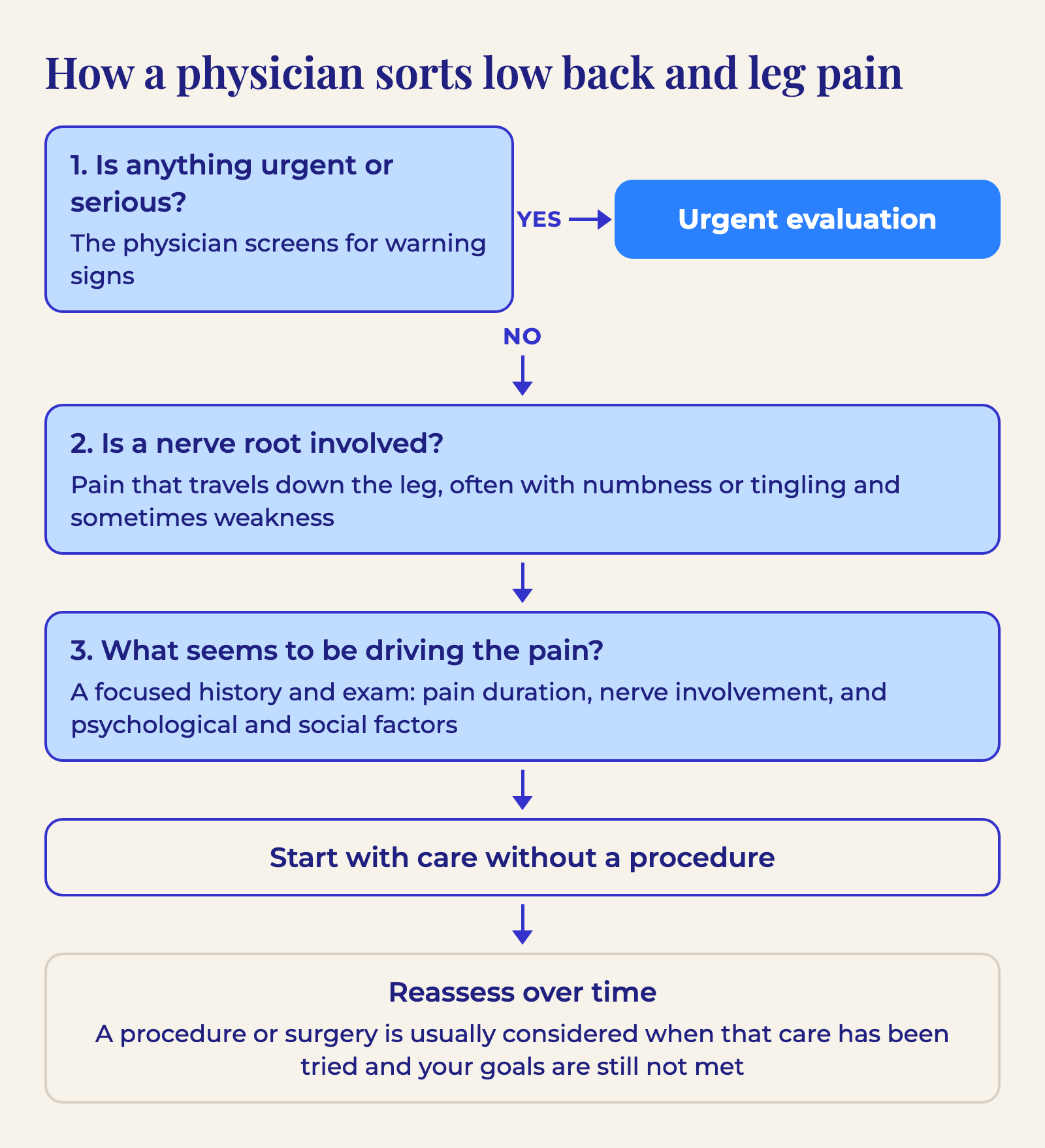
A 2007 joint guideline from the American College of Physicians and the American Pain Society asks the physician to place you in one of three groups: pain possibly tied to another specific spinal cause, pain possibly tied to a nerve root or spinal stenosis (a narrowed spinal canal), or non-specific low back pain. In that order, they can be read as three questions:
- Is anything urgent or serious? The physician screens for warning signs.
- Is a nerve root (where a nerve leaves the spine) involved? Pain that travels down the leg, often with numbness or tingling and sometimes weakness, is the pattern physicians look for in an irritated nerve root. The 2022 guideline from the U.S. Departments of Veterans Affairs and Defense (VA/DoD) describes this pattern for a herniated disc.
- What seems to be driving the pain? For nearly all people with low back pain, no single painful structure can be named, a 2018 Lancet series concluded. “Non-specific” describes what an exam and scan can show, not that the pain is unreal. The VA/DoD guideline has the physician take a focused history and exam covering pain duration, warning signs, nerve involvement, and psychological and social factors.
Do you need an MRI before choosing a treatment?
Usually not at the start. In fact, the VA/DoD guideline recommends against routine imaging for acute low back pain with no warning signs or nerve loss. It suggests an MRI for severe or worsening nerve loss, such as weakness, or for leg symptoms from a possible herniated disc or stenosis that last more than a month.
“Abnormal” findings are also common without pain. For example, a 2015 review of 33 studies pooled scans of 3,110 adults with no back pain: disc bulges appeared in roughly 30% at age 20, 50% at 40 and 69% at 60.
Example (illustrative): a sales executive with a dull ache after flights and a touring musician with burning pain below the knee can have the same “disc bulge” report, which describes the image and does not by itself show the cause of pain. The musician’s next question is whether a nerve root is involved.
What are the main options, and how strong is the evidence for each?
The 2017 American College of Physicians guideline starts with non-drug care. However, for injections, procedures and surgery, the evidence ranges from small and short-term to disputed or uncertain, depending on the type of pain.
Gramercy Center offers image-guided spinal injections, nerve blocks and minimally invasive spine procedures, as well as regenerative treatments such as platelet-rich plasma (PRP) for joints, muscles, tendons and nerves. The evidence summaries below come from the cited sources, not from our own results.
Evidence for each option, by type of pain
| Option | Evidence, by type of pain | Limits and risks |
|---|---|---|
| Non-drug care (heat, massage, exercise) | Guideline first step (2017 guideline). Sciatica: physiotherapy evidence inadequate, not proof of no benefit | Risks not covered here |
| Epidural steroid injection (for sciatica) | Small, short-term benefit (2020 Cochrane review); sources differ. Stenosis: probably no short-term pain relief (2025 neurology review) | Headache, pain flare, steroid effects, bleeding; rare serious injury |
| Radiofrequency ablation (chronic low back pain) | Disputed: small improvements (2026 analysis); VA/DoD 2022 suggests it (weak recommendation) | Below the smallest change people usually notice; no risk figures found |
| Regenerative injections (such as PRP) | Insufficient evidence for or against (VA/DoD 2022) | Benefit not established; no risk figures found |
| Surgery | Herniated disc: less leg pain early in two trials, similar at one year in one. Cauda equina syndrome (nerve compression): listed reason for surgery (UK NHS). Stenosis: uncertain (2016 Cochrane review). Fusion, chronic disc-related pain: no statistically significant difference from non-operative care; estimate leaned toward fusion (2014) | Decompression: spinal fluid leak, damage to spinal nerves or paralysis, pain that does not improve (NHS); risks differ by operation |
Exercise, heat and other non-drug care
For new and recent low back pain, the 2017 American College of Physicians guideline makes a strong recommendation, based on low- to moderate-quality evidence, to start with non-drug options such as heat, massage, acupuncture or spinal manipulation. In addition, for chronic pain it adds exercise and names anti-inflammatory medicines as the first drug option (a weak recommendation). For sciatica, however, a 2023 analysis of 18 trials judged the evidence for physiotherapy inadequate, which is not proof that it does not help.
Epidural steroid injection
An epidural steroid injection places a corticosteroid, the same kind of medicine as a cortisone shot, near an irritated nerve root to calm inflammation. For sciatica, a 2020 Cochrane review compared it with a dummy injection. It found the injection probably reduces leg pain slightly in the short term (more than 2 weeks to 3 months), by less than most people would call important.
However, reviews and guidelines differ. The American Academy of Neurology’s 2025 review found limited, mostly short-term benefit, and probably no short-term pain relief in spinal stenosis. In contrast, a 2021 guideline from a society of interventional pain physicians rated the evidence for long-term relief in disc herniation as strong, using its own grading method. So ask what result to expect, and for how long. The sources we read do not say when a repeat injection is worth trying.
In the Cochrane review, minor effects included headache or a pain flare. Steroid injections in general can raise blood sugar, and infection is a reason to avoid them.
One major event in the Cochrane review’s trials was a bleed in a person on blood thinners, so tell your physician about all your medicines. In addition, a 2015 consensus of 13 specialty societies called serious neurologic injury rare, without giving a rate. Not everyone is a candidate.
Other procedures and regenerative injections
Radiofrequency ablation uses heat to disable small nerves after a test injection of numbing medicine has relieved the pain. However, a 2026 pooled analysis of 55 trials in chronic low back pain found small improvements, below the smallest change people usually notice. The VA/DoD guideline still suggests it for chronic low back pain (a weak recommendation), so the evidence is disputed. The sources we read give no risk figures, so ask about the procedure’s risks.
Regenerative injections such as PRP (a concentrate of your own blood) are an area of ongoing research, and the same VA/DoD guideline found insufficient evidence to recommend for or against them in low back pain.
Surgery
Surgery is used for some patterns and is an option for others, but it is not a default. For example, the UK National Health Service (NHS) lists cauda equina syndrome (compression of the nerves at the base of the spine) among the reasons for decompression surgery (removing bone or tissue that presses on a nerve).
Also, two trials of sciatica from a disc herniation both found less leg pain in the first months with surgery. In a 2007 trial of 283 adults with 6 to 12 weeks of severe sciatica, about 95% in both groups felt recovered at one year, and 39% of the comparison group had surgery. In a 2020 trial of 128 adults with sciatica lasting 4 to 12 months, leg pain at six months averaged 2.8 after surgery and 5.2 with non-operative care (0 to 10 scale), and about a third of the non-operative group had surgery anyway.
Spinal stenosis, fusion and decompression
For spinal stenosis, the evidence is uncertain: a 2016 Cochrane review of five trials had very little confidence in whether surgery or non-surgical care is better.
For fusion (joining spinal bones so they heal into one) in chronic disc-related low back pain, a 2014 pooled analysis of five trials found no statistically significant difference in disability compared with non-operative care. Still, the estimate leaned toward fusion, with wide uncertainty.
For decompression, the NHS lists risks including spinal fluid leak, damage to spinal nerves or paralysis, and pain that does not improve, and calls serious complications uncommon. The NHS recovery page gives a timeline for that operation only, not for injections: you may be able to leave hospital after around 2 to 5 days and return to work around 4 to 6 weeks, and may need up to 12 weeks for all usual activities. Risks and recovery differ by operation, so ask the surgeon about yours.
When are injections, procedures or surgery usually considered?
A procedure or surgery is usually considered when:
- care without a procedure has been tried and your goals are still not met
- your symptoms, exam and any imaging point to the same place
- the procedure has a specific target and an agreed question: what will it tell us or change?
- the pattern is urgent, such as progressive weakness, which skips the usual steps
The guidelines we read set no number of weeks. This list summarizes how options are described, not a published protocol. The 2017 American College of Physicians guideline puts non-drug care before medicines. The NHS sciatica page says sciatica usually improves over a few weeks to a few months, but can last longer.
What to bring and what to ask
Bring:
- imaging reports and the images, not only the report
- a timeline: when it started, what eases or worsens it, where it travels, and any numbness, tingling or weakness
- what you have tried, including past injections and any surgeon’s recommendation, and how long each helped
- your medicines and supplements, as a list
- your goals, such as “a 12-hour flight and a full day of meetings”
Ask:
- What is driving my pain, and what points to that?
- What are my options, with benefits, risks and candidacy for each, including continuing care without a procedure?
- If a procedure is suggested: what is it aimed at, and what result would change the plan?
- How will we judge whether it is working, and what is plan B?
- What will I need to avoid afterward, and when can I fly, train and return to work?
- If surgery is suggested: which non-surgical options remain, and is a second opinion reasonable?
The sources we read give no downtime figures for injections, so ask for yours directly.
What a consultation with Dr. Preet Patel involves
At Gramercy, the first step is a full diagnostic consultation. Dr. Preet Patel reviews your records and imaging before you arrive, examines you, and explains your options in plain language. If surgery is the right answer, he will advise you and can connect you with a surgeon in his network of vetted providers. Read more about low back pain care at Gramercy.
When does back or leg pain need emergency care?
Most warning signs on screening lists are not specific, so a sign is a prompt to look further, not a diagnosis. Even so, do not wait if you have any of these:
If you have loss of bladder or bowel control, numbness in the groin or saddle area, sudden or worsening weakness, fever with back pain, pain after a major fall or accident, chest pain, or a sudden, severe headache, call 911 or go to the nearest emergency room right away.
Other signs are not emergencies but are worth an evaluation soon, says the NHS back pain page:
- pain not improving after a few weeks of home care
- pain that is worse at night or does not ease with rest
- unexplained weight loss
- a lump or swelling in the back
- pain worse with sneezing or coughing
What is the bottom line on choosing a back pain treatment?
The 2017 American College of Physicians guideline starts non-invasive care with non-drug options. However, for injections, procedures and surgery, evidence varies by type of pain, and guidelines do not all agree.
What remains uncertain is how much a given option will help you and when to move to the next step. So gather your records, timeline and goals, and bring the questions above.
Schedule a consultation with Dr. Preet Patel.
Sources
First part of the sources
- Noninvasive Treatments for Acute, Subacute, and Chronic Low Back Pain: A Clinical Practice Guideline From the American College of Physicians. Annals of Internal Medicine. 2017. https://pubmed.ncbi.nlm.nih.gov/28192789/
- The prognosis of acute and persistent low-back pain: a meta-analysis. Canadian Medical Association Journal. 2012. https://pubmed.ncbi.nlm.nih.gov/22586331/
- Systematic literature review of imaging features of spinal degeneration in asymptomatic populations. American Journal of Neuroradiology. 2015. https://pubmed.ncbi.nlm.nih.gov/25430861/
- Diagnosis and treatment of low back pain: a joint clinical practice guideline from the American College of Physicians and the American Pain Society. Annals of Internal Medicine. 2007. https://pubmed.ncbi.nlm.nih.gov/17909209/
- VA/DoD Clinical Practice Guideline for the Diagnosis and Treatment of Low Back Pain, Provider Summary, Version 3.0 (PDF). U.S. Department of Veterans Affairs and Department of Defense. 2022. https://www.healthquality.va.gov/guidelines/Pain/lbp/VADODLBPCPGProviderSummaryFinal508.pdf
- What low back pain is and why we need to pay attention. The Lancet low back pain series. 2018. https://pubmed.ncbi.nlm.nih.gov/29573870/
- How effective are physiotherapy interventions in treating people with sciatica? A systematic review and meta-analysis. European Spine Journal. 2023. https://pubmed.ncbi.nlm.nih.gov/36580149/
- Epidural corticosteroid injections for lumbosacral radicular pain. Cochrane Database of Systematic Reviews. 2020. https://pubmed.ncbi.nlm.nih.gov/32271952/
Second part of the sources
- Epidural Steroids for Cervical and Lumbar Radicular Pain and Spinal Stenosis: Systematic Review. American Academy of Neurology; Neurology. 2025. https://pubmed.ncbi.nlm.nih.gov/39938000/
- Epidural Interventions in the Management of Chronic Spinal Pain: ASIPP Comprehensive Evidence-Based Guidelines. American Society of Interventional Pain Physicians; Pain Physician. 2021. https://pubmed.ncbi.nlm.nih.gov/33492918/
- Local and Systemic Side Effects of Corticosteroid Injections for Musculoskeletal Indications. American Journal of Roentgenology. 2024. https://pubmed.ncbi.nlm.nih.gov/38117096/
- Safeguards to prevent neurologic complications after epidural steroid injections: consensus opinions from a multidisciplinary working group and national organizations. Anesthesiology. 2015. https://pubmed.ncbi.nlm.nih.gov/25668411/
- Current evidence on radiofrequency denervation for chronic low back pain: a systematic review and meta-analysis. BMJ Open. 2026. https://pubmed.ncbi.nlm.nih.gov/42463214/
- Lumbar decompression surgery: when it’s used. NHS (UK). Last reviewed March 10, 2026. https://www.nhs.uk/conditions/lumbar-decompression-surgery/why-its-done/
- Surgery versus prolonged conservative treatment for sciatica. New England Journal of Medicine. 2007. https://pubmed.ncbi.nlm.nih.gov/17538084/
- Surgery versus Conservative Care for Persistent Sciatica Lasting 4 to 12 Months. New England Journal of Medicine. 2020. https://pubmed.ncbi.nlm.nih.gov/32187469/
Third part of the sources
- Surgical versus non-surgical treatment for lumbar spinal stenosis. Cochrane Database of Systematic Reviews. 2016. https://pubmed.ncbi.nlm.nih.gov/26824399/
- Lumbar fusion versus nonoperative management for treatment of discogenic low back pain: a systematic review and meta-analysis of randomized controlled trials. Journal of Spinal Disorders & Techniques. 2014. https://pubmed.ncbi.nlm.nih.gov/24346052/
- Lumbar decompression surgery: risks. NHS (UK). Last reviewed March 10, 2026. https://www.nhs.uk/conditions/lumbar-decompression-surgery/risks/
- Lumbar decompression surgery: recovery. NHS (UK). Last reviewed March 10, 2026. https://www.nhs.uk/conditions/lumbar-decompression-surgery/recovery/
- Sciatica. NHS (UK). Last reviewed December 3, 2024. https://www.nhs.uk/conditions/sciatica/
- Prevalence of and screening for serious spinal pathology in patients presenting to primary care settings with acute low back pain. Arthritis & Rheumatism. 2009. https://pubmed.ncbi.nlm.nih.gov/19790051/
- Back pain. NHS (UK). Last reviewed March 5, 2026. https://www.nhs.uk/conditions/back-pain/
This content is for general education only and is not medical advice. It does not create a doctor-patient relationship. Treatment decisions should be made with a qualified physician after an individual evaluation. Results vary, and not everyone is a candidate for every treatment.