
If you have just had a platelet-rich plasma (PRP) injection for a tendon problem or knee arthritis, you probably want to know how long it may take for PRP to work, especially with a season or tournament on the calendar. PRP is made from a small sample of your own blood, concentrated and injected into the problem area.
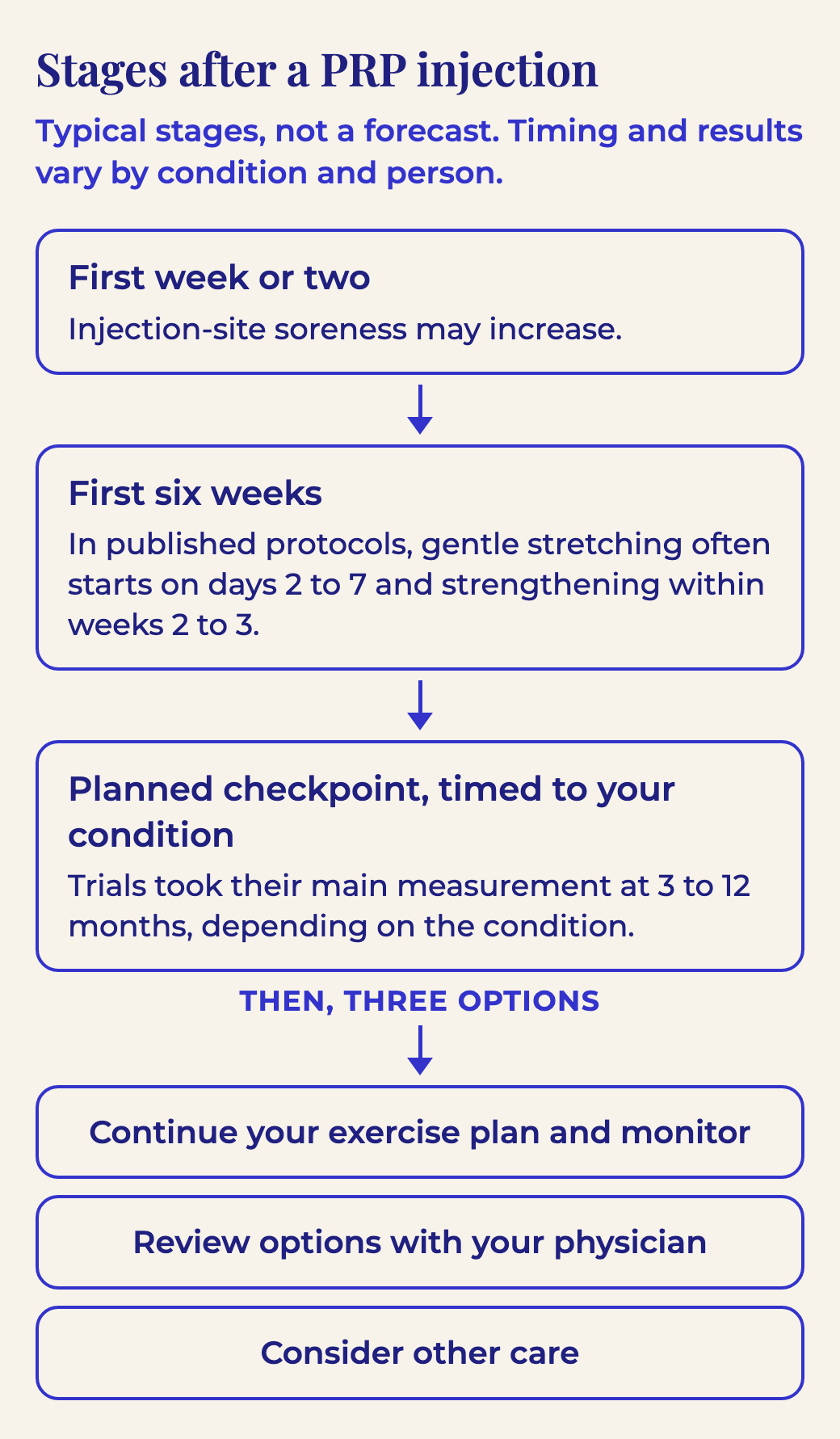
In short, PRP does not work right away. Soreness usually comes first: the American Academy of Orthopaedic Surgeons (AAOS) notes that pain at the injection site may increase for the first week or two. Any benefit takes longer, and the AAOS says it may be several weeks before a person feels one. Trials took their main measurement months later: at 3 months for tennis elbow, 6 months for the Achilles tendon and 12 months for knee arthritis. Where trials found a benefit, a difference in pain large enough to feel usually showed at about 3 months or later, as in a 2025 pooled analysis of knee trials, not in the first weeks.
Results are mixed. Some people improve and some don’t. Some placebo-controlled trials (comparisons with a dummy injection) found a benefit. For several tendon problems, though, placebo-controlled trials found no benefit. How long any benefit lasts, how many injections help and which preparation works best are not settled, and the answers differ by condition. Knowing this helps you avoid judging the result, or loading the area, too early.
Gramercy Center offers platelet-rich plasma (PRP). This article is education, and each research finding links to its source so you can check it.
Key takeaways
- Soreness comes first. Pain at the injection site may increase for the first week or two, and it tells you little about whether PRP will help.
- Trials measured results over months, not days. Main time points ran from about 3 months (tennis elbow, patellar tendon) to 12 months (knee arthritis, in the RESTORE trial of 288 people). Where trials found a benefit, a difference in pain large enough to feel usually showed from about 3 months.
- Results are mixed and differ by condition. Some trials found a benefit, and several found PRP no better than placebo at any point.
- Agree on a checkpoint with your physician before you judge the result, tell them about any event on your calendar, and keep up your exercise plan.
- Signs of a severe allergic reaction need 911. An injected joint or tendon area that becomes hot, red, swollen and more painful, especially with a fever, needs medical help the same day. Details are in the safety section below.
What happens in the first few days after a PRP injection?
Soreness at the injection site is the most common early experience, and it may get worse before it gets better (AAOS). In a UK trial of 240 adults with Achilles tendon pain, most people reported discomfort at the injection site after PRP. But many did after a sham injection too (a needle that does not deliver the treatment). Swelling and bruising were also about as common in both groups. So early soreness tells you little about whether PRP will help.
In the RESTORE trial and others, short-lived knee pain, swelling and stiffness were more common after PRP than after a saline (salt water) injection. A 2025 analysis of 24 knee trials reported complications at a rate of about 19 per 100 people given PRP, versus about 9 per 100 given comparison injections. However, nearly all were mild or moderate and settled on their own.
PRP is intended to deliver growth factors (proteins in platelets that signal cells), but the idea that they speed healing comes from early lab research, and the AAOS notes it isn’t exactly clear how PRP works.
Aftercare plans vary, and a review of 84 PRP tendon studies found that none had compared one plan with another. Many asked people to avoid anti-inflammatory medicines after the injection, often for more than two weeks. The reason given in a 2020 review of Achilles protocols is a theory that these medicines might blunt the local response PRP is meant to trigger. The research reviewed for this article found no trial testing whether these medicines change PRP results. So ask the physician who gave your injection which plan applies to you.
What do the first six weeks usually look like?
Most published plans build activity back gradually. In the review of 84 tendon studies, protocols that included exercise usually started gentle stretching 2 to 7 days after the injection, and strengthening within 2 to 3 weeks. Some protocols limited weight-bearing, and about half of the Achilles protocols used a boot or brace. Where protocols set a return to sport or full activity, it was most often at 4 to 6 weeks. But these were choices researchers made for their studies, not measurements of how long people actually took.
If a tournament, season or trip is on your calendar, tell your physician, whether your injection is already done or still booked. Questions worth asking:
- Given my condition and the event date, is the timing of my injection a concern?
- Which parts of my training can I keep, and which should I reduce or pause?
- When is my checkpoint, and does it fall before or after the event?
- What is the plan if the area is still sore, or not ready, by the date: compete, scale down or skip?
Exercise stays central throughout. For example, several tendon trials gave every group an exercise program, including a trial of athletes with patellar tendon pain and a shoulder trial. For knee arthritis, the American College of Rheumatology (ACR) strongly recommends exercise, and advises a referral to physical therapy for people with limited function or pain flares (short spells of worse pain).
Little change by six weeks is not a verdict, because most trials did not take their main measurement this early. In a 2025 pooled analysis of 18 knee trials, the pain difference from placebo was not large enough to feel at 1 month, but it was at 3 and 6 months.
When is it fair to judge whether PRP helped?
The fairest point is a checkpoint you agree with your physician in advance, timed to your condition. Trial time points are the best guide to that timing, with one caveat. A placebo-controlled trial compares PRP with a dummy injection, such as saline. Its main time point is when researchers chose to judge the result. That tells you when they expected a difference to show, not when you will feel one.
The main time points differed by condition:
- Tennis elbow: 3 months, in a placebo-controlled trial.
- Patellar tendon: 12 weeks, in a trial of athletes.
- Achilles tendon: 6 months, in a large UK trial.
- Knee arthritis: 12 months, in the RESTORE trial.
- Shoulder: no typical time point. A shoulder trial measured from 3 weeks to 1 year, so ask your physician to choose a checkpoint with you.
Where PRP did better than the comparison, the difference usually took about 3 months or longer to show. A large tennis elbow trial, for example, compared PRP with tendon needling (repeatedly passing a fine needle into the tendon), not with placebo. There was no difference at 12 weeks. PRP did better at 24 weeks, but only about half of the people were assessed then. So for tennis elbow, PRP beat needling in that one trial, but a pooled analysis of placebo-controlled trials found it no better than a dummy injection at any point up to 24 to 26 weeks. Shoulder timing is less clear, as the section on tendons and knee arthritis below explains. In several other trials, also covered there, no difference appeared at any point.
What can your checkpoint tell you?
People given placebo improved too. For example, in the shoulder trial and the tennis elbow trial listed above, symptoms eased in every group, including the saline groups. So feeling better at your checkpoint is good news, but on its own it can’t tell you whether PRP, your exercise plan or time made the difference.
That is why a checkpoint agreed in advance is more useful than judging week to week. At the checkpoint, compare with how things were before the injection:
- pain during the activities that matter to you
- what you can do in daily life and in training
- how much load the area tolerates
How long any benefit lasts is uncertain, and the knee trials disagree. A 2025 analysis of 11 knee trials found no effect at 12 months, and a trial of 237 people found the difference gone by 24 months. By contrast, a large trial in China reported benefit up to 5 years, though its published abstract gives few details. For tendons, follow-up in the trials described here stopped at about 1 year. Waiting longer does not ensure a change.
Does the timeline differ for tendons and knee arthritis?
Yes, and so does the evidence.
Tennis elbow. A 2026 pooled analysis of 6 placebo-controlled trials, with 355 people, found no difference from placebo at 4, 8 to 12, or 24 to 26 weeks.
Shoulder tendon problems, including partial rotator cuff tears. The evidence is limited and conflicting, so no typical shoulder timeline can be given. The AAOS 2025 rotator cuff guideline does not support routine PRP for rotator cuff tendinopathy (long-standing tendon pain and wear) or partial tears, because trial results are inconsistent. One 40-person trial found no difference from saline up to 1 year. However, a 2022 review of partial tears reported benefit from 3 to 6 weeks.
Achilles and patellar tendons. Two placebo-controlled Achilles trials found PRP no better than placebo. One, in 54 adults, found no difference at any check from 6 weeks to 1 year (1-year follow-up). A larger UK trial of 240 adults also found none at its main 6-month check. In the patellar tendon trial of 57 athletes, neither of two PRP types, combined with exercise, beat saline at any point up to 1 year.
Knee arthritis. The evidence is disputed. The RESTORE trial found no benefit over saline at 2 or 12 months, while other trials found benefits from about 3 months that faded by 12 or 24 months. The ACR’s 2026 guideline summary strongly recommends against PRP for knee and hip arthritis, while rating the certainty of the evidence as low. For the full picture, see how PRP compares with other knee injections.
Evidence for one condition does not carry over to another. So if your condition isn’t listed here, ask your physician what the research shows for it specifically.
What affects whether PRP helps?
Studies have looked at a few factors besides the condition itself. None is proven, and none has been shown to speed up results.
- Severity. The RESTORE trial studied mild to moderate knee arthritis, and its authors say the result may not apply to more severe disease. The AAOS guideline treats partial and full-thickness rotator cuff tears (tears that go all the way through the tendon) separately. It says routine PRP without surgery may not be indicated for full-thickness tears.
- Platelet dose. A pooled analysis of 13 tennis elbow trials linked higher platelet doses to better pain results. In the pooled knee analysis, low-platelet PRP gave no pain benefit large enough to feel. But these are associations, not settled findings.
- White blood cell content. Leukocyte-rich PRP has more white blood cells than blood, and leukocyte-poor PRP has fewer. Neither type beat saline in the patellar tendon trial. In knee trials, the leukocyte-rich type was linked to more mild pain and swelling, based on an indirect comparison.
- Number of injections (knee only). A trial of 102 people with early knee arthritis found neither one nor three injections better than saline up to 12 months. The trial of 237 people found three injections better than one at 6 and 12 months. The tendon trials described here each used a single injection.
What if it hasn’t helped by the checkpoint?
Start with a review, not a verdict. Questions worth asking your physician include whether the pain is coming from the structure that was treated, whether the exercise plan has been followed or needs changing, and whether imaging would help. For the shoulder, the AAOS guideline says MRI and ultrasound are useful alongside an examination for identifying rotator cuff tears.
Then the realistic options, each with its own trade-offs:
Continuing exercise-based rehab. This has the strongest support. For example, the ACR strongly recommends exercise for knee arthritis. The AAOS guideline rates physical therapy as improving symptoms in full-thickness rotator cuff tears, and its experts consider it reasonable for shallower (low- and intermediate-grade) partial tears. But its limits are time and consistency. For Achilles tendon problems, the AAOS notes that symptoms may take a few months to improve, and advises that eccentric (lengthening) exercises be supervised at first, because done incorrectly they can damage the tendon.
A repeat PRP injection. Evidence exists only for knee arthritis, and the two trials described above conflict. The research reviewed for this article found no trial of repeat injections for tendon problems, and no guideline statement on repeating PRP.
What about cortisone, shockwave or surgery?
A cortisone injection. Cortisone can give short-term relief, with cautions that depend on the area:
- Shoulder: The AAOS guideline says a single cortisone injection with a local anesthetic can be considered for short-term improvement in pain and function, and warns that repeated injections may compromise the rotator cuff.
- Tennis elbow: Cortisone eased pain more than PRP or saline at 1 month in a placebo-controlled trial. But a trial of 165 adults with tennis elbow found more recurrences by 1 year after cortisone (54% versus 12% with placebo).
- Achilles tendon: The AAOS advises against cortisone injections into the Achilles tendon, because they can cause it to rupture.
- Knee arthritis: The ACR strongly recommends cortisone injections into the joint, while rating the certainty as low.
Shockwave therapy. Extracorporeal shockwave therapy (ESWT) is used for some tendon problems. The AAOS describes its evidence as preliminary for the Achilles. For tennis elbow, the AAOS notes that many doctors consider it experimental, though the same page says some sources show it can be effective.
A surgical opinion. The AAOS describes when surgery may be considered after appropriate non-surgical care: for rotator cuff tears with lasting pain and limited function, including high-grade partial tears (through much of the tendon’s thickness); for the Achilles, only if pain hasn’t improved after 6 months; and for tennis elbow, after 6 to 12 months of non-surgical treatment.
Stopping is also a legitimate choice. If PRP hasn’t helped, deciding not to repeat it and to focus on other care is a reasonable decision to make with your physician.
How Dr. Preet Patel approaches this
This section describes Gramercy’s approach. It is not research evidence.
Gramercy Center offers platelet-rich plasma (PRP). Before treatment begins, Dr. Preet Patel sets clear expectations with each client: results are not instant, they vary, and not everyone is a candidate. He is board-certified by the American Board of Anesthesiology and an ACGME fellowship-trained interventional pain management specialist. He trained in pain medicine at Rutgers University. At Gramercy, clients always see an MD specialist, never a physician assistant or nurse practitioner.
After treatment, Dr. Preet Patel gives each client a return-to-activity plan, often coordinated with their trainer or physical therapist. For clients who travel or live outside Los Angeles, follow-ups can take place by telehealth. If another treatment or a surgeon’s opinion is the better next step, the team helps arrange it through Dr. Preet Patel’s network of trusted, vetted providers.
For condition-specific detail, see Gramercy’s page on shoulder pain treatment. Knee concerns are covered on the knee pain treatment page.
When should you call the clinic, and when is it an emergency?
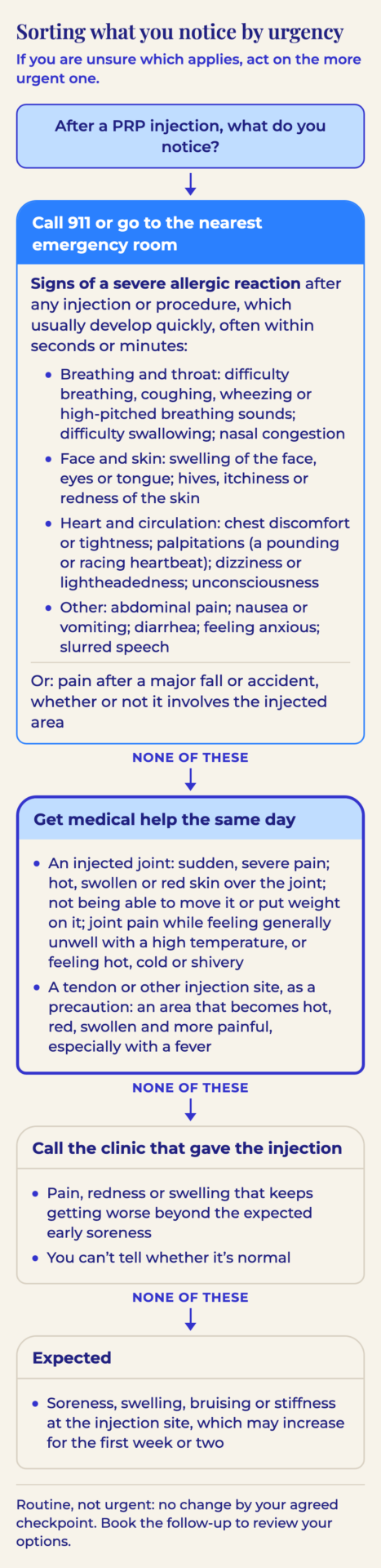
Most after-effects are expected and ease on their own. But a few need fast action. They are listed here from most to least urgent. If you’re unsure which applies, act on the more urgent one.
Which signs need help right away?
Call 911 or go to the nearest emergency room for:
- Signs of a severe allergic reaction (anaphylaxis) after any injection or procedure. These signs usually develop quickly, often within seconds or minutes. MedlinePlus lists these signs:
- Breathing and throat: difficulty breathing, coughing, wheezing or high-pitched breathing sounds; difficulty swallowing; nasal congestion
- Face and skin: swelling of the face, eyes or tongue; hives, itchiness or redness of the skin
- Heart and circulation: chest discomfort or tightness; palpitations (a pounding or racing heartbeat); dizziness or lightheadedness; unconsciousness
- Other: abdominal pain; nausea or vomiting; diarrhea; feeling anxious; slurred speech
- Pain after a major fall or accident, whether or not it involves the injected area.
Get medical help the same day if an injected joint shows these signs, which the NHS lists for a joint infection:
- sudden, severe pain in the joint
- hot, swollen or red skin over the joint
- not being able to move the joint or put weight on it
- joint pain while feeling generally unwell with a high temperature, or feeling hot, cold or shivery
Not everyone with a joint infection has a fever.
Knee arthritis injections go into the knee joint. Injections for tennis elbow, the Achilles or the patellar tendon target a tendon instead. The NHS list is written for joints. The sources reviewed for this article give no separate list for a tendon or other injection site, so as a precaution, treat the same signs the same way: an area that becomes hot, red, swollen and more painful, especially with a fever, needs medical help the same day.
Which signs are less urgent?
Call the clinic that gave the injection if pain, redness or swelling keeps getting worse beyond the early soreness described below, or if you can’t tell whether it’s normal. MedlinePlus advises contacting your provider if pain, redness, swelling or fever after an injection is becoming worse. If a fever comes with a hot, red, swollen area, use the same-day step above instead.
Expected: soreness, swelling, bruising or stiffness at the injection site. The AAOS notes that pain may increase for the first week or two.
Routine, not urgent: no change by your agreed checkpoint. Book the follow-up to review your options.
Joint infection after knee PRP appears rare in trials: a review of 91 knee trials found none in 5,914 injections, although its authors note that rates in everyday practice may be higher. The research reviewed for this article found no infection figure for tendon injections.
What is a realistic plan for the months after PRP?
Expect soreness first, possibly for a week or two. Then any change that comes is likely to be gradual. Where trials found a benefit, a difference in pain large enough to feel usually showed from about 3 months. In the meantime, follow your exercise plan, plan around your events with your physician, know the warning signs, and put a checkpoint on the calendar.
Results are mixed: some people don’t improve, and the evidence differs by condition. How long any benefit lasts and how many injections help are not settled. If PRP hasn’t helped by the checkpoint, more rehab, cortisone, shockwave therapy or a surgical opinion may be the better next step. The aim is a plan that fits your condition and your calendar, not a fixed number of weeks.
Schedule a consultation with Dr. Preet Patel. You can also call (310) 439-8009.
Sources
Soreness, side effects and aftercare
- Platelet-Rich Plasma (PRP). AAOS OrthoInfo. Undated. https://www.orthoinfo.org/en/treatment/platelet-rich-plasma-prp/
- Complications of PRP for knee osteoarthritis vs hyaluronic acid, corticosteroids and placebo: meta-analysis of RCTs (Fucaloro et al.). Arthroscopy. 2025. https://pubmed.ncbi.nlm.nih.gov/40409439/
- Post-Procedure Protocols Following Platelet-Rich Plasma Injections for Tendinopathy: A Systematic Review (Townsend et al.). PM&R. 2020. https://pubmed.ncbi.nlm.nih.gov/32103599/
- Role of Mechanical Loading for Platelet-Rich Plasma Treated Achilles Tendinopathy (Neph et al.). Current Sports Medicine Reports. 2020. https://pmc.ncbi.nlm.nih.gov/articles/PMC8898381/
- Safety and adverse events of intra-articular PRP versus other injectates for knee osteoarthritis (Nakagawa et al.). PM&R. 2026. https://pubmed.ncbi.nlm.nih.gov/42101047/
Knee arthritis trials and guidance
- Effect of Intra-articular Platelet-Rich Plasma vs Placebo Injection on Pain and Medial Tibial Cartilage Volume in Patients With Knee Osteoarthritis: The RESTORE Randomized Clinical Trial (Bennell et al.). JAMA. 2021. https://jamanetwork.com/journals/jama/fullarticle/2786501
- PRP Injections for the Treatment of Knee Osteoarthritis: The Improvement Is Clinically Significant and Influenced by Platelet Concentration (Bensa et al.). American Journal of Sports Medicine. 2025. https://pubmed.ncbi.nlm.nih.gov/39751394/
- 2026 Update of the American College of Rheumatology Recommendations for the Management of Osteoarthritis of the Knee, Hip, and Hand (Guideline Summary). American College of Rheumatology. 2026. https://assets.contentstack.io/v3/assets/bltee37abb6b278ab2c/bltb3d12c34020da842/oa-guideline-summary-2026.pdf
- Efficacy of intra-articular platelet-rich plasma compared with placebo in knee osteoarthritis: a systematic review and meta-analysis (Auroux et al.). Joint Bone Spine. 2025. https://pubmed.ncbi.nlm.nih.gov/40653151/
- Multiple platelet-rich plasma injections are superior to single PRP injections or saline in osteoarthritis of the knee (Yurtbay et al.). Archives of Orthopaedic and Trauma Surgery. 2022. https://pubmed.ncbi.nlm.nih.gov/34705072/
- Intra-articular injections of platelet-rich plasma decrease pain and improve functional outcomes than sham saline in patients with knee osteoarthritis (Chu et al.). Knee Surgery, Sports Traumatology, Arthroscopy. 2022. https://pubmed.ncbi.nlm.nih.gov/35124707/
- The effectiveness of leucocyte-poor platelet-rich plasma injections on symptomatic early osteoarthritis of the knee: the PEAK randomized controlled trial (Lewis et al.). Bone & Joint Journal. 2022. https://pubmed.ncbi.nlm.nih.gov/35638203/
Tendon trials and guidance
- Treatment of lateral epicondylitis with platelet-rich plasma, glucocorticoid, or saline: a randomized, double-blind, placebo-controlled trial (Krogh et al.). American Journal of Sports Medicine. 2013. https://pubmed.ncbi.nlm.nih.gov/23328738/
- Effect of Platelet-Rich Plasma Injection vs Sham Injection on Tendon Dysfunction in Patients With Chronic Midportion Achilles Tendinopathy (Kearney et al.). JAMA. 2021. https://pubmed.ncbi.nlm.nih.gov/34255009/
- Platelet-Rich Plasma for Patellar Tendinopathy: A Randomized Controlled Trial of Leukocyte-Rich PRP or Leukocyte-Poor PRP Versus Saline (Scott et al.). American Journal of Sports Medicine. 2019. https://pubmed.ncbi.nlm.nih.gov/31038979/
- Platelet-rich plasma injections in the treatment of chronic rotator cuff tendinopathy: a randomized controlled trial with 1-year follow-up (Kesikburun et al.). American Journal of Sports Medicine. 2013. https://pubmed.ncbi.nlm.nih.gov/23893418/
- Efficacy of Platelet-Rich Plasma for Chronic Tennis Elbow: A Double-Blind, Prospective, Multicenter, Randomized Controlled Trial of 230 Patients (Mishra et al.). American Journal of Sports Medicine. 2014. https://pubmed.ncbi.nlm.nih.gov/23825183/
- A systematic review and meta-analysis of platelet-rich plasma injection for non-surgical treatment of partial-thickness rotator cuff tears (Zhu et al.). Journal of Rehabilitation Medicine. 2022. https://medicaljournalssweden.se/jrm/article/view/1434
- Platelet-Rich Plasma Does Not Improve Pain or Function in Patients With Lateral Epicondylitis as Compared With Placebo: A Meta-analysis of Randomized Clinical Trials (Antunes Júnior et al.). American Journal of Sports Medicine. 2026. https://pubmed.ncbi.nlm.nih.gov/41508659/
- Management of Rotator Cuff Injuries: Evidence-Based Clinical Practice Guideline. American Academy of Orthopaedic Surgeons. 2025. https://www.aaos.org/rccpg2025
- Platelet-rich plasma injection for chronic Achilles tendinopathy: a randomized controlled trial (de Vos et al.). JAMA. 2010. https://pubmed.ncbi.nlm.nih.gov/20068208/
- One-year follow-up of platelet-rich plasma treatment in chronic Achilles tendinopathy: a double-blind randomized placebo-controlled trial (de Jonge et al.). American Journal of Sports Medicine. 2011. https://pubmed.ncbi.nlm.nih.gov/21602565/
- Platelet Concentration Explains Variability in Outcomes of Platelet-Rich Plasma for Lateral Epicondylitis (Oeding et al.). American Journal of Sports Medicine. 2025. https://pubmed.ncbi.nlm.nih.gov/39868742/
Other options for tendon problems
- Achilles Tendinitis. AAOS OrthoInfo. Undated. https://www.orthoinfo.org/en/diseases–conditions/achilles-tendinitis/
- Effect of corticosteroid injection, physiotherapy, or both on clinical outcomes in patients with unilateral lateral epicondylalgia: a randomized controlled trial (Coombes et al.). JAMA. 2013. https://pubmed.ncbi.nlm.nih.gov/23385272/
- Tennis Elbow (Lateral Epicondylitis). AAOS OrthoInfo. Undated. https://www.orthoinfo.org/en/diseases–conditions/tennis-elbow-lateral-epicondylitis/
Warning signs after an injection
- Anaphylaxis. MedlinePlus (National Library of Medicine). 2026. https://medlineplus.gov/ency/article/000844.htm
- Septic arthritis. NHS. 2026. https://www.nhs.uk/conditions/septic-arthritis/
- Platelet-rich plasma intra-articular knee injections from open preparation techniques do not pose a higher risk of joint infection: a systematic review of 91 randomized controlled trials and 5914 injections (Alazzeh et al.). Journal of Experimental Orthopaedics. 2024. https://pmc.ncbi.nlm.nih.gov/articles/PMC11420304/
- Steroid injections – tendon, bursa, joint. MedlinePlus (National Library of Medicine). 2026. https://medlineplus.gov/ency/article/007678.htm
This content is for general education only and is not medical advice. It does not create a doctor-patient relationship. Treatment decisions should be made with a qualified physician after an individual evaluation. Results vary, and not everyone is a candidate for every treatment.