

If a cortisone shot wore off sooner than you hoped and you are now weighing PRP vs hyaluronic acid vs cortisone for knee arthritis, the research does not support ranking them. None has been shown to change the arthritis itself.
Against placebo (a dummy injection), trials of platelet-rich plasma (PRP) conflict, hyaluronic acid’s average benefit is too small to feel, and cortisone’s pain relief is short-lived. The main trials cited here enrolled people with mild to moderate knee osteoarthritis, so the findings may not apply to advanced arthritis or to other joints.
Disclosure: Gramercy Center offers platelet-rich plasma (PRP) and intra-articular joint injections (injections into a joint). Gramercy therefore has a commercial interest in this comparison, including in PRP, so the findings in each section link to their sources for you to check.
The three injections at a glance
- PRP (made from your own blood): a large publicly funded trial (2021) found no benefit over placebo at 12 months, and one larger trial reported a benefit.
- Hyaluronic acid (“gel shots”): a 2022 review of 24 large trials found an average benefit over placebo too small to feel, about three months after the last injection.
- Cortisone (a corticosteroid): a 2015 Cochrane review found pain relief over placebo or no treatment that was largest at 1 to 2 weeks and no longer detectable at 26 weeks (6 months).
The American College of Rheumatology (2026) recommends against PRP (strongly) and against hyaluronic acid (conditionally), and recommends cortisone (strongly). Two other bodies cited below differ from it in direction or strength.
What do all three knee injections have in common?
None of the three replaces exercise. The American College of Rheumatology (ACR, 2026) and the American Academy of Orthopaedic Surgeons (AAOS, 2021) both give exercise a strong recommendation for knee osteoarthritis.
None of the three has been shown to rebuild cartilage or to change the course of knee osteoarthritis (ACR, 2019). Cartilage measurements in trials are imaging findings, not something you feel.
Each section below gives three of the published positions: the ACR’s, the AAOS’s, and that of the U.S. Departments of Veterans Affairs and Defense (VA/DoD, 2026).
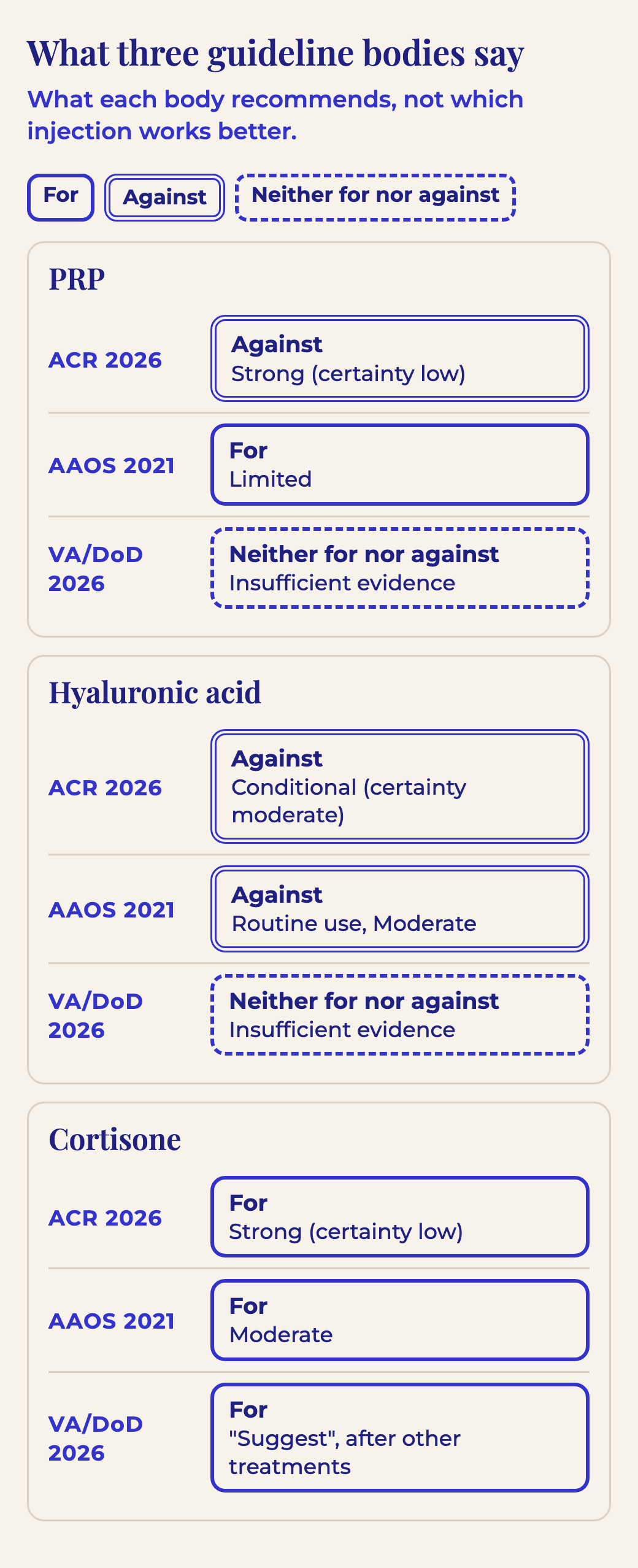
A strong recommendation is one the panel believes applies to almost everyone; a conditional one is one most informed people would follow, but some would not (the ACR’s 2019 definitions). The ACR’s 2026 update rates the strength of each recommendation and the certainty of the evidence separately, so a strong recommendation can sit beside low-certainty evidence.
What does PRP offer for knee osteoarthritis?
PRP is a concentrate of platelets (small blood components that help clotting) and plasma proteins, made from your own blood and injected into the joint (AAOS overview, 2024). It is intended to deliver growth factors from platelets to the joint.
What do trials show for PRP?
Placebo-controlled trials conflict. Three weekly injections of PRP with few white blood cells were no better than a saline (salt water) placebo for pain at 12 months in a large publicly funded trial (2021; 288 adults with mild to moderate arthritis). MRI showed no difference in cartilage volume. Two smaller trials agreed (2021, 62 people, 24 weeks; 2022, 102 people with early arthritis, 12 months).
A larger 2022 trial (610 adults who completed it) reported the opposite: PRP was better than saline for pain and function from 6 months up to 5 years, with less cartilage loss. Only its published summary was available to us; it omits arthritis severity, and its cartilage statistics are internally inconsistent.
Meta-analyses (pooled analyses) of placebo-controlled trials disagree too. One 2025 meta-analysis found a weak benefit for pain at 3 and 6 months, none at 12, and called its relevance “debatable”. Another 2025 meta-analysis judged the pain difference large enough to feel at 3 and 6 months. A 2025 review rated 26 of 29 pooled PRP analyses critically low in quality.
What do guideline bodies say about PRP?
The three bodies disagree. The ACR (2026) strongly recommends against PRP, rating the certainty of evidence as low. The AAOS (2021) says PRP “may reduce pain and improve function”, a limited-strength rating it downgraded for inconsistent evidence and open questions about side effects. Its evidence review ended in April 2020, before the 2021 trial above was published. The VA/DoD (2026) found insufficient evidence to recommend for or against PRP.
What are the risks of PRP?
Complications were more frequent with PRP than with comparison injections, including placebo. In a 2025 meta-analysis of 24 trials, there were about 19 complications per 100 people given PRP and about 9 per 100 given a comparison injection. Almost all were mild or moderate and short-lived; in the 2021 trial these were knee pain, swelling and stiffness after injections. The AAOS’s patient information also lists infection. Against hyaluronic acid or cortisone alone, the difference could have been due to chance. No improvement is also a possible result.
What does hyaluronic acid offer for knee osteoarthritis?
Hyaluronic acid is a gel-like substance found in joint fluid (AAOS patient information). It is injected into the knee, a treatment also called viscosupplementation or “gel shots”. It is intended to lubricate the joint.
What do trials show for hyaluronic acid?
Against placebo, the average effect was small. A 2022 review pooled 24 large placebo-controlled trials with 8,997 people. About three months after the last injection, hyaluronic acid reduced pain by about 2 points on a 100-point scale compared with placebo. The authors judged that too small to be clinically important, meaning too small to feel. Results for function were similar. Small trials and unpublished trials made the benefit look larger, the authors found.
When only trials at low risk of bias (the most rigorous) are counted, the effect over placebo “approaches zero”, the ACR noted in 2019. No product type has been shown to change this. Most trials enrolled people with mild to moderate arthritis, and the AAOS guideline notes worse results in the most advanced grade. The AAOS’s patient information says hyaluronic acid “has never been shown to reverse the arthritic process”.
What do guideline bodies say about hyaluronic acid?
None of the three recommends it for routine use. The ACR (2026) conditionally recommends against hyaluronic acid injections, rating the certainty of evidence as moderate. The AAOS (2021) does not recommend them for routine use, a moderate-strength statement it also downgraded, while noting they may be an option for some people after other treatments have failed. The VA/DoD (2026) found insufficient evidence to recommend for or against them.
What are the risks of hyaluronic acid?
Risks range from brief local reactions to serious events, which one review found more often than with placebo. Pain, warmth and slight swelling can follow the injection, according to the AAOS’s patient information, which also lists infection and bleeding as very rare. Rarely, the knee becomes very swollen and painful within about three days; a 2021 review of case reports describes a reaction that can look like an infection and needs to be checked the same day.
In the 2022 review, serious adverse events (hospital admission, lasting disability, a life-threatening event or death) were recorded in 3.7% of people given hyaluronic acid and 2.5% given placebo (15 trials, 6,462 people). The kinds of event are in an appendix we did not read. No improvement is also a possible result.
What does cortisone offer for knee osteoarthritis?
A cortisone shot is an injection of a corticosteroid into the joint (MedlinePlus). It is intended to relieve a joint that is swollen or inflamed.
What do trials show for cortisone?
Trials show a short-term effect that fades. A 2015 Cochrane review of 27 trials (1,767 people) found that, compared with placebo or no treatment, cortisone reduced pain by about 1 point on a 10-point scale. The effect was largest at 1 to 2 weeks, small by 13 weeks, and no longer detectable at 26 weeks (6 months). Function was better at 1 to 6 weeks, with no effect at 13 or 26 weeks. The reviewers rated the evidence as low quality. A 2024 meta-analysis of 11 placebo-controlled trials (842 people) found the difference was large enough to feel only in the first 6 weeks.
One two-year trial tested repeated injections in 140 people with mild to moderate knee osteoarthritis and joint inflammation. A corticosteroid injection every 12 weeks was no better than placebo for pain measured three months after each injection, and MRI showed more cartilage thinning (0.21 mm versus 0.10 mm over two years). Pain in the weeks after each injection was not measured, and the thinning did not come with worse symptoms. The trial tested a fixed schedule, not an occasional injection.
What do guideline bodies say about cortisone?
All three bodies support it, at different strengths. The ACR (2026) strongly recommends cortisone injections, rating the certainty of evidence as low. The AAOS (2021) says they “could provide short-term relief”, a moderate-strength statement it downgraded because of a possible risk of speeding arthritis. The VA/DoD (2026) suggests one when other treatments have not relieved persistent knee pain; “suggest” is the weaker of its two positive ratings.
What are the risks of cortisone?
Risks range from a short flare to rare infection. Pain can flare for a day or two after the injection, according to the AAOS’s patient information. In people with diabetes, blood sugar can rise for several days; MedlinePlus says a physician may advise checking it more often for 1 to 5 days. Infection and bleeding are also listed. No improvement is also a possible result.
What are the practical differences between the three injections?
PRP. Most of the PRP trials cited here used three injections one week apart. Preparations are not standardized (ACR, 2019). Evidence on how many injections are needed, and on advanced arthritis, is limited and inconsistent (AAOS guideline, 2021). Platelet-rich plasma and bone marrow aspirate are autologous therapies, which means they are made from your own body using equipment designed specifically for that purpose. Using them for specific musculoskeletal, spine, joint, and tendon conditions is a physician’s medical decision rather than an FDA-approved indication. Dr. Preet Patel will walk you through this at your initial consultation.
Hyaluronic acid. Depending on the product, it is given as 1 to 5 injections over several weeks, according to the AAOS’s patient information. In the United States, hyaluronic acid knee injections have been regulated by the FDA as medical devices. One product’s FDA approval summary gives its approved use as treating knee osteoarthritis pain in people who have not responded adequately to conservative non-drug therapy and simple pain relievers.
Cortisone. The AAOS’s patient information says there is no formal limit on repeat injections, but that physicians often set a practical limit of 3 to 4 a year. Corticosteroids for joint injection are FDA-approved prescription medicines, and one product’s label lists injection into a joint as short-term additional therapy for flare-ups of several joint conditions.
What happens when the three are compared head to head?
The evidence does not support ranking the three. Network meta-analyses, which combine indirect comparisons across trials, rank PRP above hyaluronic acid and cortisone (2024 network meta-analysis and 2025 network meta-analysis), but neither published summary reports how large the differences were against a clinically important threshold, or how prone to bias the pooled trials were. Both counted only trials with at least 6 to 12 months of follow-up, which may disadvantage a short-acting injection.
Direct trials do not support a ranking: a double-blind trial of PRP against hyaluronic acid (192 people) found no difference in symptom scores over about five years, and the one trial that tested all three against placebo at once (95 people with low baseline pain, one injection each) found none better than placebo over six months.
Which questions help you choose among knee injections?
Questions for any physician:
- How advanced is my arthritis, and did the trials of this injection include people like me?
- What is my goal: calming a flare for a few weeks, or the months ahead?
- What happened after my last injection, and how long did it last?
- For PRP: which preparation, how many injections, and which trials used that approach?
Choosing none of the three and continuing exercise-based care is also an option. For severe, disabling pain and loss of function that persist after non-surgical treatment, knee replacement may be recommended, according to the VA/DoD’s patient summary.
Timing matters if surgery is possible later. A 2022 review of studies covering several hundred thousand knee replacements links a knee injection in the three months before surgery to a higher rate of infection afterward. The VA/DoD guideline advises avoiding cortisone injections in that window.
What Gramercy Center offers
This section describes Gramercy’s services, not research evidence.
Disclosure: Gramercy Center offers platelet-rich plasma (PRP) and intra-articular joint injections, so it has a commercial interest in this comparison.
Gramercy is a cash-pay, concierge, physician-led practice in Beverly Hills, founded and led by Dr. Preet Patel, MD, who is board-certified by the American Board of Anesthesiology and an ACGME fellowship-trained interventional pain management specialist. Clients with knee pain always see an MD specialist.
Gramercy offers PRP although, of the three guideline bodies cited above, one strongly recommends against it for knee osteoarthritis and none recommends it strongly. Not everyone is a candidate, and results vary.
When should you seek care after a knee injection, and when is it an emergency?
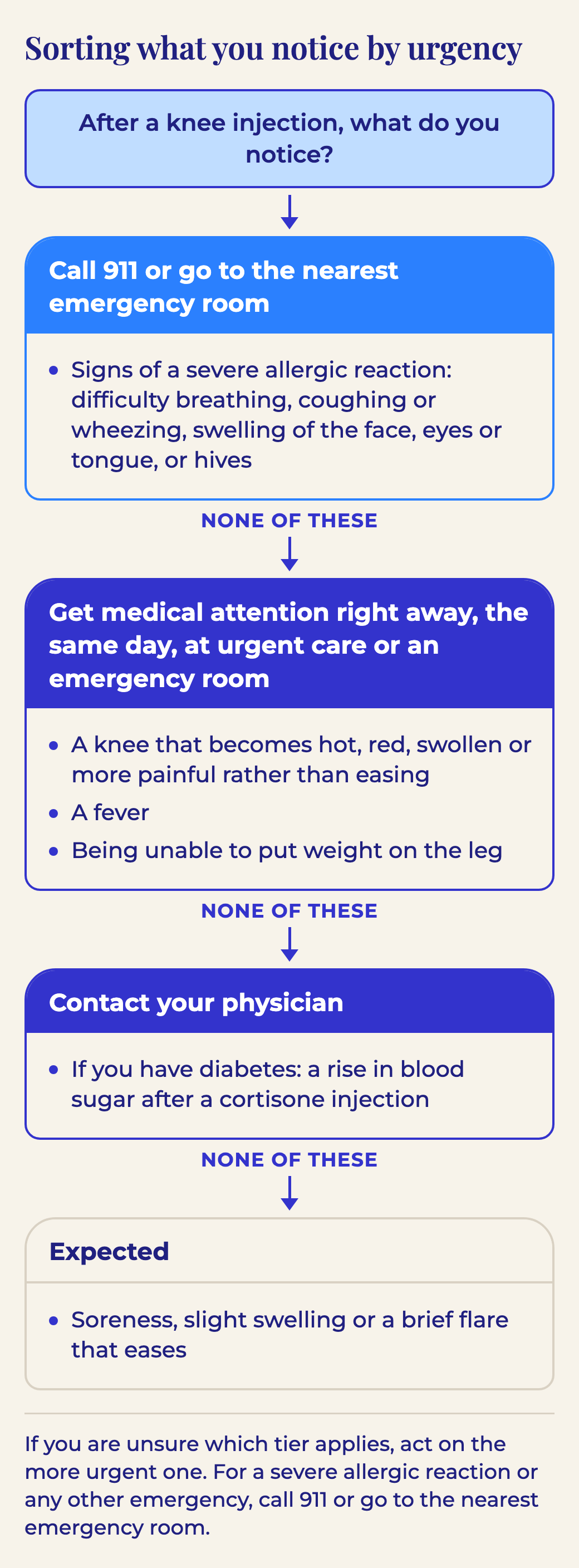
After any knee injection, sort what you notice by urgency.
- Expected: soreness, slight swelling or a brief flare that eases.
- Contact your physician: if you have diabetes, a rise in blood sugar after a cortisone injection, which MedlinePlus says can last several days.
- Get medical attention right away, the same day, at urgent care or an emergency room: a knee that becomes hot, red, swollen or more painful rather than easing, a fever, or being unable to put weight on the leg.
- Call 911: signs of a severe allergic reaction after any injection, which MedlinePlus lists as including difficulty breathing, coughing or wheezing, swelling of the face, eyes or tongue, and hives.
The same-day signs can mean a joint infection, which the AAOS’s patient information says can be serious and “require immediate medical attention”. The NHS says such symptoms “need to be checked straight away”, and that not everyone with a joint infection has a fever.
Joint infection is rare and can appear weeks after an injection (one hospital’s review of cortisone injections).
If you are unsure which tier applies, act on the more urgent one. For a severe allergic reaction or any other emergency, call 911 or go to the nearest emergency room.
What is the most useful next step?
Keep up exercise-based care, find out how advanced your arthritis is, and take the questions above to a physician. With PRP, placebo-controlled trials conflict, and a large publicly funded one found no benefit. For hyaluronic acid, the average benefit over placebo was too small to feel. Cortisone’s pain relief was short-lived. The American College of Rheumatology recommends against the first two, PRP strongly; other bodies differ. None of the three has been shown to change the arthritis itself. Results vary.
Schedule a consultation with Dr. Preet Patel.
Sources
Main trials and guideline statements
- Effect of Intra-articular Platelet-Rich Plasma vs Placebo Injection on Pain and Medial Tibial Cartilage Volume in Patients With Knee Osteoarthritis: The RESTORE Randomized Clinical Trial. JAMA. 2021. https://jamanetwork.com/journals/jama/fullarticle/2786501
- Intra-articular injections of platelet-rich plasma decrease pain and improve functional outcomes than sham saline in patients with knee osteoarthritis. Knee Surgery, Sports Traumatology, Arthroscopy. 2022. https://pubmed.ncbi.nlm.nih.gov/35124707/
- Viscosupplementation for knee osteoarthritis: systematic review and meta-analysis. BMJ. 2022. https://pmc.ncbi.nlm.nih.gov/articles/PMC9258606/
- Intra-articular corticosteroid for knee osteoarthritis. Cochrane Database of Systematic Reviews. 2015. https://pubmed.ncbi.nlm.nih.gov/26490760/
- 2026 Update of the American College of Rheumatology Recommendations for the Management of Osteoarthritis of the Knee, Hip, and Hand (Guideline Summary; the full paper is not yet published). American College of Rheumatology. 2026. https://assets.contentstack.io/v3/assets/bltee37abb6b278ab2c/bltb3d12c34020da842/oa-guideline-summary-2026.pdf
- Management of Osteoarthritis of the Knee (Non-Arthroplasty), Evidence-Based Clinical Practice Guideline, third edition. American Academy of Orthopaedic Surgeons. 2021. https://www.aaos.org/globalassets/quality-and-practice-resources/osteoarthritis-of-the-knee/oak3cpg.pdf
- 2019 American College of Rheumatology/Arthritis Foundation Guideline for the Management of Osteoarthritis of the Hand, Hip, and Knee. Arthritis & Rheumatology. 2020. https://assets.contentstack.io/v3/assets/bltee37abb6b278ab2c/blt6aa092f0134cac9a/63320f4750c8e90e3bf512c2/osteoarthritis-guideline-2019.pdf
- Platelet-Rich Plasma (PRP) for Knee Osteoarthritis Technology Overview. American Academy of Orthopaedic Surgeons. 2024. https://www.aaos.org/globalassets/quality-and-practice-resources/biologics/technology-overview_prp-for-knee-oa.pdf
More PRP trials and reviews, and the VA/DoD guideline
- Efficacy of platelet-rich plasma and plasma for symptomatic treatment of knee osteoarthritis: a double-blinded placebo-controlled randomized clinical trial. BMC Musculoskeletal Disorders. 2021. https://pubmed.ncbi.nlm.nih.gov/34560869/
- The effectiveness of leucocyte-poor platelet-rich plasma injections on symptomatic early osteoarthritis of the knee: the PEAK randomized controlled trial. The Bone & Joint Journal. 2022. https://pubmed.ncbi.nlm.nih.gov/35638203/
- Efficacy of intra-articular platelet-rich plasma compared with placebo in knee osteoarthritis: a systematic review and meta-analysis. Joint Bone Spine. 2025. https://pubmed.ncbi.nlm.nih.gov/40653151/
- PRP injections for the treatment of knee osteoarthritis: the improvement is clinically significant and influenced by platelet concentration. The American Journal of Sports Medicine. 2025. https://pubmed.ncbi.nlm.nih.gov/39751394/
- Platelet rich plasma injections for knee osteoarthritis: an overview of systematic reviews. Frontiers in Physiology. 2025. https://pubmed.ncbi.nlm.nih.gov/40671713/
- VA/DoD Clinical Practice Guideline: The Non-surgical Management of Hip and Knee Osteoarthritis, pocket card (Version 3.0). U.S. Departments of Veterans Affairs and Defense. 2026. https://www.healthquality.va.gov/HEALTHQUALITY/guidelines/CD/OA/Osteoarthritis-CPG_2026-Pocket-Card_final_20260618.pdf
- Complications of Platelet-Rich Plasma Injection for Knee Osteoarthritis Are Similar to Those of Corticosteroids and Hyaluronic Acid but Are Significantly Greater Than Those of Placebo Injections: A Meta-analysis of Randomized Controlled Trials. Arthroscopy. 2025. https://pubmed.ncbi.nlm.nih.gov/40409439/
- Platelet-Rich Plasma (PRP). American Academy of Orthopaedic Surgeons, OrthoInfo. No review date shown. https://www.orthoinfo.org/en/treatment/platelet-rich-plasma-prp/
Hyaluronic acid and cortisone: reviews, risks and product labels
- Viscosupplementation Treatment for Knee Arthritis. American Academy of Orthopaedic Surgeons, OrthoInfo. No review date shown. https://www.orthoinfo.org/en/treatment/viscosupplementation-treatment-for-knee-arthritis/
- Differential characteristics and management of pseudoseptic arthritis following hyaluronic acid injection is a rare complication: a systematic review. Journal of ISAKOS. 2021. https://pubmed.ncbi.nlm.nih.gov/33832983/
- Steroid injections – tendon, bursa, joint. MedlinePlus, National Library of Medicine. 2026. https://medlineplus.gov/ency/article/007678.htm
- Intra-articular corticosteroid injections provide a clinically relevant benefit compared to placebo only at short-term follow-up in patients with knee osteoarthritis: A systematic review and meta-analysis. Knee Surgery, Sports Traumatology, Arthroscopy. 2024. https://pubmed.ncbi.nlm.nih.gov/38294103/
- Effect of Intra-articular Triamcinolone vs Saline on Knee Cartilage Volume and Pain in Patients With Knee Osteoarthritis: A Randomized Clinical Trial. JAMA. 2017. https://jamanetwork.com/journals/jama/fullarticle/2626573
- Cortisone Shot (Steroid Injection). American Academy of Orthopaedic Surgeons, OrthoInfo. No review date shown. https://www.orthoinfo.org/en/treatment/cortisone-shot-steroid-injection/
- Summary of Safety and Effectiveness Data, PMA P090031 (Hyaluronic Acid, Intra-articular). U.S. Food and Drug Administration. 2014. https://www.accessdata.fda.gov/cdrh_docs/pdf9/P090031b.pdf
- Triamcinolone acetonide injectable suspension: prescribing information. DailyMed, National Library of Medicine. Label revised August 2024. https://dailymed.nlm.nih.gov/dailymed/drugInfo.cfm?setid=cf970688-cd77-b95c-4bd9-c541590e9722
Head-to-head comparisons, surgery timing and warning signs
- Platelet-Rich Plasma, Bone Marrow Aspirate Concentrate, and Hyaluronic Acid Injections Outperform Corticosteroids in Pain and Function Scores at a Minimum of 6 Months as Intra-Articular Injections for Knee Osteoarthritis: A Systematic Review and Network Meta-analysis. Arthroscopy. 2024. https://pubmed.ncbi.nlm.nih.gov/38331363/
- Long-term effectiveness of intra-articular injectables in patients with knee osteoarthritis: a systematic review and Bayesian network meta-analysis. Journal of Orthopaedic Surgery and Research. 2025. https://pubmed.ncbi.nlm.nih.gov/40025522/
- Platelet-Rich Plasma Versus Hyaluronic Acid Injections for the Treatment of Knee Osteoarthritis: Results at 5 Years of a Double-Blind, Randomized Controlled Trial. The American Journal of Sports Medicine. 2019. https://pubmed.ncbi.nlm.nih.gov/30545242/
- A Randomized Trial of Intra-articular Injection Therapy for Knee Osteoarthritis. Investigative Radiology. 2023. https://pubmed.ncbi.nlm.nih.gov/36728848/
- VA/DoD Clinical Practice Guideline for the Non-surgical Management of Hip and Knee Osteoarthritis: Patient Summary. U.S. Departments of Veterans Affairs and Defense. 2026. https://www.healthquality.va.gov/HEALTHQUALITY/guidelines/CD/OA/Osteoarthritis-CPG_2026-Patient-Summary_final_20260618.pdf
- Intra-articular injection receipt within 3 months prior to primary total knee arthroplasty is associated with increased periprosthetic joint infection risk. Knee Surgery, Sports Traumatology, Arthroscopy. 2022. https://pubmed.ncbi.nlm.nih.gov/35325263/
- Anaphylaxis. MedlinePlus, National Library of Medicine. 2026. https://medlineplus.gov/ency/article/000844.htm
- Septic arthritis. NHS. 2026. https://www.nhs.uk/conditions/septic-arthritis/
- Septic arthritis following intra-articular corticosteroid injections: a retrospective analysis. Archives of Orthopaedic and Trauma Surgery. 2026. https://pubmed.ncbi.nlm.nih.gov/41801449/
This content is for general education only and is not medical advice. It does not create a doctor-patient relationship. Treatment decisions should be made with a qualified physician after an individual evaluation. Results vary, and not everyone is a candidate for every treatment.