
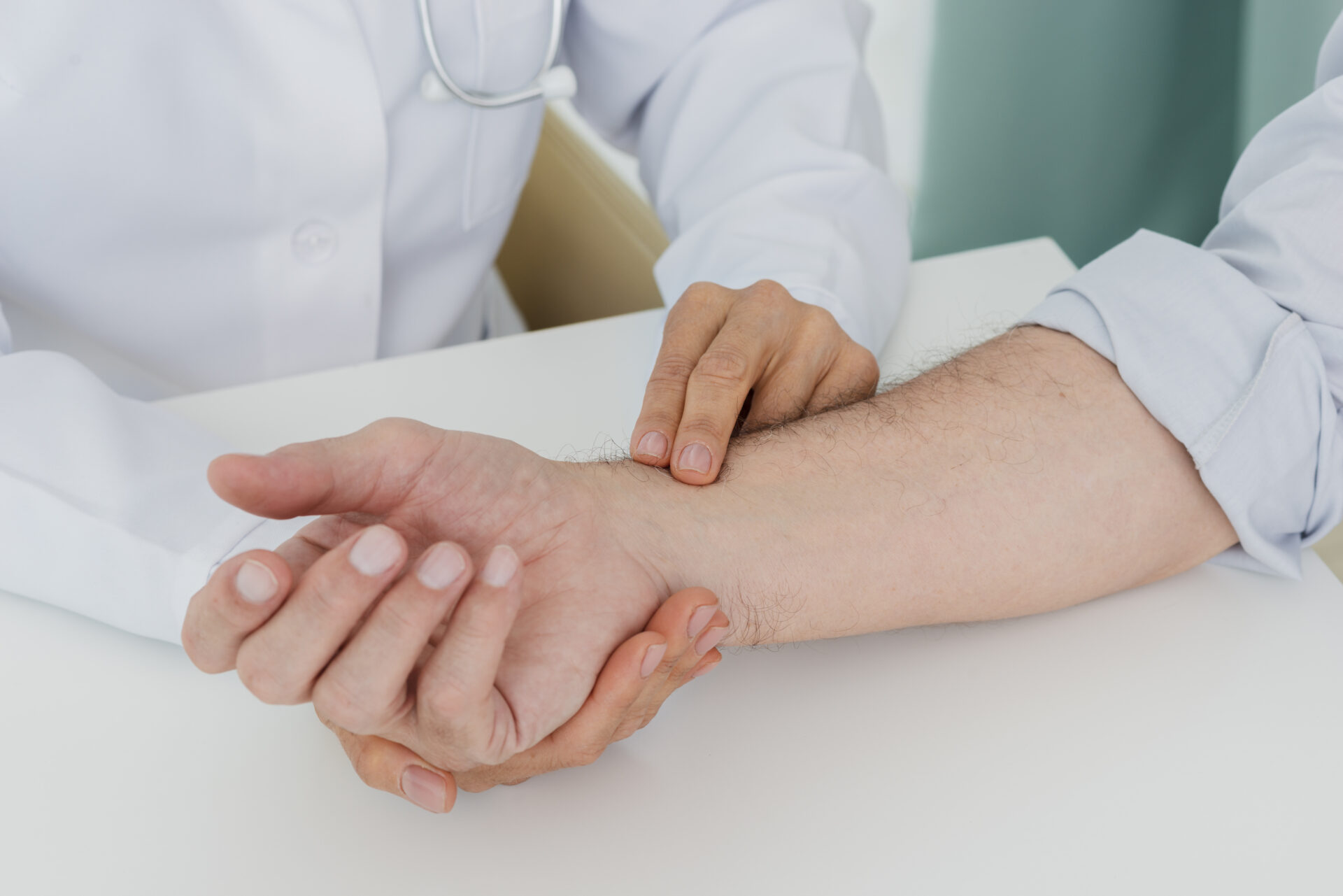
Dorsal root ganglion (DRG) stimulation is an implanted device that sends mild electrical pulses to the dorsal root ganglion, the cluster of sensory nerve cells that relays signals from a limb to the spinal cord. Clinicians consider it for complex regional pain syndrome (CRPS) that has not settled with other care, mostly in the lower limb. It is designed to change how pain signals are carried and perceived, although exactly how it eases pain is not fully known. But it does not repair tissue or cure CRPS.
The evidence is narrower than a single trial result suggests. In the main randomized trial, more people with lower-limb CRPS met the trial’s success definition with DRG stimulation than with conventional spinal cord stimulation. That trial was open-label (no one was blinded) and sponsored by the device maker. A 2023 Cochrane overview (a review of existing systematic reviews) found no high-certainty evidence for any CRPS therapy. That makes DRG stimulation a reasonable option to discuss, not a proven best choice.
Key takeaways
- One trial in lower-limb CRPS favored DRG stimulation over conventional spinal cord stimulation, with important limits.
- A short trial period comes before any permanent implant.
- Implants carry real risks, including infection, lead movement and revision surgery.
What is DRG stimulation, and what is it meant to do in CRPS?
CRPS is a long-lasting pain condition out of proportion to the original injury or surgery, often with changes in skin color, temperature, swelling and movement. Clinicians diagnose it with the Budapest criteria, which need an examination.
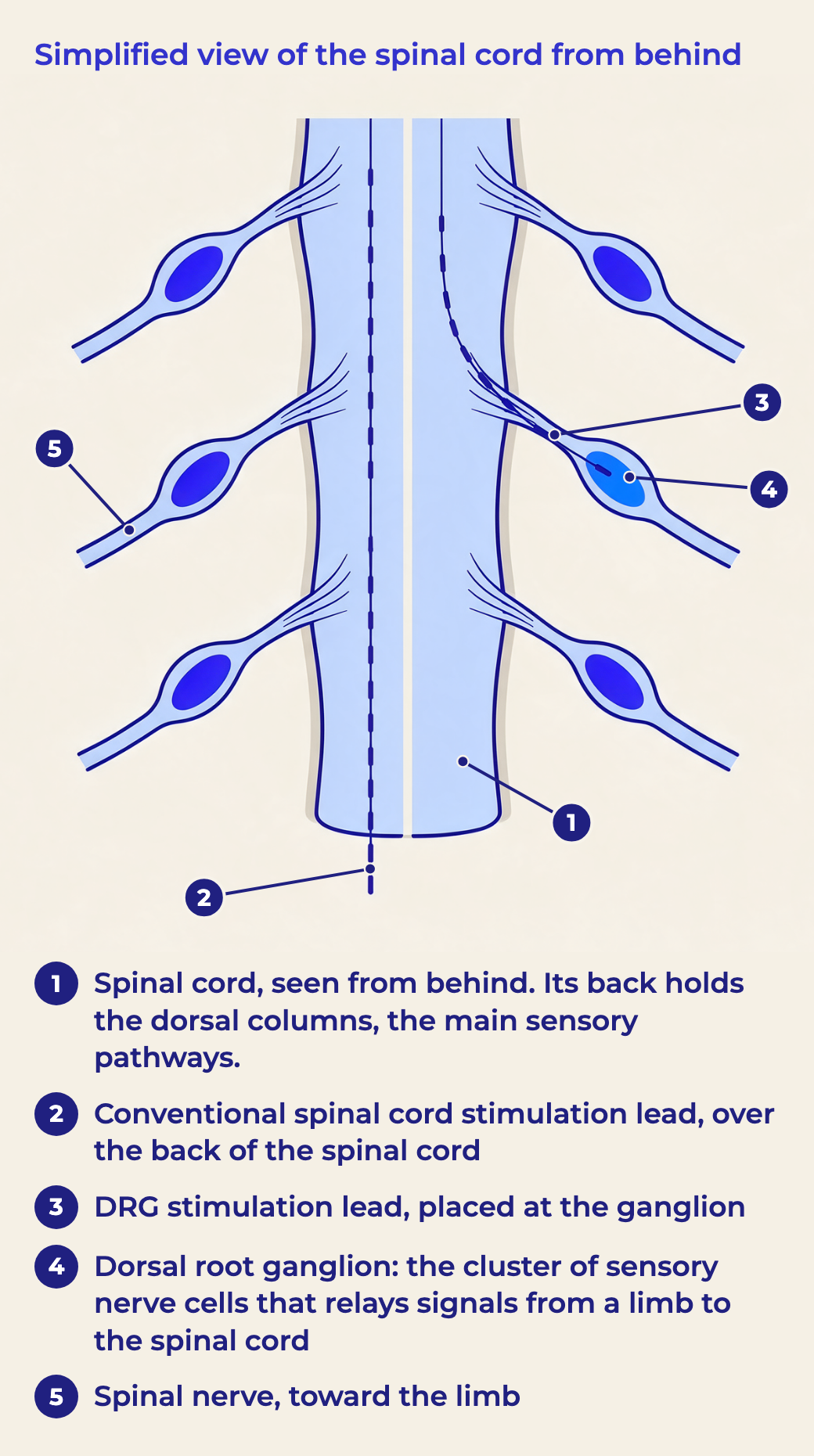
The device has two parts: thin wires called leads that sit near the dorsal root ganglion, and a small pulse generator under the skin that powers them. This approach is neuromodulation: using electrical energy to change how nerves signal. Proposed mechanisms, such as filtering pain signals at the nerve cell, include hypotheses that are not established facts.
How is DRG stimulation different from spinal cord stimulation?
Conventional spinal cord stimulation places leads over the back of the spinal cord (the dorsal columns, the main sensory pathways). DRG stimulation places leads at the ganglion that serves a specific region, such as the foot.
The hypothesis is that this focused target may suit CRPS in a foot or lower leg. The trial authors note that programming differed between the two groups, so targeting cannot be separated from programming settings.
When is DRG stimulation considered for CRPS?
A consensus guideline (Harden et al., 2022) calls physical therapy the first-line cornerstone of CRPS care. It says clinicians may consider neuromodulation when a client is not progressing, or is getting worse, despite a coordinated rehabilitation program (physical, occupational and psychological therapy together). Even so, not everyone is a candidate.
In the United States, the FDA’s February 2016 decision record for one dorsal root ganglion stimulation system lists a labeled use of chronic, intractable pain of the lower limbs in adults with CRPS type I or II. Other regions, including the arm, are outside that listing and were not what the main trial studied.
What does the research show, and how strong is it?
The evidence is limited: one randomized trial favors DRG stimulation over conventional spinal cord stimulation in lower-limb CRPS, and independent reviews rate the overall certainty low or very low.
The ACCURATE trial randomized 152 people (76 per group) with lower-limb CRPS or causalgia (CRPS with a known nerve injury) to DRG stimulation or conventional spinal cord stimulation. Everyone had pain for at least six months and had not responded to at least two classes of medication.
The trial defined success strictly. A person needed at least 50% less pain at that time point, had to pass the short trial phase, and could have no stimulation-related nerve problem. Anyone who did not go on to a permanent implant counted as a failure. Under that definition:
- At 3 months, 81.2% (56 of 69) of the DRG group met it, versus 55.7% (39 of 70) of the spinal cord stimulation group.
- At 12 months, 74.2% (49 of 66) versus 53.0% (35 of 66).
Because group sizes change between time points in the paper, each figure uses the paper’s own count for that time point.
What are the limits of this evidence?
Four caveats go with these results. First, the trial was open-label, and the device maker sponsored it and paid all the authors as trial investigators. Second, the comparison was against another implant, not placebo, sham stimulation or continued conservative care. Third, it studied lower-limb CRPS only. Fourth, we did not find published follow-up beyond 12 months.
Unlike the trial report, independent reviews are more cautious. The Cochrane overview rated every neuromodulation comparison very low certainty. A 2024 systematic review of 23 mostly observational studies (which observe people rather than assign treatment) found pain reduction with both DRG and spinal cord stimulation, but concluded that “definite conclusions were not drawn”. The guideline calls the CRPS evidence base weak and singles out DRG stimulation as a recent notable exception, but its DRG figures appear to rest on the same trial.
CRPS also varies on its own. The guideline says early CRPS likely improves naturally in many people. For that reason, uncontrolled series cannot prove benefit.
What happens in the trial before a permanent implant?
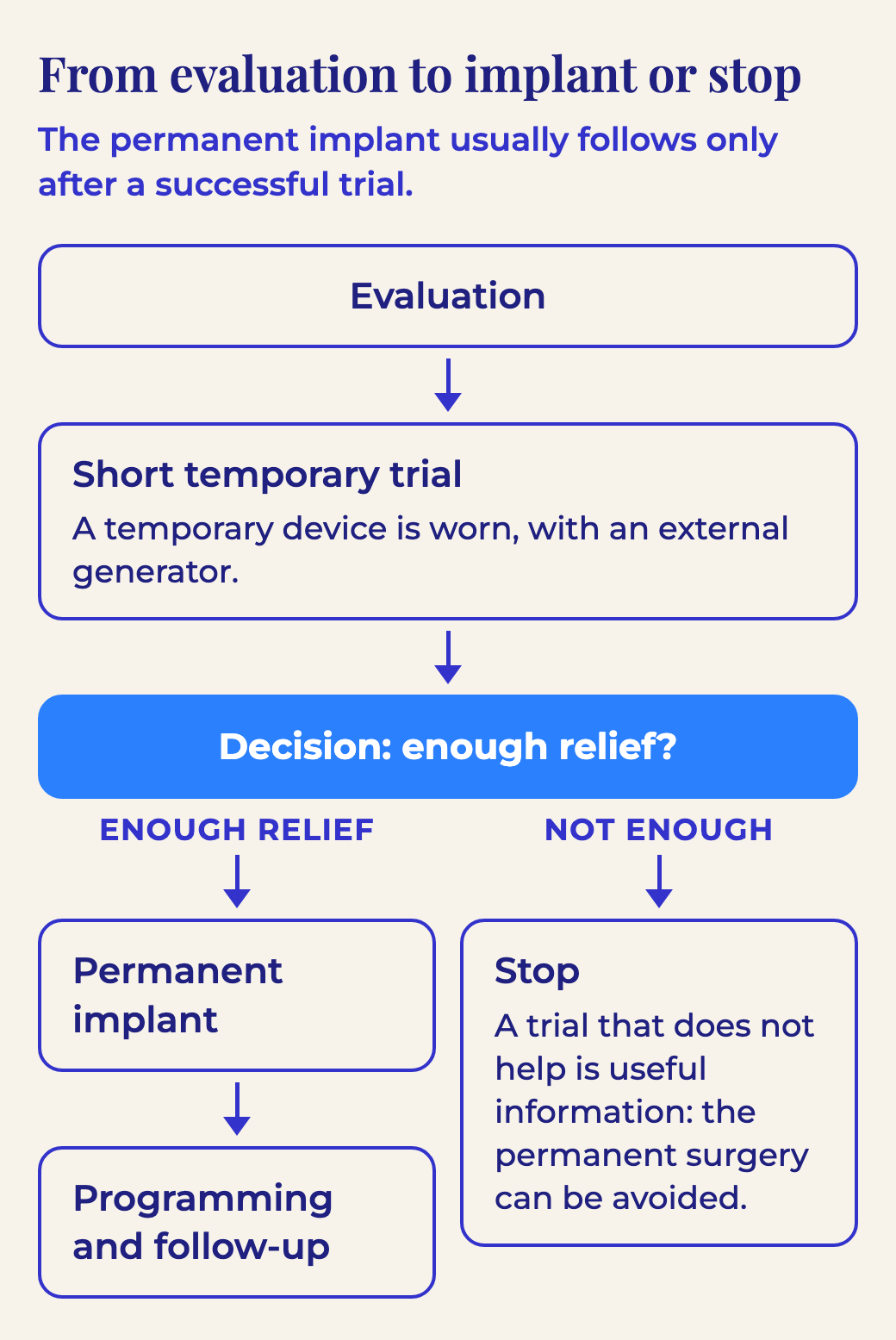
A short trial period is a standard step before a permanent implant. The Cleveland Clinic describes it for spinal cord stimulation generally: a temporary device is worn, a successful trial usually means the pain is reduced by at least half, and the permanent implant usually follows only after a successful trial.
In ACCURATE, trial stimulation lasted 3 to 30 days, about a week on average. Of 73 people per group who started it, 61 (DRG) and 54 (spinal cord stimulation) met the success criteria at the end, and 3 in each group did not continue. A trial that does not help is useful information: the permanent surgery can be avoided.
What are the risks, limits and everyday trade-offs?
Benefits and risks belong together. Through 12 months in ACCURATE, serious adverse events occurred in 8 of 76 people (DRG) and 11 of 76 (spinal cord stimulation). Procedure-related events (problems linked to the surgery or device) were more frequent with DRG (46.1% vs 26.3%), which the authors linked to longer procedures and more leads. The sources we reviewed do not break these events down by severity. Two infections in the conventional group needed device removal.
Infection is uncommon but real. Pooled data from small studies across all conditions put it at about 1% of DRG trial-phase procedures and about 5% of permanent implants.
Removal estimates vary. A four-center review of past records of mixed conditions (CRPS was 43%) found about 2% of DRG systems removed each year, most often because relief was inadequate. A 2025 pooled analysis (Vanloon et al.) of 13 studies, across all conditions and mostly observational, put removal at about 12%, with roughly 6% lead fractures and 6% lead migrations. In a small Swedish cohort, 8 of 16 DRG devices were removed over long follow-up. The sample is small, but long-term retention is uncertain. Benefit may also fade or be partial.
Can I return to training and travel?
The trial did not measure it. Instead, it tracked pain scores, not return to running, lifting or flying, and the guideline cites no clinically significant functional improvement for conventional stimulation. We did not find DRG-specific data on returning to sport or on travel.
For spinal cord stimulators generally, the Cleveland Clinic advises avoiding bending, stretching, intense exercise and heavy lifting at first, with normal routines after about four to six weeks. Also, devices can set off metal detectors, and most make MRI unsafe. Some systems carry an MR Conditional label (safe for MRI under set conditions), so ask which applies to you. Your own limits are a question for the consultation.
What other options exist for CRPS, and how do they compare?
No option is proven best for every client. Clinicians usually build CRPS care step by step around rehabilitation, adding other treatments when progress stalls.
Physical and occupational therapy. The guideline calls physical therapy first-line. Therapists also use graded motor imagery and mirror therapy. The Cochrane overview rated their evidence very low certainty, and the guideline notes that some trials of both did not improve pain.
Medications managed by other physicians. The Cochrane overview found that bisphosphonates may reduce pain (low certainty) but probably cause more side effects. These decisions sit with your other physicians.
Sympathetic nerve blocks (injections near the nerves that regulate blood flow and temperature). Evidence is mixed: the Cochrane overview found that lidocaine sympathetic blockade probably does not reduce pain more than placebo. Gramercy offers lumbar sympathetic blocks.
Conventional spinal cord stimulation. It has a longer record and was the comparator in ACCURATE. The guideline cites randomized evidence of reduced pain and better quality of life, but the Cochrane overview rated these comparisons very low certainty, and the guideline reports no clinically significant functional improvement.
Intrathecal baclofen (a muscle relaxant delivered by a pump into the fluid around the spinal cord) is mainly discussed when CRPS includes dystonia (abnormal muscle tightening).
What a consultation at Gramercy involves
Gramercy Center offers DRG stimulation and spinal cord stimulation among its neuromodulation procedures. Dr. Preet Patel is an ACGME fellowship-trained interventional pain management specialist.
Before your consultation, the team gathers your records and imaging for him to review in advance. Not everyone is a candidate for stimulation. If another step or another specialist fits better, such as a surgeon, the team helps arrange the referral.
When to seek care
If you have loss of bladder or bowel control, numbness in the groin or saddle area, sudden or worsening weakness, fever with back pain, pain after a major fall or accident, chest pain, or a sudden, severe headache, call 911 or go to the nearest emergency room right away.
If you have an implant, the Cleveland Clinic says to go to the emergency room (call 911 if you cannot get there safely) for any of these:
- redness, swelling, pain, discoloration or foul-smelling discharge at an incision, or fever
- sudden numbness, tingling or weakness below the leads, which may mean they have shifted
- a headache that worsens upright and eases lying down, which may indicate a cerebrospinal fluid leak
Unexplained worsening of CRPS symptoms warrants a prompt call to your treating physician. The NHS advises seeing a doctor if persistent pain keeps you from everyday activities.
What this means for your decision
One randomized trial favors DRG stimulation over conventional stimulation in lower-limb CRPS, and the evidence behind it is thin. Still uncertain: how long benefit lasts beyond 12 months, who benefits most, whether results hold outside the lower limb, and whether it helps people return to training and travel.
A reasonable next step is a consultation. Bring your records and a list of what you have tried. Questions worth asking:
- Does my CRPS location fit what this device has been studied in?
- What would count as a successful trial for me?
- What are the revision and removal rates, and what happens if the device is removed?
- What would we try if the trial does not help?
- What activity and travel limits would apply to me, and for how long? The trial did not measure return to training or travel.
This is not a decision to make from a blog post.
Schedule a consultation with Dr. Preet Patel.
Sources
- Dorsal root ganglion stimulation yielded higher treatment success rate for complex regional pain syndrome and causalgia at 3 and 12 months: a randomized comparative trial (ACCURATE; Deer et al.). Pain. 2017. https://pmc.ncbi.nlm.nih.gov/articles/PMC5359787
- Interventions for treating pain and disability in adults with complex regional pain syndrome: an overview of systematic reviews (Ferraro et al.). Cochrane Database of Systematic Reviews. 2023. https://pmc.ncbi.nlm.nih.gov/articles/PMC10259367
- Complex Regional Pain Syndrome: Practical Diagnostic and Treatment Guidelines, 5th Edition (Harden et al.). Pain Medicine. 2022. https://pmc.ncbi.nlm.nih.gov/articles/PMC9186375
- Mechanisms of Action of Dorsal Root Ganglion Stimulation (Abd-Elsayed et al.). International Journal of Molecular Sciences. 2024. https://pmc.ncbi.nlm.nih.gov/articles/PMC11011701/
- FDA device record, PMA P150004: the dorsal root ganglion stimulation system reviewed under this application. U.S. Food and Drug Administration (CDRH PMA database). Decision date February 11, 2016. https://www.accessdata.fda.gov/scripts/cdrh/cfdocs/cfpma/pma.cfm?id=P150004
- The Efficacy of Neuromodulation, Interventional Treatment and Unconventional Therapies in the Treatment of CRPS: A Systematic Review (Samuel et al.). Cureus. 2024. https://pmc.ncbi.nlm.nih.gov/articles/PMC11663435
- Spinal Cord Stimulator: What It Is, Side Effects & Recovery. Cleveland Clinic. Updated December 22, 2025. https://my.clevelandclinic.org/health/treatments/24237-spinal-cord-stimulator-scs
- Infectious Complications of Dorsal Root Ganglion Stimulation: A Systematic Review and Pooled Analysis of Incidence (Moman et al.). Neuromodulation. 2021. https://www.iasp-pain.org/papers/171548-infectious-complications-dorsal-root-ganglion-stimulation-systematic-review-and-pooled
- Dorsal root ganglion stimulation device explantation: a multicenter pooled data analysis (Chapman et al.). Pain Practice. 2022. https://pure.amsterdamumc.nl/en/publications/dorsal-root-ganglion-stimulation-device-explantation-a-multicente/
- Long-term explantation risk in patients with chronic pain treated with spinal cord or dorsal root ganglion stimulation (Gatzinsky et al.). Regional Anesthesia & Pain Medicine. 2025. https://pmc.ncbi.nlm.nih.gov/articles/PMC12703264/
- Noninfectious Complications of Dorsal Root Ganglion Stimulation: A Systematic Review and Meta-Analysis (Vanloon et al.). Neuromodulation. 2025;28(2):234-248. https://pubmed.ncbi.nlm.nih.gov/39601733/
- Complex regional pain syndrome. NHS (UK). Last reviewed October 27, 2022. https://www.nhs.uk/conditions/complex-regional-pain-syndrome/
This content is for general education only and is not medical advice. It does not create a doctor-patient relationship. Treatment decisions should be made with a qualified physician after an individual evaluation. Results vary, and not everyone is a candidate for every treatment.