
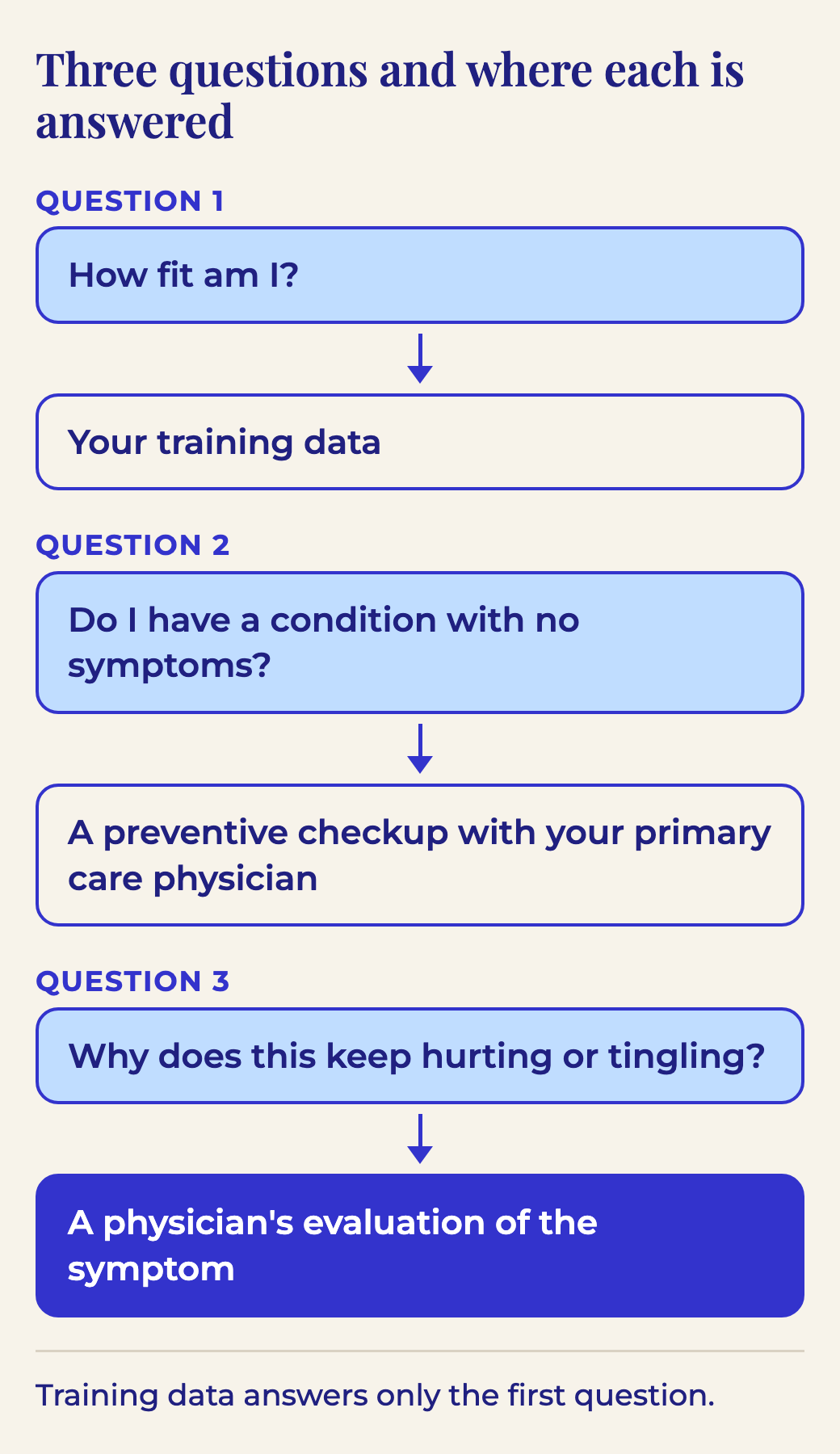
Your strength numbers, pace and recovery data show what your body can do. They can’t show what is going on inside a joint, a tendon, your spine or a nerve. It’s easy to train around a sore knee or a tingling hand when every number still looks good. The more useful signal is a symptom that persists or worsens, or numbness or tingling with no obvious cause. That is the time to see a doctor for an evaluation, not to make another program change.
If you’re wondering whether to get a scan “just to check”, one thing is well established: changes on scans are common in people without symptoms. What is less settled is timing: no single rule says how long to train around a symptom.
Key takeaways
- Fitness data shows what you can do, not what causes a symptom.
- Preventive checkups belong with your primary care physician.
- Scans of people without symptoms often find changes that may not explain anything.
- Symptoms that persist or worsen deserve an evaluation; some signs are urgent.
What can your fitness tell you, and what can’t it?
Training data can’t show a condition that causes no symptoms.
The Centers for Disease Control and Prevention notes that high blood pressure usually has no warning signs, and that measuring it is the only way to know. If you were looking for a wellness checkup for active adults, that is a preventive visit with your primary care physician. They can tell you which of the services the U.S. Preventive Services Task Force recommends apply to you.
Training doesn’t settle heart questions either. The American College of Sports Medicine noted in a 2015 update that heart events linked to exercise are often preceded by warning signs or symptoms. Don’t train through chest pain or discomfort, or the other heart attack symptoms listed under “Emergency: call 911” below.
Can you be fit and still have a joint, tendon, spine or nerve problem?
Yes. Overuse injuries develop gradually from repeated load on one area of the body, as the National Institute of Arthritis and Musculoskeletal and Skin Diseases (NIAMS) explains.
A 2018 study followed 327 recreational runners aged 18 to 65 (average age about 41) preparing for a half marathon. At any given point over 13 weeks, about 37% had a health problem, including illness. Overuse injuries made up the largest share of those problems.
In a Dutch study of about 1,900 recreational runners aged 18 and older, about 1 in 20 reported developing Achilles tendinopathy (a painful overuse problem of the Achilles tendon) between signing up for a race and a month after it.
These studies are of runners, not every active adult. Still, good numbers and a nagging symptom can exist side by side.
Should you get a scan to check your joints or spine if nothing hurts much?
A scan “just to check” can’t, on its own, tell you whether a finding matters, because scans of people without symptoms often show changes. Imaging is chosen to answer a question raised by your symptoms and an exam, and is read alongside them.
For the knee, a 2019 review of 63 studies covered 4,751 adults with no knee injury or symptoms. In studies whose participants averaged 40 or older, about 43% of knees showed cartilage defects (damage to the cartilage lining the joint) on MRI, and about 19% showed meniscal tears (tears in the knee’s cartilage cushion). The authors say findings should be read alongside a person’s symptoms.
In the shoulder, a 2013 Japanese study screened 664 residents of one village, aged from their 20s to their 80s, by ultrasound. About two-thirds of the full-thickness rotator cuff tears it found (tears that go all the way through the shoulder tendons) caused no symptoms.
For the spine, a 2015 review of 33 studies in 3,110 people without back symptoms found that disc changes such as bulges (a disc extending slightly beyond its normal edge) became more common with age.
Common does not mean meaningless, though. A 2015 analysis of adults 50 or younger found that some disc findings, such as bulges, were more common in people with back pain than in people without it.
In an April 17, 2023 statement, the American College of Radiology said it “does not believe there is sufficient evidence to justify recommending total body screening for patients with no clinical symptoms, risk factors or a family history suggesting underlying disease or serious injury.” It also raised concern about “unnecessary follow-up testing and procedures.” That statement covers whole-body screening, not a scan of one joint.
Which symptoms deserve an evaluation, and when should you seek care sooner?
A symptom that persists or worsens deserves an evaluation. NIAMS advises against trying to “work through” the pain of an injury, and says to check with a health care provider if pain or other symptoms persist or worsen.
Book an evaluation
- Pain when you exercise, or swelling and a dull ache at rest, that persists or worsens (NIAMS overuse symptoms).
- Knee pain that “does not improve within a few weeks” (the UK’s National Health Service, NHS).
- Sciatica (pain down the back of the leg) that “is stopping you doing your normal activities” (NHS sciatica advice). If it travels below the knee, contact a physician right away (MedlinePlus low back pain advice).
- Numbness or tingling that “has no obvious cause” (MedlinePlus numbness and tingling). A hand or foot that briefly “falls asleep” from pressure or position, then recovers, counts as an obvious cause.
Contact a physician right away
In this list, “right away” means contacting a physician now, not waiting for a routine appointment. If you can’t reach one, seek urgent care. The sources set no exact time frame.
- A knee you cannot move or put any weight on, or that locks, gives way, is badly swollen, has changed shape, or is red or hot with a very high temperature (NHS knee pain urgent signs).
- Back pain that wakes you up at night, or back pain with pain traveling down your leg below the knee (MedlinePlus: contact your provider right away).
- Shoulder pain with “pins and needles that do not go away” (NHS shoulder pain urgent signs).
Where tingling or numbness falls depends on what comes with it. With no obvious cause, or if you’re not sure, book an evaluation unless a sign below applies. Numbness in your buttocks, thigh or leg that comes with back pain means contacting a physician right away (MedlinePlus low back pain advice). With shoulder pain, the NHS treats pins and needles that do not go away as urgent. Tingling or numbness with sudden or worsening weakness, or right after a head, neck or back injury, is an emergency (MedlinePlus numbness and tingling; see below).
Emergency: call 911
Call 911 for chest pain, heaviness or discomfort, whether you are training or not. The National Heart, Lung, and Blood Institute lists it as a heart attack symptom, and notes that not every heart attack starts with chest pain. Other heart attack symptoms it lists include:
- Pain or discomfort in one or both arms, your back, shoulders, neck, jaw, or above your belly button
- Shortness of breath when resting or doing a little physical activity
- Light-headedness or sudden dizziness
Take these seriously, especially new ones that come on together. NHLBI says to call even if you are not sure.
If you have loss of bladder or bowel control, numbness in the groin or saddle area, sudden or worsening weakness, fever with back pain, pain after a major fall or accident, chest pain, or a sudden, severe headache, call 911 or go to the nearest emergency room right away.
Sciatica in both legs is also an emergency (NHS sciatica advice).
What happens at an evaluation, and what can it lead to?
An evaluation starts with questions and an examination, not automatically a scan, a procedure or a break from training. To diagnose a sports injury, NIAMS says a physician will likely ask about the problem and your activities, including any recent change in how hard you train, examine the area, and may order an x-ray or MRI.
Questions worth asking: What is most likely causing this? Would a scan change the plan? What can I keep doing meanwhile?
Depending on the diagnosis, options include:
- Exercise-based care, often with a physical therapist. For chronic low back pain, the American College of Physicians recommends starting with non-drug options such as exercise.
- Cortisone (steroid) injections. MedlinePlus lists risks including pain and bruising at the site, swelling, infection, bleeding and nerve damage.
- Platelet-rich plasma (PRP) injections, made from your own blood. The American Academy of Orthopaedic Surgeons says more evidence is needed and how well PRP works differs between conditions. It also notes that injection-site pain may increase for the first week or two, and that infection, tissue damage and nerve injury risks appear to be no different from cortisone’s.
- Surgery, which NIAMS notes is needed in some cases, though most musculoskeletal sports injuries do not require it.
Any injection may not help.
What Gramercy Center offers
This section describes Gramercy’s services, not research evidence.
Gramercy Center offers ultrasound-guided platelet-rich plasma (PRP) and bone marrow aspirate (BMA), along with other image-guided injections and procedures. It is a cash-pay, concierge, physician-led practice in Beverly Hills, founded and led by Dr. Preet Patel, MD.
At Gramercy, you always see Dr. Preet Patel, a physician specialist, never a physician assistant or nurse practitioner. A care coordinator gathers your records and imaging so he can review them before your consultation. Gramercy’s care is for pain and symptoms in the joints, spine, muscles, tendons and nerves, such as knee pain, shoulder pain or low back pain. A preventive checkup belongs with your primary care physician.
For PRP and BMA, consultation and treatment are possible in a single visit. If you need care outside Gramercy’s scope, the team helps arrange it. Not everyone is a candidate, and results vary.
What is the most useful next step?
Let your symptoms, not your numbers, decide when to get evaluated. An evaluation isn’t a verdict on your training. Its aim is a working diagnosis, so you can decide what to keep doing and what to change.
What is still uncertain: how long to train around a symptom, and what a scan finding means without your symptoms and examination.
If a symptom from the first list persists or worsens, book an evaluation rather than another program change. If an urgent or emergency sign appears, act on it now.
Schedule a consultation with Dr. Preet Patel.
Sources
Fitness, prevention and runners
- About High Blood Pressure. Centers for Disease Control and Prevention. 2026. https://www.cdc.gov/high-blood-pressure/about/index.html
- A & B Recommendations. U.S. Preventive Services Task Force. Date not stated on page. https://www.uspreventiveservicestaskforce.org/uspstf/recommendation-topics/uspstf-a-and-b-recommendations
- Updating ACSM’s Recommendations for Exercise Preparticipation Health Screening. Medicine & Science in Sports & Exercise (American College of Sports Medicine). 2015. https://doi.org/10.1249/MSS.0000000000000664
- Sports Injuries: Types, Symptoms, & Risk Factors. National Institute of Arthritis and Musculoskeletal and Skin Diseases. 2024. https://www.niams.nih.gov/health-topics/sports-injuries
- Prospective monitoring of health problems among recreational runners preparing for a half marathon. BMJ Open Sport & Exercise Medicine. 2018. https://doi.org/10.1136/bmjsem-2017-000308
- Incidence of Achilles tendinopathy and associated risk factors in recreational runners: a large prospective cohort study. Journal of Science and Medicine in Sport. 2020. https://doi.org/10.1016/j.jsams.2019.12.013
Scans of people without symptoms
- Prevalence of knee osteoarthritis features on magnetic resonance imaging in asymptomatic uninjured adults: a systematic review and meta-analysis. British Journal of Sports Medicine. 2019. https://doi.org/10.1136/bjsports-2018-099257
- Prevalence of symptomatic and asymptomatic rotator cuff tears in the general population: from mass-screening in one village. Journal of Orthopaedics. 2013. https://doi.org/10.1016/j.jor.2013.01.008
- Systematic literature review of imaging features of spinal degeneration in asymptomatic populations. American Journal of Neuroradiology. 2015. https://doi.org/10.3174/ajnr.A4173
- MRI findings of disc degeneration are more prevalent in adults with low back pain than in asymptomatic controls: a systematic review and meta-analysis. American Journal of Neuroradiology. 2015. https://doi.org/10.3174/ajnr.A4498
- ACR Statement on Screening Total Body MRI. American College of Radiology. 2023. https://www.acr.org/News-and-Publications/Media-Center/2023/ACR-Statement-on-Screening-Total-Body-MRI
When to get a symptom checked
- Sports Injuries: Diagnosis, Treatment, and Steps to Take. National Institute of Arthritis and Musculoskeletal and Skin Diseases. 2024. https://www.niams.nih.gov/health-topics/sports-injuries/diagnosis-treatment-and-steps-to-take
- Knee pain. NHS (UK). 2023. https://www.nhs.uk/conditions/knee-pain/
- Sciatica. NHS (UK). 2024. https://www.nhs.uk/conditions/sciatica/
- Low back pain – acute. MedlinePlus Medical Encyclopedia, National Library of Medicine. 2026. https://medlineplus.gov/ency/article/007425.htm
- Numbness and tingling. MedlinePlus Medical Encyclopedia, National Library of Medicine. 2025. https://medlineplus.gov/ency/article/003206.htm
Urgent signs and treatment options
- Shoulder pain. NHS (UK). 2023. https://www.nhs.uk/conditions/shoulder-pain/
- Heart Attack: Symptoms. National Heart, Lung, and Blood Institute. 2022. https://www.nhlbi.nih.gov/health/heart-attack/symptoms
- Noninvasive Treatments for Acute, Subacute, and Chronic Low Back Pain: A Clinical Practice Guideline From the American College of Physicians. Annals of Internal Medicine. 2017. https://doi.org/10.7326/M16-2367
- Steroid injections – tendon, bursa, joint. MedlinePlus Medical Encyclopedia, National Library of Medicine. 2026. https://medlineplus.gov/ency/article/007678.htm
- Platelet-Rich Plasma (PRP). American Academy of Orthopaedic Surgeons (OrthoInfo). Date not stated on page. https://www.orthoinfo.org/en/treatment/platelet-rich-plasma-prp/
This content is for general education only and is not medical advice. It does not create a doctor-patient relationship. Treatment decisions should be made with a qualified physician after an individual evaluation. Results vary, and not everyone is a candidate for every treatment.