
A wellness routine for chronic pain that you can keep has four plain parts: regular movement at a level you can repeat, taking poor sleep seriously, one stress skill, and a flare-up plan written in advance. That matters because of a pattern pain programs describe: doing a lot in a good week, flaring up, and then losing the next one.
The evidence behind those parts is uneven. Exercise is the best supported: a 2017 American College of Physicians guideline recommends it among the first treatments for chronic low back pain. Pacing, the planning method that pain programs teach, is a way to organize a week, yet a 2019 review of 7 randomized trials did not find that it lowers pain. No routine guarantees less pain, and results vary.
Most of the research below was done in people with chronic low back pain. Studies of pacing, sleep and psychological approaches mostly mix several pain conditions, and none of the studies cited here is specific to neck pain. This post assumes a physician has already evaluated your long-standing pain. If not, that is the first step.
Key takeaways
- The goal is a week you can repeat, not hard days followed by lost ones.
- Movement has the strongest evidence, mostly in chronic low back pain. Reviews disagree on whether one type is better.
- Pacing organizes the week. It is not a proven pain treatment.
- In a flare-up, scale down instead of stopping, then build back gradually.
- The add-ons checked here (vitamin D, diets and massage) have weak, unfavorable or missing evidence.
- An episode that is different and feels worse needs a physician’s evaluation.
Why do routines for chronic pain break down?
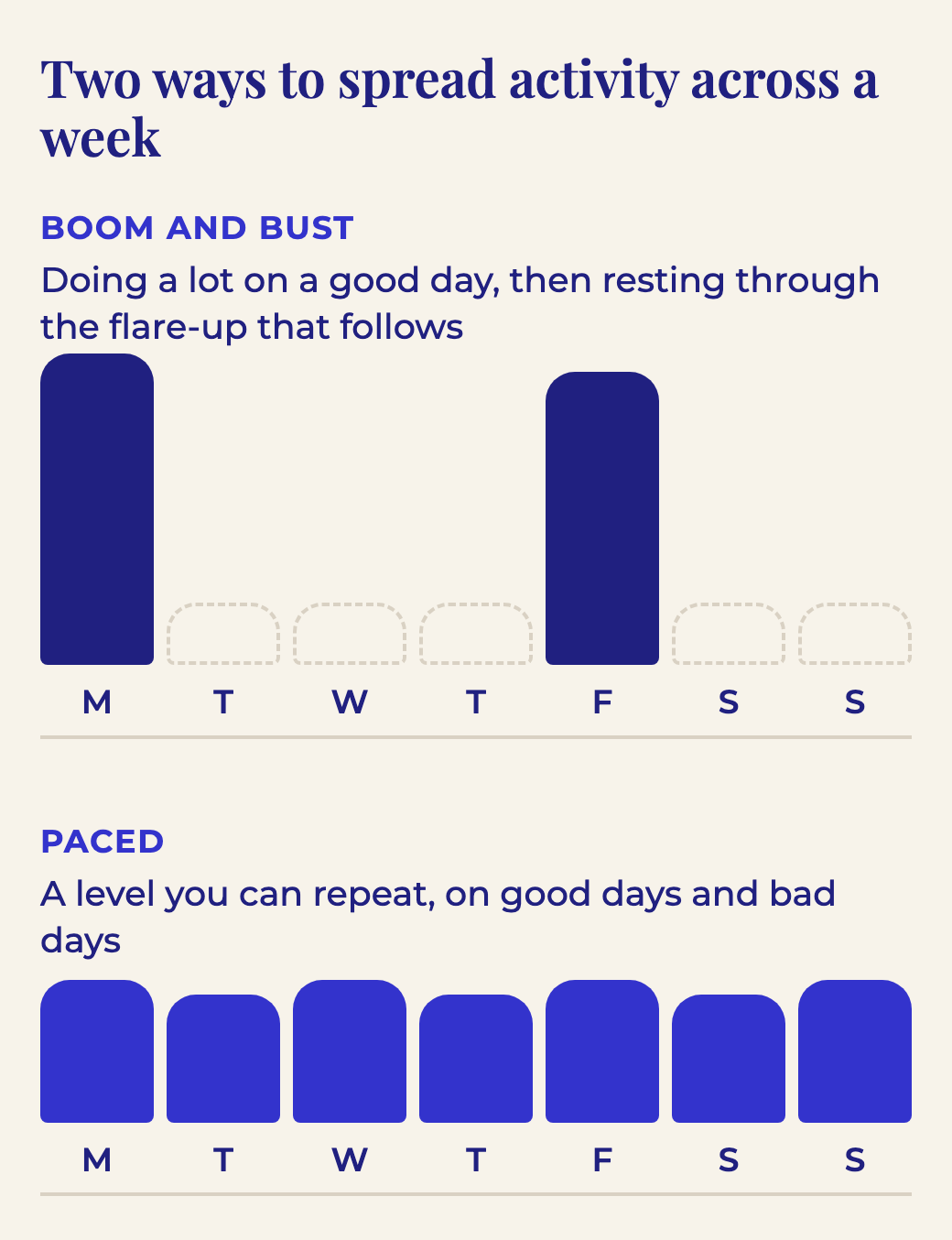
One UK National Health Service (NHS) leaflet describes a “boom and bust” pattern: doing a lot on a good day, then resting through the flare-up that follows. A 2012 review of 41 studies linked overdoing activity to poorer outcomes in adults with chronic pain (pain that lasts or keeps coming back for more than 3 months), without showing that one causes the other.
How do you pace activity so the routine lasts?
Pacing, as one 2026 review defines it, means planning activity by a set amount, such as time or distance, rather than by how you feel that day.
How do you find a starting level you can repeat?
The same NHS leaflet describes a baseline as an amount of an activity you can do on both good days and bad days. Pain services set a baseline with different rules of thumb, and none has been tested against another, so this post gives no numbers. A physical therapist or qualified trainer can help you set yours.
Example (illustrative): a 47-year-old woman with long-standing low back pain takes two Pilates classes and a long hike in a good week, then does nothing for five days. She asks what she could still manage in a bad week: a gentler class and shorter walks. Even when she feels able to do more, she keeps to that in good weeks too, and adds to it gradually. If an episode felt different and worse, she would see a physician.
What does the research say about pacing?
Pain programs teach pacing. The trial evidence is weak. A 2019 review of 7 randomized trials found that pacing did not reduce pain severity, though it may lessen how much fatigue interferes with daily life. A 2026 review found mixed results for pain, a lean toward better function, and very low confidence in the evidence. These studies mixed several chronic pain conditions.
The 2012 review cited earlier also found that people who reported pacing more tended to report more pain and disability, though better psychological functioning. That is a link, not proof of cause: its authors note that people in more pain may simply pace more.
Why include pacing, then? Use it to schedule a week you can repeat, not as a pain treatment in itself.
What belongs in the routine, and how strong is the evidence?
Three of the four parts have been studied in people with long-standing pain: movement, sleep and a stress skill.
Which kind of movement helps most?
Reviews disagree on whether one kind is better than another.
In a 2021 Cochrane review of 249 trials in chronic low back pain, exercise probably reduced pain by about 15 points on a 100-point scale, compared with no treatment, usual care (whatever care people would normally get) or placebo. The gain in day-to-day function was small, and reported side effects were mostly minor, such as muscle soreness.
A 2021 analysis of 217 trials ranked some types, including Pilates, ahead of others. A 2015 Cochrane review of Pilates found no conclusive evidence that it is superior to other exercise. The authors of the larger analysis suggest choosing a form you enjoy, because you are more likely to keep doing it.
Yoga’s measured benefit is small. A 2022 Cochrane review in chronic low back pain compared yoga with no exercise. At 3 months, function and pain were slightly better with yoga, but the reviewers judged the difference too small to matter clinically. For function, yoga was probably about the same as other back exercise; whether it differs for pain is uncertain. Over 6 to 12 months, more people doing yoga than people doing no exercise reported side effects, mainly increased back pain (about 43 versus 9 per 1,000, on low-certainty evidence). Compared with other exercise, there was little or no difference in side effects, also on low-certainty evidence.
How are sleep and pain connected?
Poor sleep is linked to a higher chance of developing chronic musculoskeletal pain later, in a 2024 review of long-term studies. That finding is observational, so it shows a link, not a cause, and it does not show that better sleep eases pain you already have.
In a 2021 review of 12 trials with 762 adults who had both insomnia and chronic pain, cognitive behavioral therapy for insomnia (CBT-I), a structured non-drug program, improved sleep. Its effect on pain was small.
A practical suggestion, not a trial finding: raise persistent trouble sleeping with a physician rather than training around it.
Do stress skills change pain?
Modestly, on current evidence. A 2016 trial of 342 adults with chronic low back pain compared usual care with an 8-week group course in mindfulness-based stress reduction (MBSR) or cognitive behavioral therapy (CBT). About 61% of people in the mindfulness course and 58% in the CBT course had a meaningful improvement in function (30% or more) at 26 weeks, compared with 44% with usual care.
Across many chronic pain conditions, a 2020 Cochrane review found that CBT has small or very small benefits for pain, disability and distress.
These are skills, taught by qualified professionals and then practiced. Learning one does not suggest the pain is imagined. The trial did not test an app or self-taught practice.
How do you keep the routine going through a flare-up?
What should a flare-up plan include?
A plan written on a good day can include three steps. Writing it in advance is a practical suggestion, not something trials have tested:
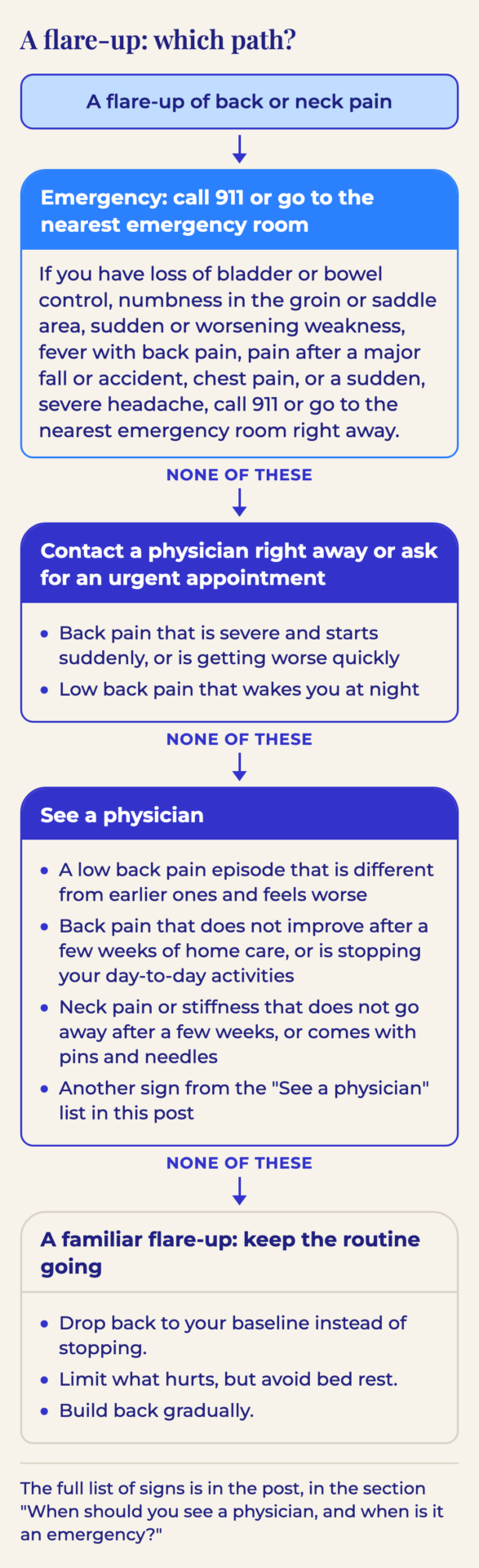
- Drop back to your baseline instead of stopping. A baseline is meant for bad days too, and the same NHS leaflet says pacing and baselines may be particularly useful during a flare-up.
- Limit what hurts, but avoid bed rest. That is what NIH’s arthritis institute advises for back pain.
- Build back gradually. The same NIH page advises increasing activity gradually, as tolerated. For long-term pain in general, the NHS says that becoming more active gradually is unlikely to cause harm. That guidance is about exercise with familiar pain, not about a flare-up that feels different (see the next section).
When is it more than a flare-up?
For low back pain, a 2019 expert consensus put a flare-up’s length at hours to weeks. MedlinePlus advises contacting a physician when a low back pain episode is different from earlier ones and feels worse. The full list is under when to see a physician.
Do supplements, diets and massage deserve a place?
The evidence for these add-ons is weak, mixed or missing.
Supplements. Only vitamin D is covered here. NIH’s complementary health center reports that a 2018 review of 8 studies did not find vitamin D helpful for low back pain. Some supplements have side effects and can interact with medicines, the same center notes, so tell your physician or pharmacist what you take.
Diets. We found no review-level evidence that tests a diet for chronic back or neck pain.
Massage. For sub-acute and chronic low back pain, a 2015 Cochrane review found massage eased pain in the short term compared with no treatment, not in the long term, and its authors had very little confidence that massage is an effective treatment for low back pain. Increased pain was the most common side effect, reported by 1.5% to 25% of participants, and no serious side effects were reported in the trials.
Bottom line: for back pain, none of the add-ons covered here is as well supported as movement.
What if a good routine isn’t enough?
A routine does not diagnose anything. Pain that persists despite a steady routine may have a source worth identifying. The main kinds of care are these:
- Exercise and psychological approaches such as CBT or MBSR are among the first options the 2017 American College of Physicians guideline recommends for chronic low back pain.
- Medicines are a decision for you and your own physician.
- Image-guided injections and other procedures depend on the diagnosis. The American Academy of Orthopaedic Surgeons describes spinal injections as generally safe, with risks that include bleeding, infection, nerve injury and increased pain. No injection or procedure helps everyone, and each carries its own risks.
- Surgery is the right answer for some structural problems. It is sometimes necessary, sometimes uncertain and sometimes not the best choice.
None of these replaces the routine, and the routine replaces none of them.
What Gramercy Center offers
This section describes Gramercy’s services. It is not research evidence.
Gramercy Center offers ultrasound-guided platelet-rich plasma (PRP) and bone marrow aspirate (BMA), along with other image-guided injections and procedures.
Gramercy Pain & Neuroscience Center is a cash-pay, concierge, physician-led practice in Beverly Hills, founded and led by Dr. Preet Patel, MD. Clients always see an MD specialist. Conditions treated include low back pain. The practice is opioid-free, with no medication management.
It is also an access point to Dr. Preet Patel’s network of vetted providers, such as trainers and Pilates studios, and the team helps arrange care that falls outside Gramercy’s scope. Not everyone is a candidate, and results vary.
When should you see a physician, and when is it an emergency?
The signs below come from public guidance on back and neck pain only. In this post, “a few weeks” is counted from the start of a new episode or flare-up.
See a physician:
- Back pain that does not improve after a few weeks of home care, or is stopping your day-to-day activities (NHS).
- Back pain with weight loss you did not intend (NHS).
- A low back pain episode that is different from earlier ones and feels worse (MedlinePlus).
- Neck pain or stiffness that does not go away after a few weeks, or comes with pins and needles (NHS neck pain page).
- NIH’s arthritis institute lists numbness and tingling among its reasons to see a doctor. Numbness in the groin or saddle area, or any sudden or worsening weakness, is an emergency sign (see below).
Contact a physician right away or ask for an urgent appointment:
- Back pain that is severe and starts suddenly, or is getting worse quickly: the NHS advises asking for an urgent appointment.
- Low back pain that wakes you at night: MedlinePlus advises contacting a physician right away. The NHS lists back pain that is worse at night as a reason to be seen.
Emergency: If you have loss of bladder or bowel control, numbness in the groin or saddle area, sudden or worsening weakness, fever with back pain, pain after a major fall or accident, chest pain, or a sudden, severe headache, call 911 or go to the nearest emergency room right away.
What is the most useful next step?
Pick an amount of movement you could repeat on a bad day, take poor sleep seriously, add one stress skill, and write the flare-up plan before you need it. The add-ons covered here remain unproven. No routine guarantees a result.
Start with one change this week. If an episode feels different and worse, or a flare-up has not improved after a few weeks, get it evaluated.
Schedule a consultation with Dr. Preet Patel.
Sources
Exercise guideline and pacing
- Noninvasive Treatments for Acute, Subacute, and Chronic Low Back Pain: A Clinical Practice Guideline From the American College of Physicians. Annals of Internal Medicine. 2017. https://pubmed.ncbi.nlm.nih.gov/28192789/
- Effectiveness of Pacing as a Learned Strategy for People With Chronic Pain: A Systematic Review. American Journal of Occupational Therapy. 2019. https://pubmed.ncbi.nlm.nih.gov/31120836/
- Pacing and Setting Baselines (patient leaflet). Calderdale and Huddersfield NHS Foundation Trust. 2026. https://plr.cht.nhs.uk/download/1091/Pacing%20and%20Setting%20Baselines%20A4
- Activity pacing, avoidance, endurance, and associations with patient functioning in chronic pain: a systematic review and meta-analysis. Archives of Physical Medicine and Rehabilitation. 2012. https://pubmed.ncbi.nlm.nih.gov/22728699/
- Chronic pain as a symptom or a disease: the IASP Classification of Chronic Pain for ICD-11. Pain (International Association for the Study of Pain). 2019. https://pubmed.ncbi.nlm.nih.gov/30586067/
- Operant Approach Activity Pacing Interventions for the Management of Chronic Pain: A Systematic Review. Clinical Journal of Pain. 2026. https://pubmed.ncbi.nlm.nih.gov/42085181/
Movement, sleep and stress skills
- Exercise therapy for chronic low back pain. Cochrane Database of Systematic Reviews. 2021. https://pubmed.ncbi.nlm.nih.gov/34580864/
- Some types of exercise are more effective than others in people with chronic low back pain: a network meta-analysis. Journal of Physiotherapy. 2021. https://pubmed.ncbi.nlm.nih.gov/34538747/
- Pilates for low back pain. Cochrane Database of Systematic Reviews. 2015. https://pubmed.ncbi.nlm.nih.gov/26133923/
- Yoga for chronic non-specific low back pain. Cochrane Database of Systematic Reviews. 2022. https://pubmed.ncbi.nlm.nih.gov/36398843/
- The bidirectional relationship between sleep problems and chronic musculoskeletal pain: a systematic review with meta-analysis. Pain. 2024. https://pubmed.ncbi.nlm.nih.gov/38809241/
- Cognitive behavioral therapy for insomnia in patients with chronic pain: a systematic review and meta-analysis of randomized controlled trials. Sleep Medicine Reviews. 2021. https://pubmed.ncbi.nlm.nih.gov/33610967/
- Effect of Mindfulness-Based Stress Reduction vs Cognitive Behavioral Therapy or Usual Care on Back Pain and Functional Limitations in Adults With Chronic Low Back Pain: A Randomized Clinical Trial. JAMA. 2016. https://pubmed.ncbi.nlm.nih.gov/27002445/
- Psychological therapies for the management of chronic pain (excluding headache) in adults. Cochrane Database of Systematic Reviews. 2020. https://pubmed.ncbi.nlm.nih.gov/32794606/
Flare-ups and add-ons
- Back Pain: Diagnosis, Treatment, and Steps to Take. NIH, National Institute of Arthritis and Musculoskeletal and Skin Diseases. 2023. https://www.niams.nih.gov/health-topics/back-pain/diagnosis-treatment-and-steps-to-take
- 10 ways to reduce pain. NHS. 2023. https://www.nhs.uk/live-well/pain/ways-to-manage-chronic-pain/
- A Definition of “Flare” in Low Back Pain: A Multiphase Process Involving Perspectives of Individuals With Low Back Pain and Expert Consensus. The Journal of Pain. 2019. https://pubmed.ncbi.nlm.nih.gov/30904517/
- Low back pain – acute (MedlinePlus Medical Encyclopedia). NIH, National Library of Medicine. 2026. https://medlineplus.gov/ency/article/007425.htm
- Low-Back Pain and Complementary Health Approaches: What You Need To Know. NIH, National Center for Complementary and Integrative Health. 2020. https://www.nccih.nih.gov/health/low-back-pain-and-complementary-health-approaches-what-you-need-to-know
- Chronic Pain and Complementary Health Approaches: Usefulness and Safety. NIH, National Center for Complementary and Integrative Health. 2023. https://www.nccih.nih.gov/health/chronic-pain-what-you-need-to-know
- Massage for low-back pain. Cochrane Database of Systematic Reviews. 2015. https://pubmed.ncbi.nlm.nih.gov/26329399/
Other care and warning signs
- Spinal Injections (OrthoInfo). American Academy of Orthopaedic Surgeons. Review date not shown on the page. https://www.orthoinfo.org/en/treatment/spinal-injections/
- Back pain. NHS. 2026. https://www.nhs.uk/conditions/back-pain/
- Neck pain. NHS. 2023. https://www.nhs.uk/conditions/neck-pain-and-stiff-neck/
- Back Pain: symptoms, types and causes. NIH, National Institute of Arthritis and Musculoskeletal and Skin Diseases. 2023. https://www.niams.nih.gov/health-topics/back-pain
This content is for general education only and is not medical advice. It does not create a doctor-patient relationship. Treatment decisions should be made with a qualified physician after an individual evaluation. Results vary, and not everyone is a candidate for every treatment.