
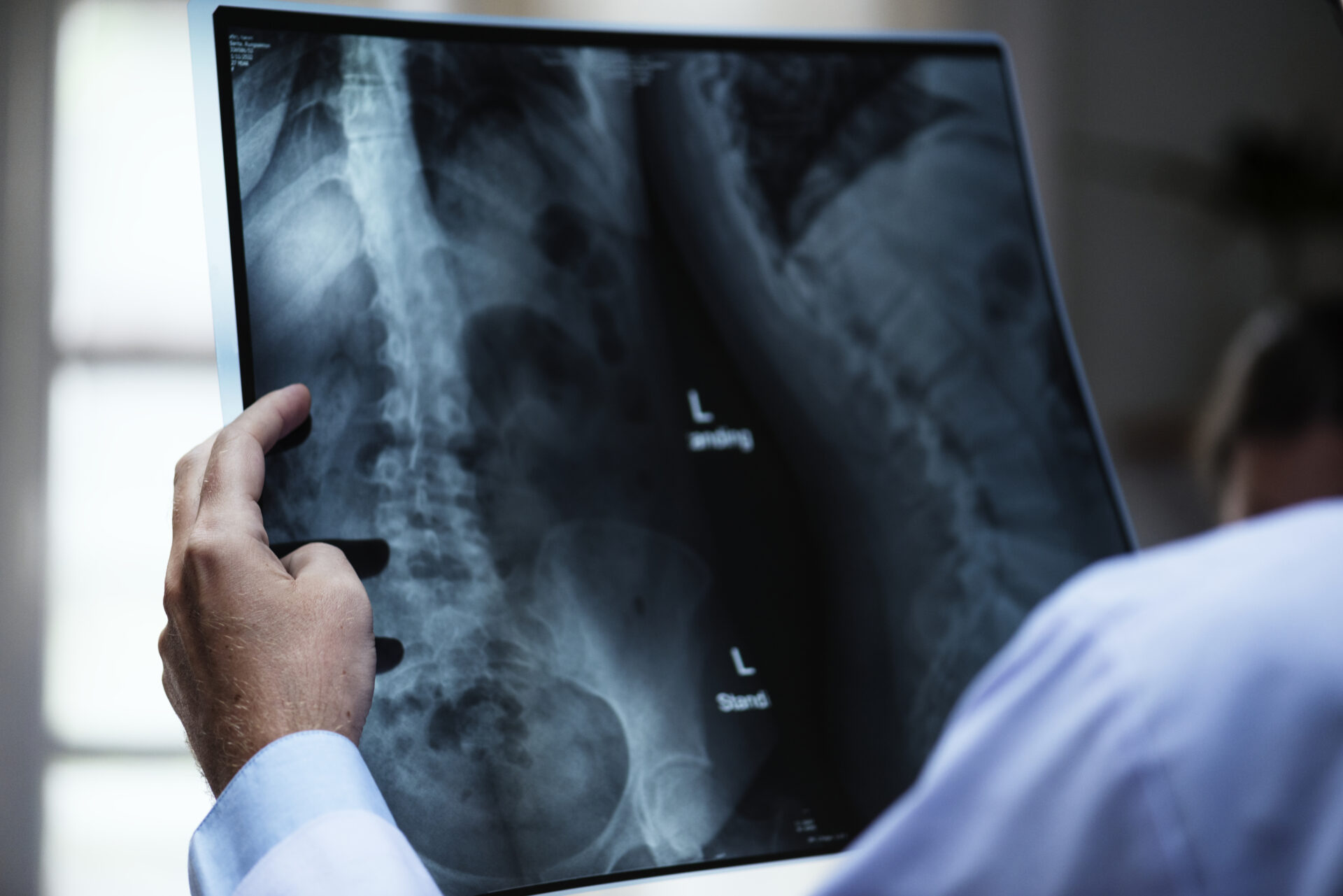
“Degenerative disc disease” appears on many back MRI and X-ray reports. It usually means the discs between your spinal bones show changes of the kind that come with age. By itself, the label does not tell you whether a disc is the source of your pain.
This article is general education, not a reading of anyone’s own scan. Disc changes are common in adults without back pain, so the label can be present without pain, though several findings are more common with pain. Still, pain from a degenerated disc is real, and persistent pain deserves evaluation whatever a scan shows.
Emergency signs first. Loss of bladder or bowel control, numbness in the groin or saddle area, or sudden or worsening weakness calls for 911 or the nearest emergency room right away. The full emergency list also covers fever with back pain, pain after a major fall or accident, chest pain and a sudden, severe headache.
Key takeaways
- “Degenerative disc disease” usually describes age-related disc changes on imaging. By itself it does not show the source of your pain.
- These findings are common without pain, and some are more common with it. Common does not mean harmless, and the label does not reliably forecast future pain.
- Age and family history have the strongest evidence as contributors. Smoking, weight and loading are smaller or less certain.
- Three tiers guide when to seek care: emergency signs, signs that call for evaluation soon, and pain that has not improved after a few weeks. Neck reports have their own signs.
What does “degenerative disc disease” actually mean?
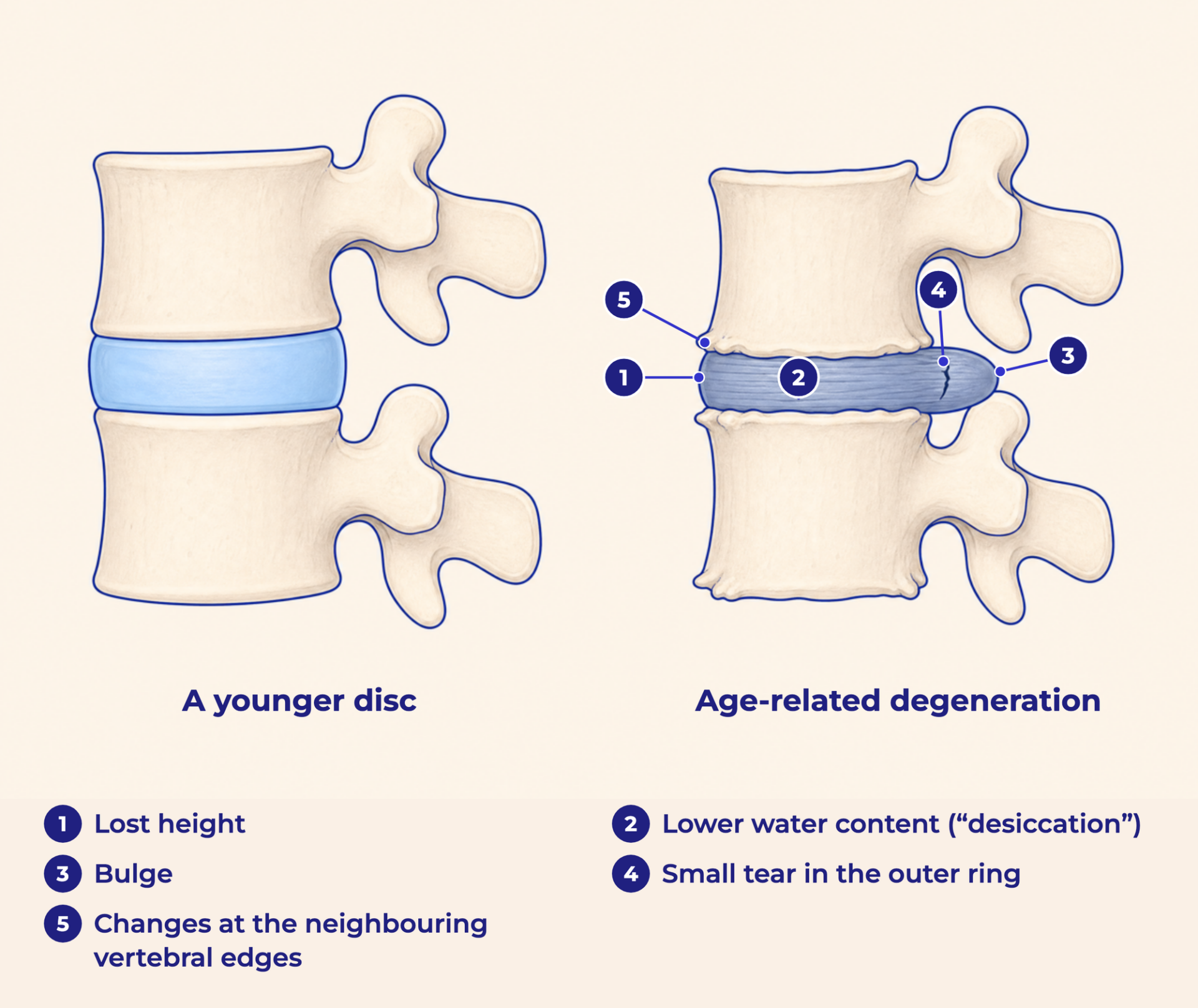
A disc is the cushion between two spinal bones. The American Academy of Orthopaedic Surgeons (AAOS) says discs begin to wear and shrink with age. For example, reports use “desiccation” for lower water content, “annular fissure” for a small tear in the outer ring, and “bulge” for disc material pushing past its usual edge.
On any report, three things are separate: changes on a scan, symptoms such as back or leg pain, and a diagnosis of what is causing that pain. A scan can show the first, while an evaluation connects it to the others.
What causes discs to change over time?
Age and family history have the strongest evidence, while smoking, body weight and physical loading have smaller or less certain links. Most research is observational, so it shows links, not proof.
Age. The National Institute of Arthritis and Musculoskeletal and Skin Diseases (NIAMS) says aging causes the discs to break down.
Family history. Twin studies suggest genes explain a meaningful share of why one person’s discs degenerate more than another’s. A Finnish study of 300 male twin pairs put heritability, the share of variation attributable to genes, at 29% to 54%, depending on the finding and spinal level. However, these figures describe populations, not your personal odds.
Smoking and body weight. Most evidence concerns back pain, not disc change. In studies following people over time, a 40-study meta-analysis (pooled results of many studies) found current smokers had about 30% higher odds of developing low back pain (its authors called the link fairly modest), and a 33-study meta-analysis found about 50% higher odds in people with obesity. Still, these are observational links; nothing reviewed here shows that quitting smoking or changing weight alters existing disc findings.
Physical loading. A Twin Spine Study review, written by the study’s own investigators, found surprisingly little difference in disc degeneration on MRI between twins with very different adult occupational and leisure loading. In 45 pairs of identical male twins with very different lifetime driving, MRI disc degeneration did not differ, though driving may worsen symptoms. However, these studies looked at disc changes, not pain. Sitting and flying have not been studied directly in the evidence reviewed, so their effect on discs is not established.
Overall, a 2023 systematic review found the risk factors for disc degeneration many and multifactorial. Your own report cannot say which factors applied to you.
How common are these findings in people with no back pain?
The clearest data come from a 2015 review that combined 33 studies of 3,110 adults with no back pain who had CT or MRI scans. Specifically, estimated shares rose from 37% at age 20 to 96% at age 80 for disc degeneration and from 30% to 84% for disc bulge. Protrusion and annular fissure also rose, less steeply; the chart shows all four.
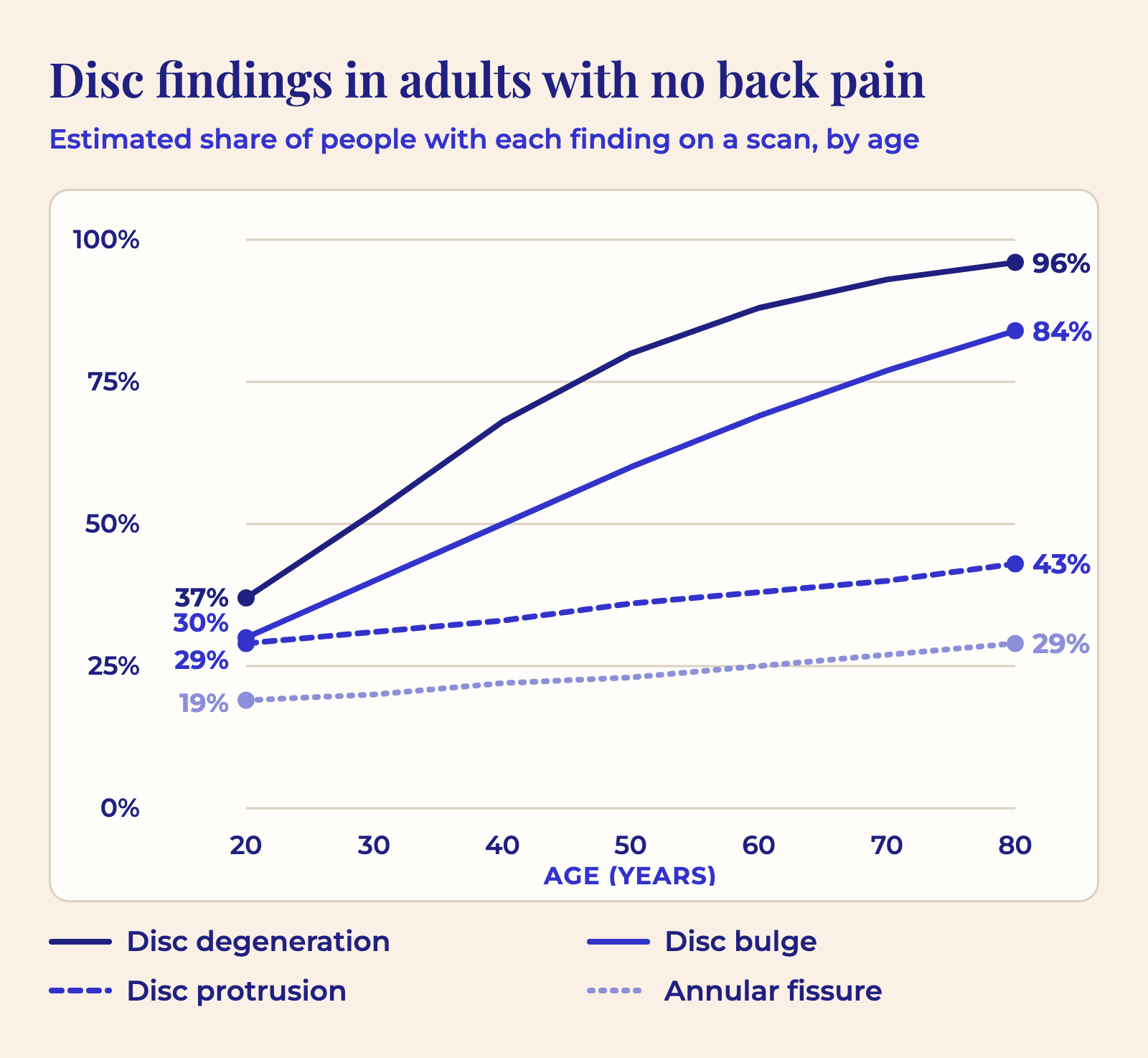
However, it is a snapshot of different people at each age, not people followed over time. Still, its authors concluded the findings are likely part of normal aging and must be read in clinical context.
Common does not mean harmless
However, common does not mean harmless. For example, a separate 2015 meta-analysis of 14 studies compared 3,097 adults aged 50 or younger with and without low back pain. Disc bulge, protrusion and extrusion (disc material pushing out past its usual edge), disc degeneration and Modic type 1 changes (a bone change beside the disc) were more common in people with pain. In contrast, annular fissures and Modic changes overall did not differ significantly.
So is a “degenerative disc disease” label a forecast of future pain? Not reliably. A 2014 systematic review of 12 studies found no consistent evidence that MRI findings predict future back pain, though the studies were too small and varied to pool. How a given disc will change over time is not established by the sources reviewed; that is a question for your physician.
In addition, the American College of Physicians advises imaging for low back pain only for severe or progressive neurologic deficits or signs of a serious underlying condition.
What are the options if a degenerated disc is linked to pain?
This is a map, not a treatment guide.
Time. In fact, most episodes of low back pain improve. In a 2012 meta-analysis of 33 groups followed over time, acute pain on a 0-to-100 scale averaged 52 at the start and 23 by 6 weeks. Meanwhile, for people whose pain was already persistent, the average went from 51 to about 23 after 1 year.
Noninvasive care. The 2017 American College of Physicians guideline starts with non-drug care because most people improve regardless: heat for acute or subacute pain, and exercise, multidisciplinary rehabilitation, acupuncture or mindfulness-based stress reduction for chronic pain.
Spinal injections. For leg pain from an irritated nerve root (radiculopathy), a 2015 meta-analysis of 30 placebo-controlled trials (trials with an inactive comparison) found epidural steroid injections gave small, short-term benefit below clinically important thresholds, with no clear effect on later surgery. Still, like any injection procedure, they carry risks; commonly cited ones include soreness, infection, bleeding and no improvement.
Surgery. For chronic back pain from degenerative disc disease alone, a 2021 meta-analysis of six prospective studies found spinal fusion (joining two vertebrae) no better than nonoperative treatment. The evidence is limited, and an earlier review found surgery may beat unstructured nonsurgical care but could not reach firm conclusions. Surgery is sometimes necessary and, like any operation, carries risks; whether it fits is a decision for an individual evaluation with a surgeon.
Biologic injections. Injecting platelet-rich plasma or cell products into the disc is being studied for disc-related back pain. However, a 2022 systematic review of PRP and cell injections rated the evidence very low quality, and a 2025 review of mesenchymal cell injections called the data preliminary. So these are not established standard care, and results vary.
When should you seek care, and how quickly?
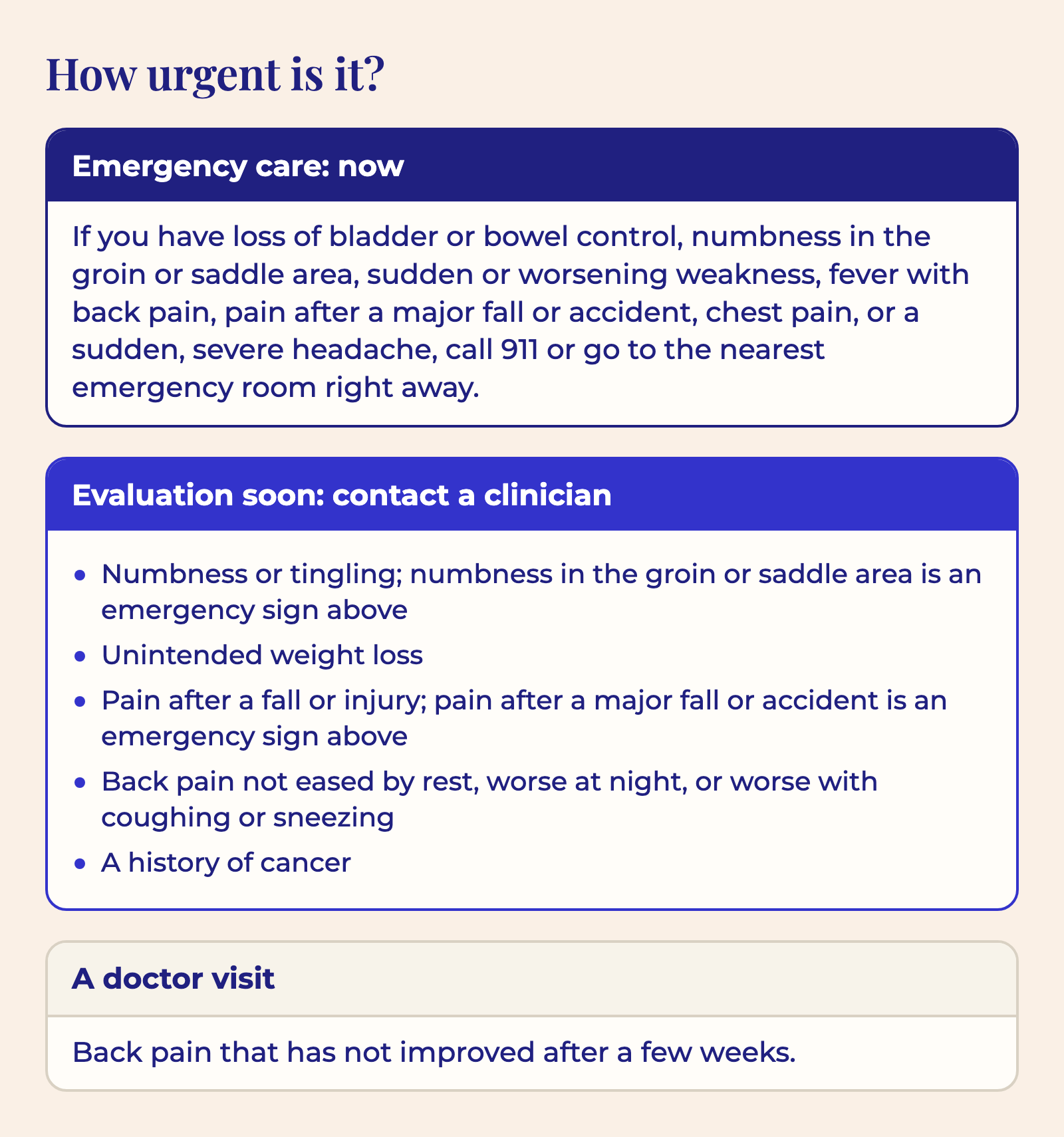
The three tiers differ in speed: emergency signs mean now, warning signs mean contacting a clinician soon, and pain that has not improved means seeing a doctor after a few weeks. Note that these tiers summarize published guidance, not personal advice; you can always see a physician sooner.
Emergency signs
Emergency care (now). If you have loss of bladder or bowel control, numbness in the groin or saddle area, sudden or worsening weakness, fever with back pain, pain after a major fall or accident, chest pain, or a sudden, severe headache, call 911 or go to the nearest emergency room right away.
The first two items can signal cauda equina syndrome, compression of the nerve roots at the base of the spine. A cauda equina review lists bladder or bowel dysfunction or reduced saddle sensation among its defining features. AAOS says leg weakness needs prompt medical attention. When it is sudden or getting worse, treat it as an emergency. Chest pain and a sudden, severe headache also call for emergency care; the UK’s National Health Service (NHS) likewise lists chest pain among its 999 signs for back pain.
Evaluation soon (not an emergency)
Rather than waiting out weeks of self-care, contact a clinician if you have any of these:
- Numbness or tingling (NIAMS); numbness in the groin or saddle area is an emergency sign above
- Unintended weight loss (NIAMS)
- Pain after a fall or injury (NIAMS); pain after a major fall or accident is an emergency sign above
- Back pain not eased by rest, worse at night, or worse with coughing or sneezing (NHS)
- A history of cancer (AAOS)
However, these sources say “see a doctor” and set no number of days. Each sign is a weak predictor on its own, so treat the list as a reason for evaluation, not a diagnosis: a systematic review of 14 studies found only a few, such as a history of cancer, raised the probability of fracture or cancer much.
Example (illustrative, not a real client): a frequent flyer notices tingling in one foot after lifting a bag. That sign is in the evaluation-soon group above. If the same person also lost bladder control or felt numbness in the saddle area, the emergency signs apply.
If your report is of the neck
AAOS lists loss of hand dexterity, trouble walking or falls as signs of cervical myelopathy (spinal cord compression). Its page gives no urgency interval, so these signs are a reason for a clinician to evaluate your neck. Sudden or worsening weakness is an emergency sign.
Persistent pain (a few weeks or more)
The NHS, NIAMS and AAOS each advise seeing a doctor if back pain has not improved after a few weeks. For scale, NIAMS calls pain subacute at 4 to 12 weeks and chronic after 12.
How Dr. Preet Patel approaches this
Gramercy Center offers consultations and image-guided spinal procedures.
Dr. Preet Patel is board-certified by the American Board of Anesthesiology and an ACGME fellowship-trained interventional pain management specialist. Clients begin with a full diagnostic consultation: he reviews records and imaging in advance, examines you, often uses ultrasound in the room, and explains your options in plain language. When surgery is the right answer, he refers you to a vetted surgeon in his network.
For how Gramercy evaluates back pain, see the low back pain page.
What should you take from your report, and what comes next?
The phrase “degenerative disc disease” describes common, age-related disc changes. However, it does not, on its own, show where your pain comes from, and persistent pain deserves evaluation whatever the scan shows. Still, what remains uncertain is why a given disc hurts. So keep your report. An evaluation is how a report becomes a plan you can fit around travel, work and training. If pain persists or a warning sign appears, arrange an evaluation; for the emergency signs, go to emergency care.
Schedule a consultation with Dr. Preet Patel. You can also call (310) 439-8009; staff will collect your imaging report before the consultation.
Sources
First part of the sources
- Systematic literature review of imaging features of spinal degeneration in asymptomatic populations. AJNR American Journal of Neuroradiology. 2015. https://pubmed.ncbi.nlm.nih.gov/25430861/
- MRI findings of disc degeneration are more prevalent in adults with low back pain than in asymptomatic controls: a systematic review and meta-analysis. AJNR American Journal of Neuroradiology. 2015. https://pubmed.ncbi.nlm.nih.gov/26359154/
- Low back pain. OrthoInfo, American Academy of Orthopaedic Surgeons. Undated page. https://www.orthoinfo.org/en/diseases–conditions/low-back-pain/
- Back pain. National Institute of Arthritis and Musculoskeletal and Skin Diseases, NIH. Reviewed February 2023. https://www.niams.nih.gov/health-topics/back-pain
- Genetic and environmental effects on disc degeneration by phenotype and spinal level: a multivariate twin study. Spine. 2008. https://pubmed.ncbi.nlm.nih.gov/19050586/
- The association between smoking and low back pain: a meta-analysis. The American Journal of Medicine. 2010. https://pubmed.ncbi.nlm.nih.gov/20102998/
- The association between obesity and low back pain: a meta-analysis. American Journal of Epidemiology. 2010. https://pubmed.ncbi.nlm.nih.gov/20007994/
- The Twin Spine Study: contributions to a changing view of disc degeneration. The Spine Journal. 2009. https://pubmed.ncbi.nlm.nih.gov/19111259/
Second part of the sources
- Occupational driving and lumbar disc degeneration: a case-control study. The Lancet. 2002. https://pubmed.ncbi.nlm.nih.gov/12423982/
- Patient-related risk factors and lifestyle factors for lumbar degenerative disc disease: a systematic review. Neurochirurgie. 2023. https://pubmed.ncbi.nlm.nih.gov/37586480/
- Does magnetic resonance imaging predict future low back pain? A systematic review. European Journal of Pain. 2014. https://pubmed.ncbi.nlm.nih.gov/24276945/
- Diagnostic imaging for low back pain: advice for high-value health care from the American College of Physicians. Annals of Internal Medicine. 2011. https://pubmed.ncbi.nlm.nih.gov/21282698/
- The prognosis of acute and persistent low-back pain: a meta-analysis. CMAJ. 2012. https://pubmed.ncbi.nlm.nih.gov/22586331/
- Noninvasive treatments for acute, subacute, and chronic low back pain: a clinical practice guideline from the American College of Physicians. Annals of Internal Medicine. 2017. https://pubmed.ncbi.nlm.nih.gov/28192789/
- Epidural corticosteroid injections for radiculopathy and spinal stenosis: a systematic review and meta-analysis. Annals of Internal Medicine. 2015. https://pubmed.ncbi.nlm.nih.gov/26302454/
- Is lumbar fusion necessary for chronic low back pain associated with degenerative disk disease? A meta-analysis. World Neurosurgery. 2021. https://pubmed.ncbi.nlm.nih.gov/33253955/
Third part of the sources
- Systematic review of randomized trials comparing lumbar fusion surgery to nonoperative care for treatment of chronic back pain. Spine. 2007. https://pubmed.ncbi.nlm.nih.gov/17414918/
- Intradiscal biologic treatments for discogenic low back pain: a systematic review. The Spine Journal. 2022. https://pubmed.ncbi.nlm.nih.gov/34352363/
- Mesenchymal stromal cells for the treatment of discogenic low back pain: a systematic review of clinical studies. Neurospine. 2025. https://pubmed.ncbi.nlm.nih.gov/41508590/
- Cauda equina syndrome: a practical guide to definition and classification. International Orthopaedics. 2021. https://pmc.ncbi.nlm.nih.gov/articles/PMC8782783/
- Back pain. NHS (England). Last reviewed March 5, 2026. https://www.nhs.uk/conditions/back-pain/
- Red flags to screen for malignancy and fracture in patients with low back pain: systematic review. BMJ. 2013. https://pubmed.ncbi.nlm.nih.gov/24335669/
- Cervical spondylotic myelopathy (spinal cord compression). OrthoInfo, American Academy of Orthopaedic Surgeons. Undated page. https://www.orthoinfo.org/en/diseases–conditions/cervical-spondylotic-myelopathy-spinal-cord-compression
This content is for general education only and is not medical advice. It does not create a doctor-patient relationship. Treatment decisions should be made with a qualified physician after an individual evaluation. Results vary, and not everyone is a candidate for every treatment.