

Gramercy Center offers nerve blocks and related procedures. Dr. Preet Patel’s approach has its own section near the end.
A nerve block is an injection of medicine placed close to a specific nerve to give temporary pain relief. For chronic neck or low back pain, and for headaches that start in the neck, it can do two jobs. As a test, it can help show whether that nerve is carrying your pain. As a treatment, it may ease pain for a period that runs from hours to months, depending on the block and the cause. If your pain has outlasted rest, therapy and cortisone shots, that information may help guide the next decision.
Here is what we know, and what we do not. The strongest case for a block is as a test for pain from the small joints of the lower spine (facet joints). However, even there, confidence is modest. A 2020 guideline from several medical societies rates the evidence for the test’s usefulness as low certainty, which means more research could change the picture. In addition, most of the firm evidence is for the lower back, and the evidence for the neck is thinner. For lasting relief, the evidence is limited or mixed. Also, a single block can mislead, relief varies widely, and some people get none. For headaches that start at the base of the skull, a 2025 review found the evidence limited and the relief often short-lived.
Key takeaways
- A nerve block places numbing medicine, sometimes with a steroid, beside a specific nerve to interrupt its pain signals.
- Many blocks are done first as a test. Meaningful short-term relief suggests that nerve may carry the pain, but a single test can mislead, and experts disagree on how to confirm it.
- A nerve block differs from a typical cortisone shot mainly in its target: the nerve, rather than an inflamed joint. Some blocks also contain a steroid, so the two overlap.
- Relief can last from hours to months. Results vary by block type and cause, and the evidence for lasting benefit is limited or mixed.
- Complications are described as rare, but exact rates are not well established. There are real risks, and not everyone is a candidate.
In this article
- What is a nerve block, and how does it ease pain?
- Is a nerve block a test, a treatment, or both?
- How is a nerve block different from a cortisone shot?
- Which kinds of nerve blocks are used for chronic pain?
- How long does relief last, and how well do nerve blocks work?
- What happens during a nerve block, and what are the risks?
- Where do nerve blocks fit among other options for chronic neck and back pain?
- How Dr. Preet Patel approaches nerve blocks
- When to seek care: neck, back or head pain, or symptoms after a block
- What’s the bottom line on nerve blocks for chronic pain?
What is a nerve block, and how does it ease pain?
RadiologyInfo.org, a public information site run by two radiology societies, describes a nerve block as an injection of an anesthetic, an anti-inflammatory medicine, or both, aimed at a nerve or group of nerves. A local anesthetic (numbing medicine) interrupts pain signals and typically lasts a few hours to a few days. A corticosteroid (steroid), when added, acts more slowly and can last weeks or months.
Doctors often use imaging to guide the needle: ultrasound, or X-ray-based imaging such as fluoroscopy (live X-ray) or a CT scan (a detailed X-ray scan). Which one, if any, depends on the block. The X-ray-based types involve a small amount of radiation. This article covers blocks used for chronic pain, not the anesthesia blocks used during surgery.
Is a nerve block a test, a treatment, or both?
It can be both, and the difference changes how you read the result.
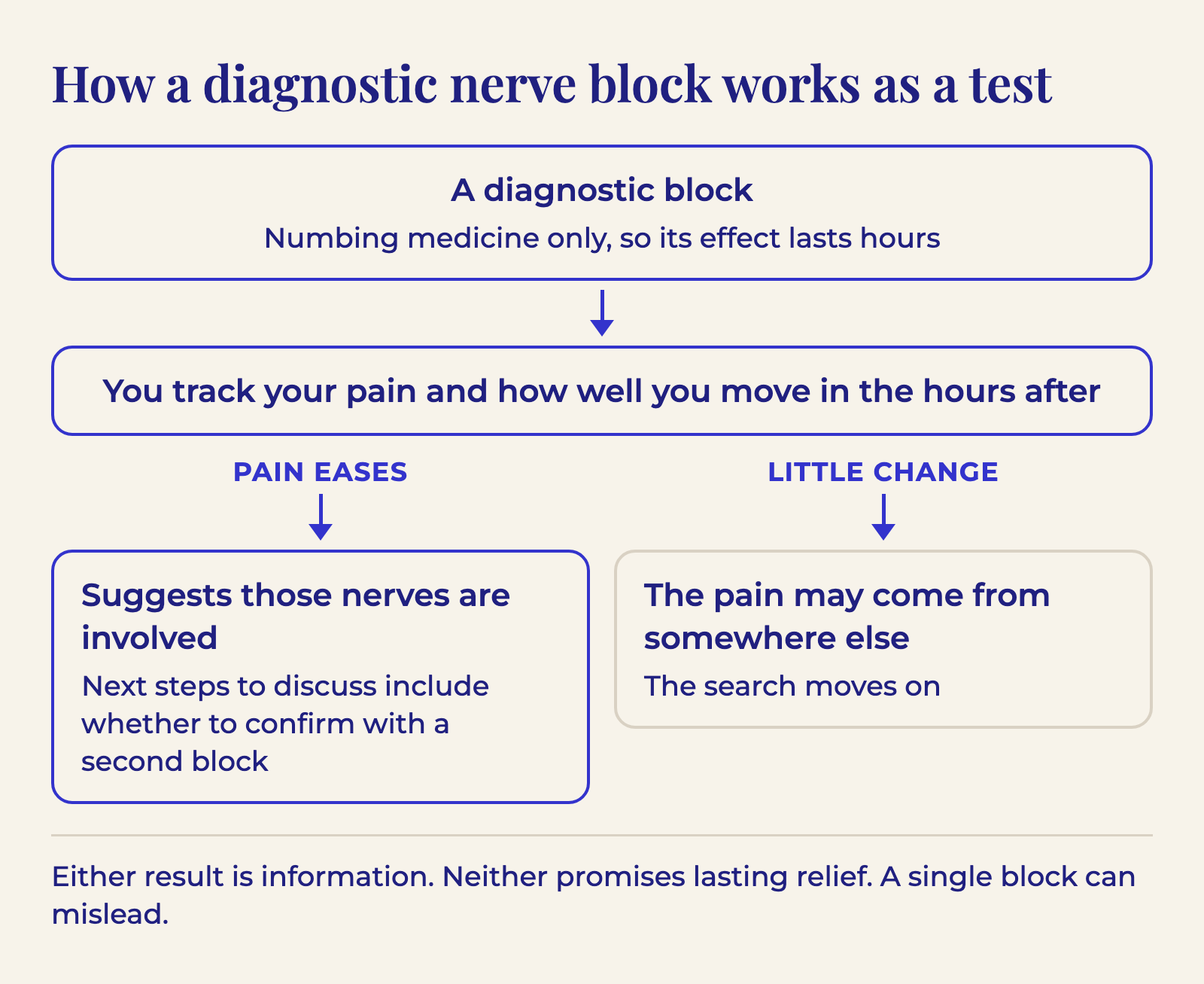
A diagnostic block uses numbing medicine only, so its effect lasts hours. You track your pain during that window. Cleveland Clinic explains that if the pain eases, it generally means the targeted nerves are the source. If it does not, the pain may come from somewhere else, which is useful information too.
For lower back facet joint pain, the 2020 guideline calls a real-time pain diary the most objective way to judge a block. The diary should track how well you move as well as how much it hurts, because the numbing window is brief. The guideline counts more than 50% pain relief as a positive block. It covers the lower back only, so its numbers may not apply to a neck problem.
Why one block can mislead
A false positive is a result that looks positive but is not. For lower back facet pain, the 2020 guideline estimates the false-positive rate at 17% to 41%, based on varied studies. In addition, experts disagree on how to guard against it. The guideline accepts a single block before a heat treatment of the nerve, and it notes that other groups want two. So ask your physician how they confirm a result, and why.
A therapeutic block
A therapeutic block aims to ease pain and may include a steroid, so its effect can outlast the numbing medicine. A positive test can also point to a treatment aimed at that nerve and intended to last longer, called radiofrequency ablation (RFA), in which heat disables a small nerve. The evidence for that step is disputed, and the options section covers it.
An illustrative example: a diagnostic block
Example (illustrative): a 52-year-old consultant who flies weekly has low back pain that worsens when she stands up after long flights. Her physician suspects the facet joints and suggests a diagnostic medial branch block (a block of the tiny nerves that serve those joints) with numbing medicine only. For the next several hours she then records her pain and how easily she moves. If her pain drops by more than half and she moves more freely, the block counts as positive. That suggests those nerves play a part, and she and her physician can discuss next steps, including whether to confirm with a second block. If the pain barely changes, it may come from somewhere else, and the search moves on. Either result is information. However, neither one promises lasting relief.
How is a nerve block different from a cortisone shot?
The main difference is the target. A typical cortisone shot goes into an inflamed joint to calm inflammation there, as the American Academy of Orthopaedic Surgeons (AAOS) describes it. A nerve block aims at the nerve carrying the pain signal. The purpose often differs too. A cortisone shot aims at relief. Many nerve blocks also aim to find the source of the pain.
However, the two overlap. RadiologyInfo notes that a block can contain an anti-inflammatory medicine, so some nerve blocks include a steroid.
Cortisone deserves a fair hearing. The AAOS says relief can last several weeks, and a 2026 guideline from several medical societies on joint injections in adults says they generally give short-term relief lasting weeks to a few months, with mixed long-term results. For the right person, weeks of relief can be worth having, and cortisone is sometimes the right treatment. Still, it has limits. Specifically, the AAOS says it does not treat the underlying cause of the inflammation, doctors often cap shots at about 3 to 4 a year, and repeated shots can harm cartilage. Nerve blocks have limits too, as the next sections show.
Which kinds of nerve blocks are used for chronic pain?
Three common blocks show how they differ.
| Block | What it targets, and a common use | Test or treatment? |
|---|---|---|
| Occipital nerve block | Nerves at the back of the head. Headaches that start at the base of the skull or in the neck, such as occipital neuralgia (nerve pain at the back of the head) and cervicogenic headache (a headache that comes from the neck) | Both. A 2025 review says it can help with diagnosis and may ease pain for a short time |
| Medial branch block | Tiny nerves to the facet joints of the neck or low back. Pain thought to come from those joints | Mostly a test, often before RFA for low back facet pain, per the 2020 guideline |
| Peripheral nerve block | A nerve outside the spine. Pain in one specific area. A 2026 safety review of procedures away from the spine, which include peripheral nerve blocks, says most targets are close to the surface and suited to ultrasound guidance | Depends on why it is done |
How long does relief last, and how well do nerve blocks work?
Duration. Numbing medicine typically lasts a few hours to a few days, according to RadiologyInfo. For therapeutic blocks, it says relief typically lasts a few weeks to months, and occasionally longer. However, some people need several blocks, and some get no benefit. So treat that as a range, not a promise.
Evidence by block and condition. In short: the best-supported use is as a test for lower back facet joint pain. As a longer-term treatment, however, the evidence is thinner. A short-term result is not a long-term outcome, so judge each use separately.
Medial branch blocks (lower back facet pain). The 2020 guideline recommends them over injections into the joint as the test of choice before ablation (RFA). Separately, it rates the evidence on how well these tests predict who will respond to ablation as low certainty. It recommends against the routine use of facet injections given as treatment rather than as a test. For the neck, a 2025 overview says a diagnostic block is a test, not a treatment, although some people have a longer-lasting effect afterward.
Occipital nerve blocks (occipital neuralgia and cervicogenic headache). The evidence is limited, and relief tends to be short. For example, a 2025 review found that injections at these sites give pain relief for only a short period. The American Headache Society’s 2013 expert paper described the evidence base for headache nerve blocks as thin, apart from cluster headache.
What happens during a nerve block, and what are the risks?
The day itself
The injection usually takes only minutes, followed by a 15 to 30 minute rest, according to RadiologyInfo. Blocks are often outpatient procedures. Cleveland Clinic adds that staff watch for side effects during the rest. With sedation, it advises fasting for 6 to 8 hours beforehand and arranging for someone to drive you home.
Recovery and activity
The sources we used do not give a standard timeline for when you can drive, work, train or fly again. Instead, your physician will give instructions for your block. Settle this before the day, and use the last question in the list at the end.
Common after-effects
The American Society of Regional Anesthesia and Pain Medicine (ASRA Pain Medicine) lists soreness where the needle went in after facet and epidural injections, and temporary numbness after epidural injections. See its information for the public.
Medicines
Blood thinners can matter, because some procedures carry more bleeding risk than others. A 2018 guideline from ASRA Pain Medicine and other societies leaves decisions about blood thinners to case-by-case judgment. Your physician will tell you whether anything needs to change beforehand.
Risks
Cleveland Clinic describes complications as rare, but a 2026 safety review cautions that a low reported count does not establish a precisely low rate. RadiologyInfo lists the first six risks below, and the safety review adds the last three (local anesthetic toxicity, collapsed lung and nerve injury):
- Infection
- Bleeding
- Accidental injection into the bloodstream
- Spread of medicine to other nerves or the spinal canal
- A block that does not work
- The wrong nerve being blocked
- Toxicity from the numbing medicine
- A collapsed lung (pneumothorax), for certain block types
- Nerve injury
So ask which of these apply to your block.
If a steroid is used
A 2024 review in the American Journal of Roentgenology lists facial flushing and raised blood sugar among the effects of steroid injections for musculoskeletal pain, and it advises against them when there is an infection at the site.
Who may not be a candidate
An infection at the injection site, bleeding risk and blood-thinner use can all change the plan. Your physician decides this in an individual evaluation.
Where do nerve blocks fit among other options for chronic neck and back pain?
A block is usually one step in a plan, not the whole plan. The right option depends on the source of the pain. Each option below has benefits and limits, and the order is not a ranking.
- Exercise and physical therapy. For chronic low back pain, the American College of Physicians’ 2017 guideline strongly recommends starting with non-drug treatment, such as exercise, rehabilitation programs and acupuncture, though it rated the supporting evidence low to moderate. For neck facet pain, a 2025 overview names focused exercise, graded activity and range-of-motion training as first-line care.
- Medicines a physician may recommend. The American College of Physicians guideline suggests anti-inflammatory medicines (NSAIDs) for low back pain if non-drug care is not enough.
- Cortisone injection. See the cortisone section above for what it can and cannot do.
- Heat treatment of the nerve. In radiofrequency ablation (RFA), heat is applied to a small nerve to interrupt its signal. For the lower back, the 2020 guideline describes the relief as durable compared with steroid injections, but still time-limited. The evidence is disputed, as the next subsection explains.
- Treatment aimed at the tissue itself. If a block or an exam suggests the pain comes from a joint, tendon or ligament rather than a nerve, the plan may shift to that tissue, such as targeted rehabilitation or an injection into the tissue. Gramercy’s approach is in the next section.
- Surgery. MedlinePlus says spinal surgery is considered only for nerve or bone damage that does not heal over time. The NHS says non-surgical treatments are often tried first for a compressed nerve, and that serious complications of decompression surgery are uncommon but possible. Surgery is sometimes necessary, sometimes uncertain, and sometimes not the best choice. That is a decision for an individual evaluation.
What about radiofrequency ablation (RFA) after a positive block?
The evidence is disputed, mostly for the lower back. The 2020 guideline says lumbar ablation “may provide benefit to well-selected individuals,” but relief is time-limited because the nerve can recover. Three 2017 randomized trials compared RFA plus exercise with exercise alone in people with chronic low back pain and a positive test block. The block was at the facet joints in one trial, the sacroiliac joints in another, and a mix of sites in the third. None found a clinically meaningful added benefit at 3 months. The trials were not blinded, so people knew which treatment they received. A 2026 review of RFA trials for chronic low back pain also found only small gains. So RFA after a positive block is a decision to discuss with a physician, not a settled next step. Ask what the evidence is for your part of the spine.
How Dr. Preet Patel approaches nerve blocks
Gramercy Center offers nerve blocks, including occipital nerve blocks and peripheral nerve blocks, as well as spinal procedures such as medial branch blocks and radiofrequency ablation, and regenerative treatments such as platelet-rich plasma (PRP).
Dr. Preet Patel is board-certified by the American Board of Anesthesiology and an ACGME fellowship-trained interventional pain management specialist. His first consultation is a full diagnostic consultation. He reviews your records and imaging before you arrive, examines you, and explains your options in plain language.
Sometimes testing shows the source is a joint, tendon or ligament rather than a nerve. For those problems, Dr. Preet Patel may discuss regenerative options such as PRP, which is made from a sample of your own blood, where the evidence for that condition supports it. If surgery is the right answer, he will advise you and make sure you are referred to an excellent surgeon. For low back pain, Gramercy’s page on low back pain treatment has more.
Every consultation and procedure is with Dr. Preet Patel, a physician specialist. Virtual consultations are available for clients who travel. If he recommends a procedure, he performs it at the Beverly Hills clinic. Gramercy is an opioid-free practice. Whether a block is right for you depends on the source of your pain, your health and your goals, results vary, and not everyone is a candidate.
When to seek care: neck, back or head pain, or symptoms after a block
Some symptoms need emergency care, with or without a nerve block.
If you have loss of bladder or bowel control, numbness in the groin or saddle area, sudden or worsening weakness, fever with back pain, pain after a major fall or accident, chest pain, or a sudden, severe headache, call 911 or go to the nearest emergency room right away.
The NHS covers several of these signs for back pain and sciatica. MedlinePlus covers sudden severe headache.
After a block, contact your physician right away for new symptoms or complications. Cleveland Clinic gives infection, and nerve problems such as burning pain, weakness or tingling, as examples. Before you leave, ask which other signs to watch for after your specific procedure, who to call, and the after-hours number. Ask for all three in writing.
What’s the bottom line on nerve blocks for chronic pain?
A nerve block can be a useful test and a possible treatment. A positive result is one piece of information, not proof, and experts still debate what follows from it.
What stays uncertain is how long relief lasts, which varies widely. In addition, one block can mislead, and experts disagree on how to confirm it. Ablation afterward is unsettled.
If a physician suggests a block, these questions can make the evaluation more useful:
- Is this block a test or a treatment?
- What result would change the plan?
- What comes after it?
- What are the risks for me?
- When can I drive, fly and train again after this block?
Whatever comes next, make it a choice you and your physician reach with a clear view of what the evidence shows and what it does not.
Schedule a consultation with Dr. Preet Patel.
Sources
First part of the sources
- Consensus practice guidelines on interventions for lumbar facet joint pain from a multispecialty, international working group (Cohen SP et al.). Regional Anesthesia & Pain Medicine. 2020. https://pubmed.ncbi.nlm.nih.gov/32245841/
- Cervicogenic headache and occipital neuralgia (Lefel N et al.). Pain Practice. 2025. https://pubmed.ncbi.nlm.nih.gov/39219023/
- Nerve Block (patient page). RadiologyInfo.org (RSNA and ACR). Reviewed 2025. https://www.radiologyinfo.org/en/info/nerveblock
- Nerve Block: What It Is, Procedure, Side Effects & Types. Cleveland Clinic. 2023. https://my.clevelandclinic.org/health/treatments/12090-nerve-blocks
- Cortisone Shot (Steroid Injection). OrthoInfo, American Academy of Orthopaedic Surgeons. Reviewer disclosures 2024. https://www.orthoinfo.org/en/treatment/cortisone-shot-steroid-injection/
- Use and safety of corticosteroid injections in joints and musculoskeletal soft tissue: guidelines (Benzon HT et al.). Regional Anesthesia & Pain Medicine. 2026. https://pubmed.ncbi.nlm.nih.gov/40015722/
- Interventional Pain Procedures: A Narrative Review Focusing on Safety and Complications. Part 4 (Lo Bianco G et al.). Journal of Pain Research. 2026. https://pubmed.ncbi.nlm.nih.gov/42774701/
- Cervical facet pain: Degenerative alterations and whiplash-associated disorder (Hellinga MD et al.). Pain Practice. 2025. https://pubmed.ncbi.nlm.nih.gov/39846460/
- Expert consensus recommendations for the performance of peripheral nerve blocks for headaches: a narrative review (Blumenfeld A et al.). Headache, American Headache Society. 2013. https://pubmed.ncbi.nlm.nih.gov/23406160/
- Treatment options for chronic pain (patient information). ASRA Pain Medicine. 2021. https://asra.com/patient-information/chronic-pain-management/treatment-options-for-chronic-pain
Second part of the sources
- Interventional Spine and Pain Procedures in Patients on Antiplatelet and Anticoagulant Medications (Second Edition) (Narouze S et al.). Regional Anesthesia & Pain Medicine. 2018. https://pubmed.ncbi.nlm.nih.gov/29278603/
- Local and Systemic Side Effects of Corticosteroid Injections for Musculoskeletal Indications (Kamel SI et al.). AJR American Journal of Roentgenology. 2024. https://pubmed.ncbi.nlm.nih.gov/38117096/
- Noninvasive Treatments for Acute, Subacute, and Chronic Low Back Pain: A Clinical Practice Guideline From the American College of Physicians (Qaseem A et al.). Annals of Internal Medicine. 2017. https://pubmed.ncbi.nlm.nih.gov/28192789/
- Low back pain – chronic (MedlinePlus Medical Encyclopedia). NIH, National Library of Medicine. Reviewed 2025. https://medlineplus.gov/ency/article/007422.htm
- Lumbar decompression surgery: when it’s used. NHS (UK). Reviewed 2026. https://www.nhs.uk/conditions/lumbar-decompression-surgery/why-its-done/
- Effect of Radiofrequency Denervation on Pain Intensity Among Patients With Chronic Low Back Pain: The Mint Randomized Clinical Trials (Juch JNS et al.). JAMA. 2017. https://pubmed.ncbi.nlm.nih.gov/28672319/
- Current evidence on radiofrequency denervation for chronic low back pain: a systematic review and meta-analysis (Truong KMTL et al.). BMJ Open. 2026. https://pubmed.ncbi.nlm.nih.gov/42463214/
- Back pain. NHS (UK). Reviewed 2026. https://www.nhs.uk/conditions/back-pain/
- Sciatica. NHS (UK). Reviewed 2024. https://www.nhs.uk/conditions/sciatica/
- Headaches – danger signs (MedlinePlus Medical Encyclopedia). NIH, National Library of Medicine. Reviewed 2025. https://medlineplus.gov/ency/patientinstructions/000424.htm
This content is for general education only and is not medical advice. It does not create a doctor-patient relationship. Treatment decisions should be made with a qualified physician after an individual evaluation. Results vary, and not everyone is a candidate for every treatment.