

Spinal injections are generally low risk, but “low” does not mean “none.” Most side effects are minor and short-lived. Serious problems, such as infection, bleeding around the spinal nerves, or nerve and spinal cord injury, are uncommon to rare. A 2025 American Academy of Neurology (AAN) review describes them as appearing mainly in case reports. Still, your risk may depend on your health, your medications and the approach used.
This matters if a physician has suggested an epidural or facet injection, or a cortisone shot is wearing off, and you have read warnings online. The useful question is “safe compared with what?”, including waiting. The common minor effects are reasonably well described. However, precise rates of rare events are not. In addition, benefit varies by condition. Gramercy offers these injections, so read this as education, not independent evidence for our services.
Key takeaways
- Risk is generally low, not zero. Most effects are temporary soreness or a short pain flare. Serious risks are rare, and their exact frequency is not well established.
- Tell your physician about blood thinners, diabetes, allergies, infection, possible pregnancy and earlier steroid doses.
- For epidural steroid injections, benefit is usually modest and short-term. Short-term relief matters to some people.
Which spinal injections are we talking about, and what are they meant to do?
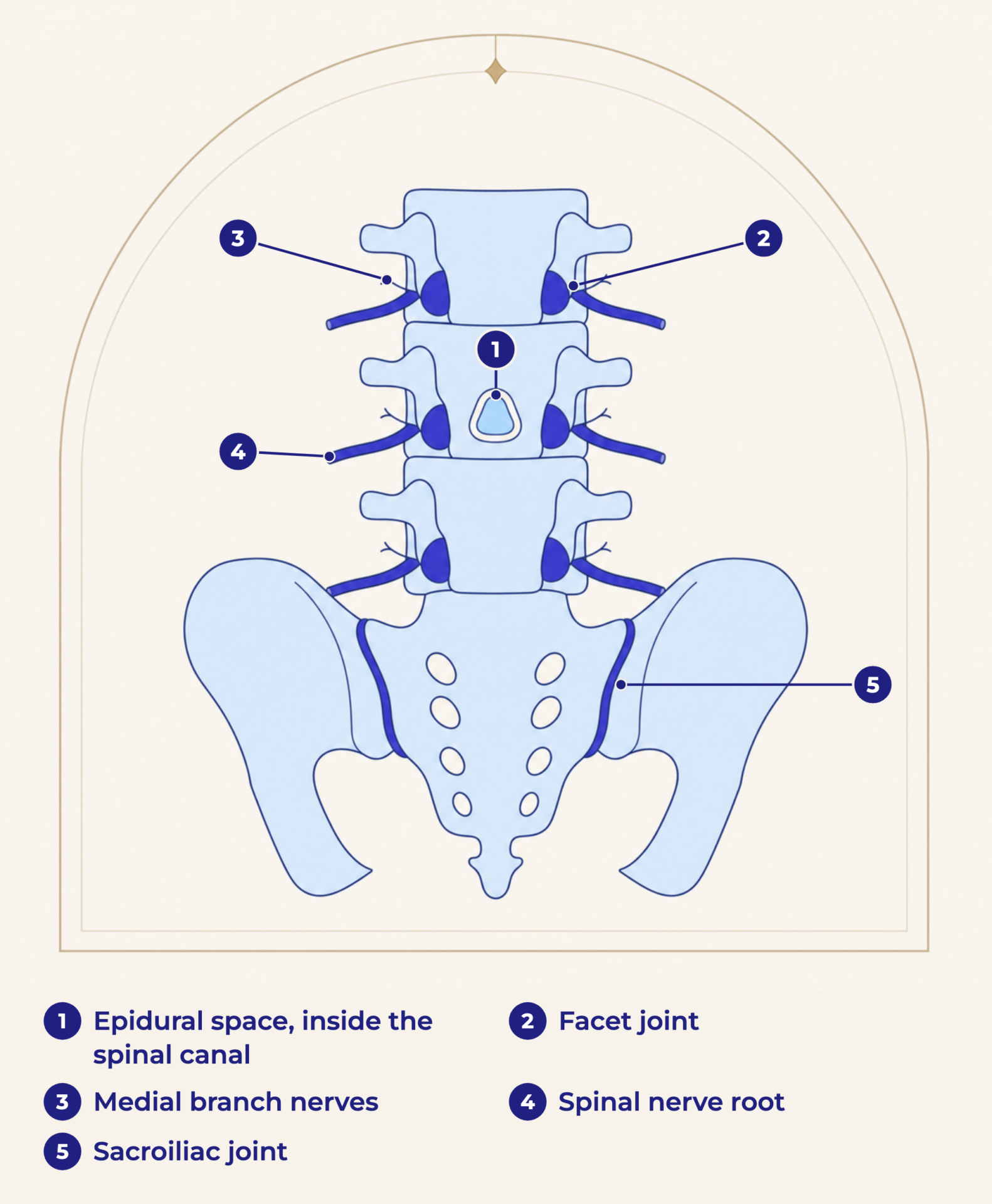
- Epidural steroid injection: steroid placed in the epidural space (around the spinal cord’s covering) to calm an irritated nerve root.
- Facet joint injection: medicine placed in the small joints at the back of the spine.
- Medial branch block: anesthetic around the tiny nerves that carry facet-joint pain, often used to confirm where pain comes from.
- Sacroiliac joint injection: medicine placed in the joint where the spine meets the pelvis.
These aim to reduce inflammation or locate the pain source. However, they do not change the underlying structure, and relief varies from person to person. Learn more: epidural steroid injections, facet joint injections, medial branch blocks and sacroiliac joint injections.
How often do side effects and serious complications happen?
Common and minor
In a 2011 chart review from one academic practice, 4,265 fluoroscopy-guided (live X-ray) epidural injections in 1,857 people led to a minor complication 2.4% of the time (about 1 in 40), most often a temporary increase in pain. None were major. However, it counted only people who contacted the clinic within 10 days. Reported complication rates vary widely across studies, according to the AAN review. In addition, MedlinePlus lists dizziness, headache and nausea, usually mild.
Uncommon
Accidental puncture of the dura (the spinal cord’s covering) can cause a positional headache. A Benelux expert group (a Belgian, Dutch and Luxembourg panel) cites rates of about 0.33% to 1% in the lumbar spine. MedlinePlus also lists allergic reaction and infection, but we found no reliable per-injection rates. For sacroiliac injections, a meta-analysis of 43 studies found about a 1% complication rate with steroids (type and severity not specified). However, two studies reported 19% and 50%. Study quality was limited, so treat these as rough figures.
Rare but serious
Serious events include deep infection, bleeding around the spinal column, nerve injury and, rarely, stroke-like events. Still, the best evidence shows few of them, and no source gives a precise rate:
- AAN review: serious events appear rare and are mainly described in case reports.
- 2020 Cochrane review (25 placebo-controlled trials in sciatica): one major event, bleeding behind the abdominal lining in a person taking a blood thinner. Adverse-event reporting was poor and the evidence very low quality, so this is not a reliable rate.
- Facet injections and medial branch blocks: no pooled complication rate was found.
Steroid effects beyond the day
A steroid injection can raise blood sugar for hours to days, according to a safety document from the International Pain and Spine Intervention Society. The Benelux expert group says observational studies link repeated steroid exposure to lower bone density. “Linked to” is not “causes,” and the AAN found no studies on repeated epidural injections.
What did the FDA’s 2014 warning and the label say?
In April 2014 the FDA asked that a warning be added to the labels of all injectable corticosteroids because of rare but serious neurologic events after epidural injection, as a 2016 review describes. That is a label requirement, not a ban on the procedure. In addition, the warning rests on voluntary reports. The Benelux expert group notes they show that events can happen but cannot give a rate, and it estimates about 9 million epidural steroid injections a year in the United States. This section draws on peer-reviewed reviews and the manufacturer’s label.
The label for Depo-Medrol, an injectable steroid (revised December 2025), lists spinal cord infarction (loss of blood supply to the cord), paralysis, vision loss from the brain and stroke, some resulting in death, reported with and without fluoroscopy. It says the safety and effectiveness of epidural use have not been established and that corticosteroids are not approved for this use. The Benelux group calls epidural use off-label: a physician’s choice to use a drug for a purpose its label does not list. So you can ask your physician what that means for your case.
Who are injections usually considered for, and what changes your risk?
The AAN evidence is strongest for leg pain from an irritated nerve root (radiculopathy), so that is where physicians most often consider epidural injections. Not everyone is a candidate, and the same injection carries different risk for different people. Tell your physician about:
- Blood thinners. Bleeding is the main reason blood thinners matter. The Cochrane review’s one major event (bleeding behind the abdominal lining) occurred in a person on an anticoagulant, and a multisociety guideline sorts spine procedures by bleeding risk. Your physician will tell you what to do about your medications. Example (illustrative): a person takes a daily blood thinner. The injection team and prescriber agree on a plan beforehand, and the person does not stop the medicine alone.
- Diabetes. Steroids can raise blood sugar. The Intervention Society document says injections can generally proceed in type 2 diabetes, even when control is not ideal, and your physician will tell you how to manage glucose.
- Allergies, including to contrast dye or medicines used in injections.
- Any current or recent infection, or fever.
- Pregnancy or possible pregnancy. Many spinal injections use fluoroscopy, and your physician decides what is appropriate.
- Bone health and earlier steroid doses, including joint injections.
Does image guidance make injections safer?
Imaging lets the physician see where the needle sits, but the sources do not show it makes injections safer on its own. For transforaminal injections (toward the opening where a nerve root exits), the Benelux expert group, a regional consensus, calls contrast dye with real-time imaging “essential.” Studies it cites found dye entering a blood vessel in roughly 8% to 15.5% of lumbar cases. That is why physicians use contrast: it can show when a needle is in a vessel before they inject steroid.
The sources do not show that any one steroid is safer than another. Which imaging suits which target is the physician’s call, and a fair question to ask.
How do the risks compare with the alternatives, including waiting?
Waiting. In a UK primary care cohort of 609 adults with back-related leg pain who received usual guideline-based care, 55% reported meaningful improvement at 12 months (follow-up was available for 450). However, the rest did not report that much. The American College of Physicians (ACP) guideline notes most people with acute or subacute low back pain improve over time regardless of treatment.
Physical therapy and exercise. For chronic low back pain, the ACP recommends exercise-based and other non-drug approaches first. The guideline covers low back pain generally, not sciatica specifically.
Medicines. The ACP lists NSAIDs (anti-inflammatory pain relievers) as the first-line drug option and opioids only after other treatments have failed. For sciatica, however, a Cochrane review found no clear pain benefit from NSAIDs over placebo and more side effects, at low to very low certainty.
Spinal injections. The Cochrane injection review found epidural steroids probably reduce leg pain and disability slightly up to three months, below its threshold for clinical importance, with no meaningful difference later. In contrast, the AAN review (90 trials) reports a larger short-term benefit: pain and disability probably improve in radiculopathy. The two measure differently. Both agree long-term evidence is limited, and the AAN found insufficient evidence that injections reduce the need for surgery. The evidence we could verify does not support a benefit claim for facet joint injections or medial branch blocks.
Surgery. A 2023 BMJ meta-analysis found discectomy (removing disc material pressing on a nerve) gave faster leg-pain relief than non-surgical care in selected people with sciatica, but the difference was small by 12 months, at very low to low certainty. Still, surgery carries its own risks and is sometimes the right answer.
What should you expect before, during and after an injection?
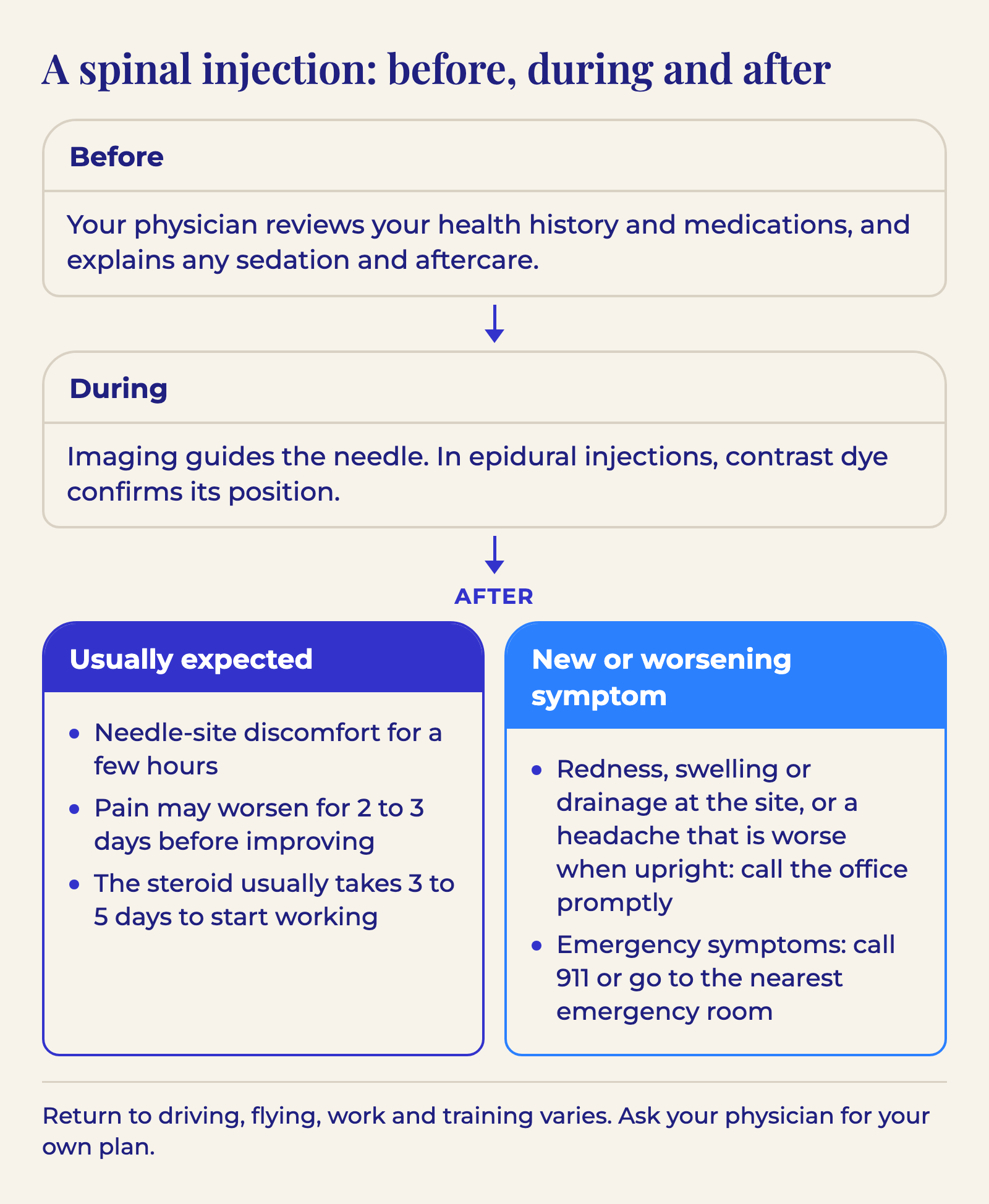
Before, your physician reviews your health history and medications and explains any sedation and aftercare. During, imaging guides the needle, and contrast dye confirms its position in epidural injections. Afterward, per MedlinePlus, needle-site discomfort lasts a few hours, pain may worsen for 2 to 3 days before improving, and the steroid usually takes 3 to 5 days to start working. Return to driving, flying, work and training varies, so ask your physician for your own plan.
What should you ask before you agree?
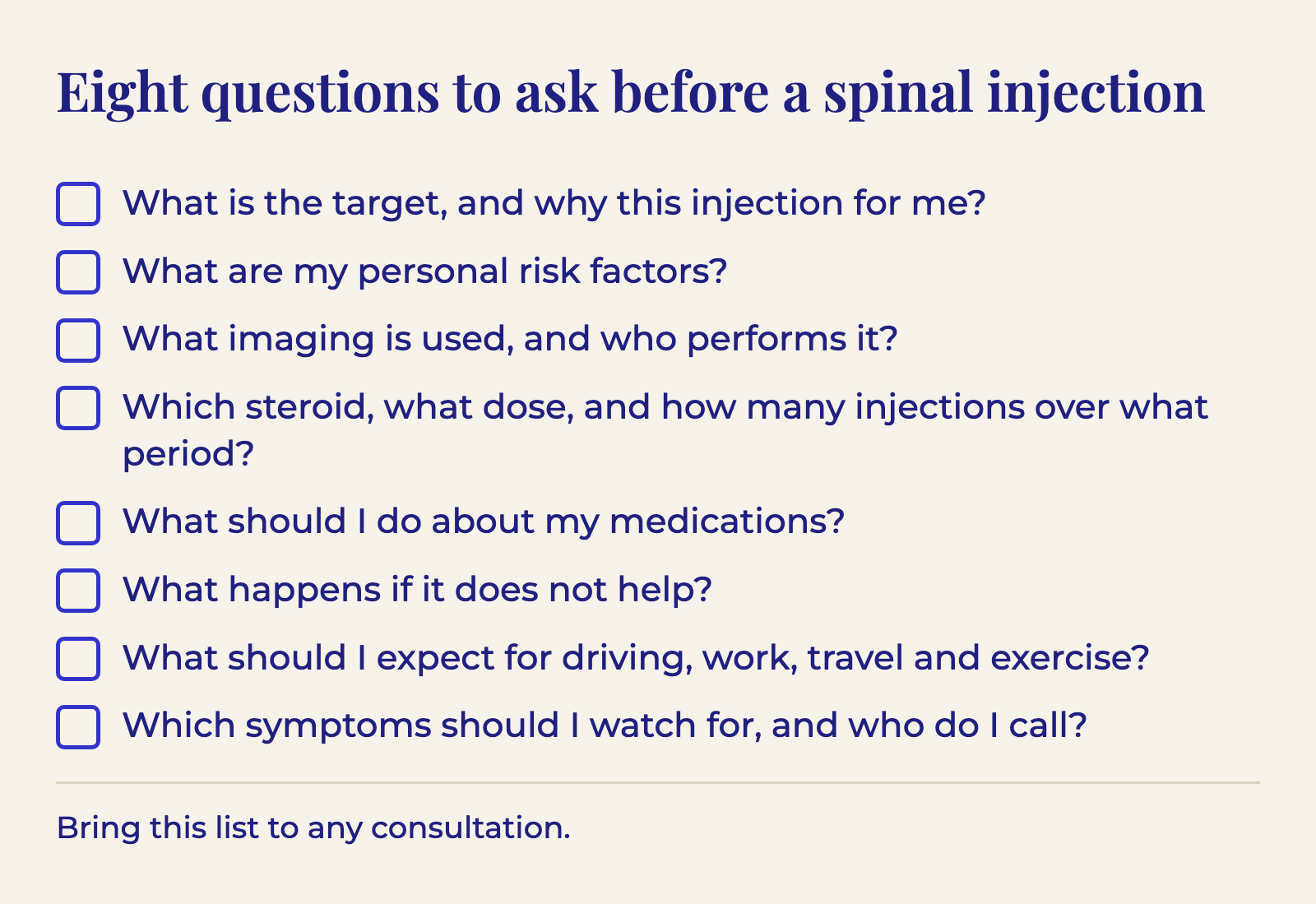
- What is the target, and why this injection for me?
- What are my personal risk factors?
- What imaging is used, and who performs it?
- Which steroid, what dose, and how many injections over what period?
- What should I do about my medications?
- What happens if it does not help?
- What should I expect for driving, work, travel and exercise?
- Which symptoms should I watch for, and who do I call?
A printable version of these eight questions follows.
How Dr. Preet Patel approaches spinal injections
Gramercy offers each of these injections. Clients always see an MD specialist, never a physician assistant or nurse practitioner. Dr. Preet Patel reviews your records and imaging in advance and explains your options in plain language, so the eight questions above are the ones to bring. Gramercy’s spinal injections are image-guided. If surgery is the right answer, he will say so and refer you to an excellent surgeon. Our low back pain page covers the conditions we evaluate.
When should you get help after an injection?
If you have loss of bladder or bowel control, numbness in the groin or saddle area, sudden or worsening weakness, fever with back pain, pain after a major fall or accident, chest pain, or a sudden, severe headache, call 911 or go to the nearest emergency room right away.
For any other new or worsening symptom after an injection, such as redness, swelling or drainage at the site, or a headache that is worse when upright, call the office that performed it promptly. If you cannot reach the office or are unsure, go to the nearest emergency room.
So, how safe are spinal injections for you?
Spinal injections are generally low risk, with real but uncommon serious risks. Your risk may depend on your health, your medications and the approach used, and you should weigh it against the alternatives, including waiting. Before any consultation, bring the questions above and your full medication and health history.
Schedule a consultation with Dr. Preet Patel. You can also call (310) 439-8009.
Sources
First part of the sources
- Epidural steroids for cervical and lumbar radicular pain and spinal stenosis: systematic review summary, Report of the AAN Guidelines Subcommittee. American Academy of Neurology / Neurology. 2025. https://pmc.ncbi.nlm.nih.gov/articles/PMC12289388/
- Incidence and characteristics of complications from epidural steroid injections. Pain Medicine. 2011. https://pubmed.ncbi.nlm.nih.gov/21392252/
- Epidural injections for back pain (MedlinePlus Medical Encyclopedia). NIH National Library of Medicine. Reviewed 2025. https://medlineplus.gov/ency/article/007485.htm
- Safe Use of Epidural Corticosteroid Injections: Recommendations of the WIP Benelux Work Group. Pain Practice. 2019. https://pmc.ncbi.nlm.nih.gov/articles/PMC7379698/
- Injective Treatments for Sacroiliac Joint Pain: A Systematic Review and Meta-analysis. Indian Journal of Orthopaedics. 2024. https://pmc.ncbi.nlm.nih.gov/articles/PMC11130093/
- Epidural corticosteroid injections for lumbosacral radicular pain. Cochrane Database of Systematic Reviews. 2020. https://pmc.ncbi.nlm.nih.gov/articles/PMC7145384/
- FactFinders for patient safety: Hyperglycemia and steroid injections. International Pain and Spine Intervention Society, Interventional Pain Medicine. 2026. https://pmc.ncbi.nlm.nih.gov/articles/PMC13194597/
Second part of the sources
- Serious neurological events complicating epidural injections of glucocorticoid suspensions. RMD Open. 2016. https://pmc.ncbi.nlm.nih.gov/articles/PMC5051450
- DEPO-MEDROL (methylprednisolone acetate injectable suspension) prescribing information. Pfizer. Revised December 2025. https://labeling.pfizer.com/ShowLabeling.aspx?id=869
- Interventional spine and pain procedures in patients on antiplatelet and anticoagulant medications, 2nd edition. ASRA and partner societies, Regional Anesthesia and Pain Medicine. 2018 (ASRA page posted December 2022). https://asra.com/guidelines-articles/guidelines/guideline-item/guidelines/2022/12/14/interventional-spine-and-pain-procedures-in-patients-on-antiplatelet-and-anticoagulant-medications-(second-edition)
- Prognosis of sciatica and back-related leg pain in primary care: the ATLAS cohort. The Spine Journal. 2018. https://pmc.ncbi.nlm.nih.gov/articles/PMC5984249/
- Noninvasive treatments for acute, subacute, and chronic low back pain: a clinical practice guideline from the American College of Physicians. Annals of Internal Medicine. 2017. https://pubmed.ncbi.nlm.nih.gov/28192789/
- Non-steroidal anti-inflammatory drugs for sciatica. Cochrane Database of Systematic Reviews. 2016. https://pubmed.ncbi.nlm.nih.gov/27743405/
- Surgical versus non-surgical treatment for sciatica: systematic review and meta-analysis of randomised controlled trials. BMJ. 2023. https://pubmed.ncbi.nlm.nih.gov/37076169/
This content is for general education only and is not medical advice. It does not create a doctor-patient relationship. Treatment decisions should be made with a qualified physician after an individual evaluation. Results vary, and not everyone is a candidate for every treatment.