

Usually, yes. Most nerve pain from a compressed or irritated nerve, such as sciatica from a herniated disc, a pinched nerve in the neck, or carpal tunnel syndrome at the wrist, is treated without surgery first. Most people with sciatica or a pinched nerve in the neck improve. A 2024 clinical review estimates that sciatica settles in roughly 6 to 8 of every 10 people within 6 to 12 weeks, and in 8 to 9 of 10 over a year or more. Carpal tunnel often responds to non-surgical care for a time. Surgery is the better answer in a defined set of situations: progressive weakness, loss of bladder or bowel control, or severe compression that is wasting a muscle. It becomes a strong option when pain has not improved after a fair trial of non-surgical care.
If a surgeon has raised surgery: timing and odds
Perhaps you have already done physical therapy and had a steroid injection that wore off, and a surgeon has raised a discectomy or another decompression (an operation that takes the pressure off the nerve). If so, the real question is not “surgery or never.” It is timing and odds. Here is what we know.
In a Dutch trial of 283 adults with severe sciatica, early surgery relieved leg pain faster, but disability at 1 year was the same whether people had early surgery or started with non-surgical care and had surgery only if needed. Three things are less settled. Which injection helps whom, and for how long. Whether surgery wins once sciatica has lasted more than 4 months: so far that rests on one Canadian trial, which found it clearly did for leg pain at 6 months. And how much the newer options add: platelet-rich plasma around a nerve rests on early evidence, and nerve stimulation on mixed evidence.
Key takeaways
- Most compressed-nerve pain improves without surgery. Surgery is for specific situations, not a default.
- The non-surgical options work at different levels: time and movement, physical therapy, medication, image-guided injections, and, for persistent pain, regenerative or stimulation options with early or mixed evidence.
- When there is no weakness, a 2024 clinical review puts the usual non-surgical trial at about 6 to 12 weeks, counted from when symptoms began (see below). Worsening weakness or bladder or bowel symptoms change that timeline immediately.
- Already months into sciatica and not improving? Past about 4 months, one randomized trial found surgery clearly better for leg pain at 6 months. At that stage surgery is a strong option, not a last resort, and a surgical opinion and the next-tier options belong in the same conversation.
- Starting with non-surgical care did not cost sciatica trial participants their result: outcomes at 1 to 5 years were similar either way. Severe carpal tunnel with muscle wasting is different: surgery may be recommended to prevent lasting damage.
In this article
- Which kinds of nerve pain does the surgery question apply to?
- How often does nerve pain improve without surgery?
- What are the non-surgical options, and what does the evidence say for each?
- When is surgery the better answer, and how long should you try first?
- How Dr. Preet Patel approaches this
- When to seek care
- The bottom line: usually yes, with clear exceptions
Which kinds of nerve pain does the surgery question apply to?
This post is about pain from a nerve that is being pressed on or irritated. That means a herniated disc pressing on a nerve root in the low back (sciatica) or in the neck (cervical radiculopathy, felt as arm pain), or the median nerve squeezed at the wrist (carpal tunnel syndrome). Radiculopathy, the everyday “pinched nerve,” means a nerve root is compressed or irritated where it leaves the spine, as the American Academy of Orthopaedic Surgeons (AAOS) OrthoInfo page describes. The pain travels along that nerve’s path, which is why a back problem is felt in the leg and a neck problem in the arm. An injection calms the inflammation around the nerve. Decompression surgery removes the pressure itself. For these conditions, surgery is a real option.
However, nerve pain from peripheral neuropathy is a different problem. There, nerves are damaged more diffusely, most often by diabetes, and the question is rarely surgery. If that is your situation, our page on painful diabetic neuropathy is the better starting point.
How often does nerve pain improve without surgery?
For sciatica from a herniated disc, most people improve without surgery, but not everyone, and the number depends on who was studied. The 2024 review above pools the published literature into an estimate of 60% to 80% improved within 6 to 12 weeks, and 80% to 90% over a year or more. Everyday primary care looks less tidy: in a UK cohort of 609 adults with back-related leg pain or sciatica, 55% reported meaningful improvement at 12 months, and longer-lasting leg pain was linked to worse odds.
The improvement is real biology, not just time passing. Specifically, inflammation around the nerve settles, and the herniated disc material itself often shrinks over months. In a systematic review of imaging studies, the largest herniations were the most likely to regress: sequestrations (a fragment that has broken free) and extrusions (disc material pushed well out of the disc) more often than smaller protrusions. Those are imaging findings, not a promise about pain. Still, they explain why waiting is a treatment rather than doing nothing.
A pinched nerve in the neck, and carpal tunnel syndrome
Likewise, a pinched nerve in the neck follows a similar course. A systematic review of cervical disc herniation with radiculopathy, drawing on a small number of good-quality studies, found most improvement in the first 4 to 6 months, and full recovery in about 83% of people within 2 to 3 years.
Carpal tunnel syndrome has its own pattern: it often responds to non-surgical care for a time. For mild to moderate cases, a 2023 Cochrane review of 14 trials (994 participants) found a steroid injection into the wrist probably improves symptoms and function for up to 6 months. However, the 2024 AAOS and hand-surgery guideline found strong evidence that it does not provide long-term improvement. A wrist injection that helped and then faded followed the expected course; that is not a failure.
The caveat: by the long-term estimates above, 1 to 2 people in 10 do not improve, and in everyday primary care the share is higher. If that is you, the rest of this post is for you.
What are the non-surgical options, and what does the evidence say for each?
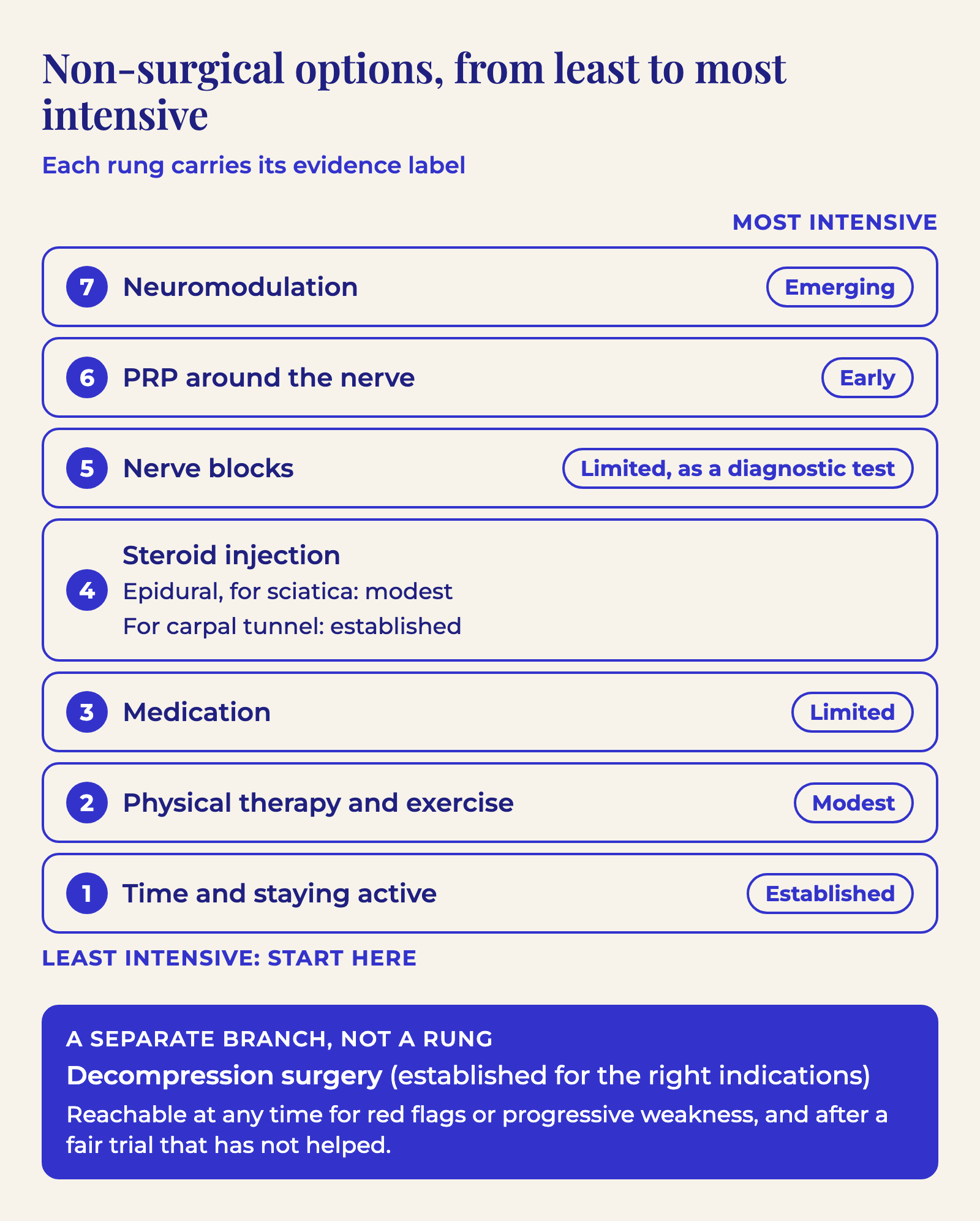
The options below run from least to most intensive. Meanwhile, decompression surgery, the alternative to all of them, has its own section next. The paragraphs share one order: what the option targets, how strong the evidence is, where it usually fits in the sequence, and its main risks, with any condition-specific detail last. The evidence labels are established (guidelines, meta-analyses or consistent trials), modest (established, but the benefit is small), limited (weak evidence), early (a few small trials with short follow-up) and emerging (mixed findings so far, with the picture still forming).
Time, staying active and adjusting activity
This is the baseline, and it relies on the natural course described above. The evidence is established: for sciatica, a Cochrane review found moderate-quality evidence of little or no difference between advice to rest in bed and advice to stay active. It is the comparison point for every other non-surgical option, and it comes first in the sequence: keep moving within what the pain allows, and adjust what clearly provokes it rather than stopping altogether. The risks are the pain continuing while you wait, and missing a red flag, so keep the signs under “When to seek care” in mind.
Physical therapy and exercise
This targets movement, strength and how much activity you can tolerate. The evidence is modest: a 2015 systematic review of five trials found structured exercise gave a small extra reduction in leg pain in the short term over advice to stay active, and no long-term difference. It fits from the first weeks, alongside everything else, and it keeps you active and training while the nerve settles. The main risk is a temporary flare-up.
Medication
This targets inflammation and pain signaling. However, the evidence is limited, weaker than most people expect. A 2016 Cochrane review of 10 trials (1,651 participants) found anti-inflammatories had no clear effect on sciatica pain compared with placebo, a small edge in overall improvement, and more side effects. In the PRECISE trial of 209 adults with sciatica, pregabalin, a nerve-pain medicine, was no better than placebo at 8 weeks or 1 year and caused more side effects. Its role is short-term comfort, with side effects as the main risk. Medication decisions belong with the physician who prescribes for you.
Epidural steroid injections
If you had one that wore off, that is the expected course, not a failure. Here is why. The injection places steroid around the nerve roots inside the spinal canal to calm inflammation. It does not change the disc. The evidence is modest. A 2020 Cochrane review of 25 placebo-controlled trials (2,470 participants with sciatica) found moderate-quality evidence (a fairly reliable finding) that the injections reduce leg pain and disability in the short term. Even so, the average effect was small, under 10 points on a 100-point scale, which many people would not notice as meaningful. Individual responses vary around that average.
The usual role is pain-dominant sciatica that is disrupting activity. Reported side effects were mostly minor, though the trials collected limited safety data. The steroid’s prescribing information also lists rare but serious nerve injuries, including spinal cord injury, paralysis, vision loss and stroke, reported with and without X-ray guidance. However, those come from case reports, and the label gives no rate.
Nerve blocks, and the carpal tunnel injection
A nerve block numbs one specific nerve or nerve root with local anesthetic, sometimes with steroid. Its first job is diagnostic: if numbing that nerve removes the pain, that nerve is likely the source. Still, the evidence for it as a test is limited. In a review of diagnostic nerve-root blocks for the UK’s National Institute for Health and Care Research (NIHR), the block identified about 93% of true cases but was also positive in many people whose pain came from elsewhere, so it is useful but imperfect. It sits at the injection level in the sequence, and the relief that follows varies: no good study pins down a typical duration. In the same review, minor complications occurred in 0% to 6% of people.
For carpal tunnel, the injection at this level is the wrist steroid injection described above, for mild to moderate cases. It targets the swelling around the median nerve at the wrist, and the evidence is established: the 2023 Cochrane review found months of relief, and the guideline described above found no long-term change. In addition, the wrist injection’s main risks are a temporary flare after the injection and, rarely, a serious event.
Platelet-rich plasma (PRP) around the nerve
PRP is made by concentrating platelets from a sample of your own blood. Under ultrasound guidance it can be injected around a nerve (perineural), and that surrounding tissue is what it targets. However, the evidence is early, and it depends on the condition.
For sciatica, a meta-analysis of five small trials (310 participants) found epidural PRP performed about the same as an epidural steroid injection, not better. Specifically, those trials placed the PRP in the epidural space, by the same routes used for an epidural steroid injection. They compared pain, function and quality-of-life scores at set check-ins, up to 6 months in the pooled analysis, and none of them measured how long relief lasted. So they do not show that PRP lasts longer than a steroid injection either. They also do not single out who benefits, so choosing PRP over a repeat steroid injection is a case-by-case decision. Its role is persistent cases. Also, the main risks are injection-site soreness and no improvement, and not everyone is a candidate.
In addition, for a pinched nerve in the neck, PRP has very little evidence at all. In carpal tunnel syndrome, a meta-analysis of eight small trials (436 participants) found PRP improved symptoms and function at 3 months, and symptom scores at 6 months, more than the comparison treatments (mostly steroid, splinting or saline). The trials were small and follow-up short. The 2024 AAOS and hand-surgery guideline found strong evidence that PRP does not provide long-term benefit for carpal tunnel.
Neuromodulation for persistent nerve pain
These options target nerve signaling. They deliver mild electrical pulses to a nerve, the spinal cord or the dorsal root ganglion (the cluster of nerve cell bodies just outside the spine). The stimulators are implanted devices, so each is a procedure in its own right. However, the evidence is emerging, and it differs by device. A 2024 health technology assessment found moderate-certainty evidence that an implanted peripheral nerve stimulator likely reduces chronic nerve pain not controlled by usual care. In contrast, a 2023 Cochrane review found spinal cord stimulation probably does not improve low back or leg pain compared with placebo stimulation. Pulsed radiofrequency applied to the dorsal root ganglion has low-certainty evidence of a small benefit at 3 months.
Overall, these options are for pain that persists despite everything above, including after surgery. Implanted systems carry their own risks. Across the trials pooled in a 2021 Cochrane review of implanted spinal stimulators, infection rates ranged from 3% to 7%, problems with the wire (lead) from 0.9% to 14%, and repeat surgery from 2% to 31%. For most people reading this, these are the end of the non-surgical sequence, not the start.
When is surgery the better answer, and how long should you try first?
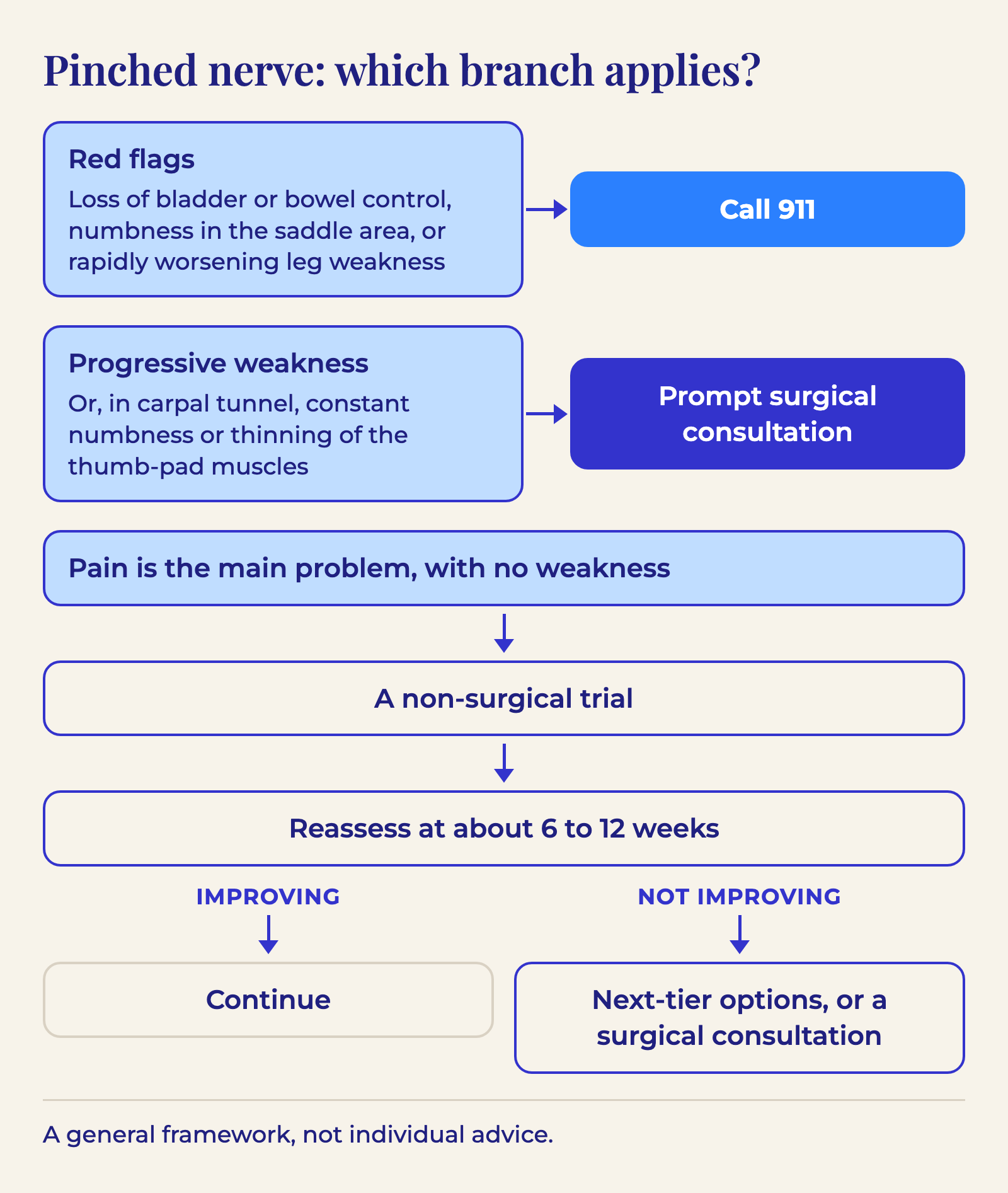
Surgery for a compressed nerve is sometimes necessary, sometimes uncertain, and sometimes not the best choice. In fact, the deciding factor is rarely how much it hurts. Instead, it is whether the nerve is losing function, and how long you have already waited. If you are already months in, here is the short version. Once sciatica has lasted more than about 4 months without improving, surgery is a strong option rather than a last resort: one randomized trial, described below, found it clearly better for leg pain at 6 months. Choosing surgery for faster relief, after an informed discussion, is as reasonable as choosing to wait. The three branches below, and the trials behind them, are the detail.
A general framework, not individual advice.
Red flags: urgent surgical evaluation today
Loss of bladder or bowel control, numbness in the saddle area (the parts of you that would touch a saddle), or rapidly worsening leg weakness can signal cauda equina syndrome. In that condition, the bundle of nerve roots at the bottom of the spinal canal is compressed. It is treated as an absolute surgical emergency, with decompression within 24 to 48 hours. The early warning signs are listed under “When to seek care” below. This is the “call 911” branch, not the “book a consultation” branch.
Progressive weakness: a surgical consultation within days
Progressive muscle weakness from the compressed nerve moves you out of the wait-and-see group. The same 2024 review advises offering surgery within about 3 days where possible when the weakness is severe. Across the studies it reviewed, between a third and three quarters of people (33% to 75%) recovered their strength, depending on how severe the weakness was and on how and when it was treated. In addition, more severe and longer-lasting weakness was linked to less complete recovery. Carpal tunnel with constant numbness or thinning of the thumb-pad muscles (thenar wasting) is the hand’s version. AAOS OrthoInfo notes surgery may be recommended in these long-standing cases to prevent irreversible damage. A clinical review in American Family Physician advises offering surgery for severe carpal tunnel, or when 4 to 6 months of conservative care has not helped.
Pain only, no weakness: a 6 to 12 week non-surgical trial
When pain is the main problem and strength is intact, a non-surgical trial is the standard path. A systematic review of 12 treatment guidelines found they recommend non-surgical care first, for about 6 to 8 weeks after symptoms begin, unless the nerve is already losing function. The 2024 clinical review puts the common range at 6 to 12 weeks, and the major trials enrolled people only after at least 6 weeks of sciatica. Two details matter. The clock starts when symptoms began, not on the day you first see a doctor. And a “trial” usually means staying active and following a plan, with a set point for reassessment.
What the trials show about trying non-surgical care first
For sciatica, the plain version comes first: in the trials, more than half of the people who started without surgery never had it, and both groups ended up in much the same place by 1 to 5 years. In the Dutch trial, early surgery relieved leg pain faster, but by 1 year disability was the same in both groups. The early advantage was gone by 6 months and stayed gone at the 2-year follow-up, when about 1 in 5 participants overall reported an unsatisfactory result. About 4 in 10 of those assigned to non-surgical care had surgery anyway, most within the first year, rising to nearly half at the 5-year follow-up, when outcomes were still similar. Those who eventually had surgery got there after a longer period of pain.
The larger US Spine Patient Outcomes Research Trial (SPORT) (501 surgical candidates) found the same pattern: faster relief with surgery, and only small differences between the groups as randomized, because so many participants switched. Judged by the treatment people actually received, those who had surgery did better out to 8 years, though that comparison is no longer randomized. Pooling 24 trials, a 2023 BMJ meta-analysis found surgery reduces leg pain more than non-surgical care in the first weeks and months, with the difference shrinking to negligible by 1 year. The certainty of that evidence was low to very low, and adverse events were similar in both groups.
Where surgery clearly won
Where surgery clearly won: in a Canadian trial of 128 adults whose sciatica had already lasted 4 to 12 months, surgery (a microdiscectomy, described below) gave much lower leg pain at 6 months, 2.8 versus 5.2 on a 10-point scale. In addition, about a third of the non-surgical group later had surgery. In a SPORT analysis, symptoms lasting more than 6 months were linked to worse outcomes whether people had surgery or not. Surgery’s extra benefit, though, did not depend on how long symptoms had lasted. Put together: trying non-surgical care for a few months did not cost trial participants their surgical result. However, very long waits may matter.
Surgery for a pinched nerve in the neck or carpal tunnel
For a pinched nerve in the neck, a 2026 pooled analysis of five trials found surgery may give somewhat better arm pain and function than non-surgical care, mainly when a herniated disc is the cause, and called for better trials. For carpal tunnel, a 2024 Cochrane review found surgery probably improves symptoms more often than splinting over the long term, though the overall evidence was limited. The clinical reviews above are firmer when numbness is constant or the thumb muscles are wasting.
What surgery involves, its risks, and recovery
Microdiscectomy removes the fragment of disc pressing on the nerve root through a small incision. Foraminotomy widens the bony opening where the nerve leaves the spine. Carpal tunnel release cuts the ligament that roofs the carpal tunnel to give the median nerve room. These are established operations with their own risks. In a meta-analysis of 42 prospective studies, about 1 in 8 people (12.5%) had some complication after open microdiscectomy. Nerve-root injury occurred in 2.6%, the disc re-herniated in 4.4%, and 7.1% had a repeat operation. Persistent pain is the other risk. As the Dutch trial showed, it happens after surgery as well as without it.
Also, recovery after a microdiscectomy or a carpal tunnel release has its own timeline. Your surgeon is the right person to give it, and it belongs in the same conversation as the odds above.
Example (illustrative composite, not a client): A woman in her 50s has had right-leg sciatica for 9 weeks, worse on long flights. She has done 6 weeks of physical therapy and had one epidural injection that helped for 3 weeks. Her strength and reflexes are normal, and she has no bladder or bowel symptoms. So the evidence supports continuing active non-surgical care and reassessing at about 12 weeks from onset. If she is clearly improving, she continues. Should she be flat or worse, she and her specialist discuss a surgical consultation and the next-tier options together. If instead she were 5 months in and flat, the evidence supports treating surgery as a strong option now, alongside those options. Finally, if at any point she develops foot weakness, the timeline shrinks to days.
How Dr. Preet Patel approaches this
Gramercy Center offers several of the non-surgical treatments described here.
The consultation starts with the question above: which nerve is involved, and does anything about the picture point to surgery now? Dr. Preet Patel reviews your records and imaging before you arrive. In the room, he examines you, often using ultrasound to look at the nerve and the tissue around it, and he explains what he sees in plain language. It is a full diagnostic consultation, not a five-minute triage, and you get as much time as you need. If weakness, bladder or bowel symptoms, or severe compression point to surgery, he says so and refers you to an excellent surgeon from his network.
For pain-dominant cases, he walks through the options above, including how strong the evidence is for each in your condition, and you decide together. Several office-based, ultrasound-guided treatments can often be done in the same visit: peripheral nerve blocks to confirm the source and provide a period of relief, carpal tunnel injections, and platelet-rich plasma around the nerve where he judges your picture supports it. Where the evidence is early, as it is for PRP around a nerve, he says so.
For sciatica, PRP has not been shown to beat a steroid injection, so you and he decide case by case whether a repeat steroid injection, PRP or neither makes sense for you. Epidural steroid injections are also available, and for nerve pain that persists after everything else, including after surgery, so are neuromodulation options such as peripheral nerve stimulation. Some procedures need a separate session or a different setting, and he will tell you if that applies.
What the days after look like
For the office-based injections and nerve blocks above, Dr. Preet Patel sets the expectation that most clients walk out and return to light activity within a day or two, and that some soreness for a few days is normal. Whether a flight or a training session fits inside that window depends on the procedure and on you, so he gives you a specific return-to-activity plan, often coordinated with your trainer or physical therapist. That is Gramercy’s typical experience, not a research finding, and none of it replaces staying active.
Gramercy is an opioid-free practice and does no medication management. For clients who travel, virtual consultations are available wherever you are, with the same review of your records and imaging. If a procedure is recommended, it is performed at the Beverly Hills clinic, with telehealth follow-ups afterward. Because sciatica starts in the low back, our low back pain page covers the conditions behind it.
When to seek care
If you have loss of bladder or bowel control, numbness in the groin or saddle area, sudden or worsening weakness, fever with back pain, pain after a major fall or accident, chest pain, or a sudden, severe headache, call 911 or go to the nearest emergency room right away.
The UK cauda equina pathway adds early warning signs to treat the same way: new difficulty starting or feeling urine flow, new altered sensation around the genitals or anus, and sudden pain in both legs or leg pain that switches sides.
Arrange an evaluation within the week, rather than waiting for a scheduled follow-up, if you notice any of these:
- new or worsening weakness in the leg, foot, arm or hand, which the 2024 review treats as a reason for early surgical assessment
- numbness that has become constant rather than coming and going, especially in the hand, which AAOS OrthoInfo describes as a feature of long-standing carpal tunnel
- pain that is not improving at all after several weeks of active non-surgical care, or that is getting worse, which the same 2024 review lists as a reason to consider surgery early
The bottom line: usually yes, with clear exceptions
Most nerve pain from a compressed nerve is treated without surgery first, and most people with sciatica or a pinched nerve in the neck improve over weeks to months. Surgery is the right answer when the nerve is losing function or red flags appear, and a strong option when a fair trial has not helped, especially once sciatica has passed 4 months. Still uncertain: how long any given injection will help a given person, and how much the newer regenerative and stimulation options add. The next steps are to know your red flags, give non-surgical care a fair and active trial when it is safe to, and reassess with a specialist who will tell you honestly which side of the line you are on.
Schedule a consultation with Dr. Preet Patel. Or call (310) 439-8009.
About the medical reviewer. Dr. Preet Patel is board-certified by the American Board of Anesthesiology and an ACGME fellowship-trained interventional pain management specialist, and the founder of Gramercy Pain & Neuroscience Center in Beverly Hills. With more than 10 years of clinical experience, he specializes in regenerative medicine, including ultrasound-guided treatments such as PRP and bone marrow aspirate, along with minimally invasive spine and nerve procedures, and he is a member of the medical staff at Cedars-Sinai Medical Center. Posts by the Gramercy Editorial Team are reviewed by him for medical accuracy before publication.
Sources
First part of the sources
- Lumbar Disc Herniation: The Significance of Symptom Duration for the Indication for Surgery (Kögl N et al.). Deutsches Ärzteblatt International. 2024. https://pmc.ncbi.nlm.nih.gov/articles/PMC11465477/
- Surgery versus prolonged conservative treatment for sciatica (Peul WC et al.). New England Journal of Medicine. 2007. https://pubmed.ncbi.nlm.nih.gov/17538084/
- Surgery versus Conservative Care for Persistent Sciatica Lasting 4 to 12 Months (Bailey CS et al.). New England Journal of Medicine. 2020. https://pubmed.ncbi.nlm.nih.gov/32187469/
- Surgery versus prolonged conservative treatment for sciatica: 5-year results of a randomised controlled trial (Lequin MB et al.). BMJ Open. 2013. https://pmc.ncbi.nlm.nih.gov/articles/PMC3657649/
- Carpal Tunnel Syndrome. AAOS OrthoInfo (American Academy of Orthopaedic Surgeons). Undated. https://www.orthoinfo.org/en/diseases–conditions/carpal-tunnel-syndrome/
- Cervical Radiculopathy (Pinched Nerve). AAOS OrthoInfo (American Academy of Orthopaedic Surgeons). Undated. https://www.orthoinfo.org/en/diseases–conditions/cervical-radiculopathy-pinched-nerve/
- Peripheral neuropathy (Medical Encyclopedia). NIH MedlinePlus. 2026. https://medlineplus.gov/ency/article/000593.htm
- Prognosis of sciatica and back-related leg pain in primary care: the ATLAS cohort (Konstantinou K et al.). The Spine Journal. 2018. https://pmc.ncbi.nlm.nih.gov/articles/PMC5984249/
- The probability of spontaneous regression of lumbar herniated disc: a systematic review (Chiu CC et al.). Clinical Rehabilitation. 2015. https://pubmed.ncbi.nlm.nih.gov/25009200/
Second part of the sources
- The course and prognostic factors of symptomatic cervical disc herniation with radiculopathy: a systematic review of the literature (Wong JJ et al.). The Spine Journal. 2014. https://pubmed.ncbi.nlm.nih.gov/24614255/
- Local corticosteroid injection versus placebo for carpal tunnel syndrome (Ashworth NL et al.). Cochrane Database of Systematic Reviews. 2023. https://pubmed.ncbi.nlm.nih.gov/36722795/
- AAOS/ASSH Clinical Practice Guideline Summary: Management of Carpal Tunnel Syndrome. Journal of the American Academy of Orthopaedic Surgeons. 2024. https://pmc.ncbi.nlm.nih.gov/articles/PMC11928260/
- Advice to rest in bed versus advice to stay active for acute low-back pain and sciatica (Dahm KT et al.). Cochrane Database of Systematic Reviews. 2010. https://pubmed.ncbi.nlm.nih.gov/20556780/
- Advice to Stay Active or Structured Exercise in the Management of Sciatica: A Systematic Review and Meta-analysis (Fernandez M et al.). Spine. 2015. https://pubmed.ncbi.nlm.nih.gov/26165218/
- Non-steroidal anti-inflammatory drugs for sciatica (Rasmussen-Barr E et al.). Cochrane Database of Systematic Reviews. 2016. https://pubmed.ncbi.nlm.nih.gov/27743405/
- Trial of Pregabalin for Acute and Chronic Sciatica (Mathieson S et al., PRECISE). New England Journal of Medicine. 2017. https://pubmed.ncbi.nlm.nih.gov/28328324/
- Epidural Corticosteroid Injections for Sciatica: An Abridged Cochrane Systematic Review and Meta-Analysis (Oliveira CB et al.). Spine. 2020. https://pubmed.ncbi.nlm.nih.gov/32890301/
- DEPO-MEDROL (methylprednisolone acetate) prescribing information: Serious Neurologic Adverse Reactions with Epidural Administration. NIH DailyMed. Label revised November 2025. https://dailymed.nlm.nih.gov/dailymed/drugInfo.cfm?setid=9a7b3837-e038-48bf-97e9-78ad463760dc
Third part of the sources
- The diagnostic utility and cost-effectiveness of selective nerve root blocks in patients considered for lumbar decompression surgery: a systematic review and economic model (Beynon R et al.). Health Technology Assessment (NIHR). 2013. https://pubmed.ncbi.nlm.nih.gov/23673151/
- Is platelet-rich plasma better than steroids as epidural drug of choice in lumbar disc disease with radiculopathy? Meta-analysis of randomized controlled trials (Muthu S et al.). Experimental Biology and Medicine. 2025. https://pmc.ncbi.nlm.nih.gov/articles/PMC11832311/
- Effectiveness of Platelet-Rich Plasma for Patients With Carpal Tunnel Syndrome: A Systematic Review and meta-Analysis of Current Evidence in Randomized Controlled Trials (Jiang J et al.). Frontiers in Pharmacology. 2022. https://pmc.ncbi.nlm.nih.gov/articles/PMC9092282/
- Peripheral Nerve Stimulation for Chronic Neuropathic Pain: A Health Technology Assessment. Ontario Health Technology Assessment Series. 2024. https://pubmed.ncbi.nlm.nih.gov/39886278/
- Spinal cord stimulation for low back pain (Traeger AC et al.). Cochrane Database of Systematic Reviews. 2023. https://pubmed.ncbi.nlm.nih.gov/36878313/
- Pulsed radiofrequency of lumbar dorsal root ganglion for lumbar radicular pain: A systematic review and meta-analysis (Park D et al.). Pain Practice. 2024. https://pubmed.ncbi.nlm.nih.gov/38294072/
- Implanted spinal neuromodulation interventions for chronic pain in adults (O’Connell NE et al.). Cochrane Database of Systematic Reviews. 2021. https://pubmed.ncbi.nlm.nih.gov/34854473/
- Carpal Tunnel Syndrome: Diagnosis and Management (Wipperman J, Goerl K). American Family Physician. 2016. https://pubmed.ncbi.nlm.nih.gov/28075090/
- A Systematic Review of Treatment Guidelines for Lumbar Disc Herniation (Jin H et al.). Neurospine. 2025. https://www.e-neurospine.org/journal/view.php?number=1714
Fourth part of the sources
- Prolonged conservative care versus early surgery in patients with sciatica caused by lumbar disc herniation: two year results of a randomised controlled trial (Peul WC et al.). BMJ. 2008. https://pubmed.ncbi.nlm.nih.gov/18502911/
- Surgical vs nonoperative treatment for lumbar disk herniation: the Spine Patient Outcomes Research Trial (SPORT): a randomized trial (Weinstein JN et al.). JAMA. 2006. https://pubmed.ncbi.nlm.nih.gov/17119140/
- Surgical versus nonoperative treatment for lumbar disc herniation: eight-year results for the Spine Patient Outcomes Research Trial (Lurie JD et al.). Spine. 2014. https://pubmed.ncbi.nlm.nih.gov/24153171/
- Surgical versus non-surgical treatment for sciatica: systematic review and meta-analysis of randomised controlled trials (Liu C, Ferreira GE et al.). BMJ. 2023. https://pubmed.ncbi.nlm.nih.gov/37076169/
- Duration of symptoms resulting from lumbar disc herniation: effect on treatment outcomes: analysis of the Spine Patient Outcomes Research Trial (Rihn JA et al.). Journal of Bone and Joint Surgery (American). 2011. https://pubmed.ncbi.nlm.nih.gov/22012528/
- Nonsurgical versus surgical treatment for cervical radiculopathy: a systematic review and meta-analysis of randomized controlled trials. European Journal of Orthopaedic Surgery & Traumatology. 2026. https://pubmed.ncbi.nlm.nih.gov/42029974/
- Surgical versus non-surgical treatment for carpal tunnel syndrome. Cochrane Database of Systematic Reviews. 2024. https://pubmed.ncbi.nlm.nih.gov/38189479/
- Lumbar microdiscectomy complication rates: a systematic review and meta-analysis (Shriver MF et al.). Neurosurgical Focus. 2015. https://pubmed.ncbi.nlm.nih.gov/26424346/
- The National Suspected Cauda Equina Syndrome Pathway: implications for physiotherapists. Chartered Society of Physiotherapy. 2024. https://www.csp.org.uk/journal/article/physiotherapy-journal-march-2024/national-suspected-cauda-equina-syndrome-pathway
This content is for general education only and is not medical advice. It does not create a doctor-patient relationship. Treatment decisions should be made with a qualified physician after an individual evaluation. Results vary, and not everyone is a candidate for every treatment.