
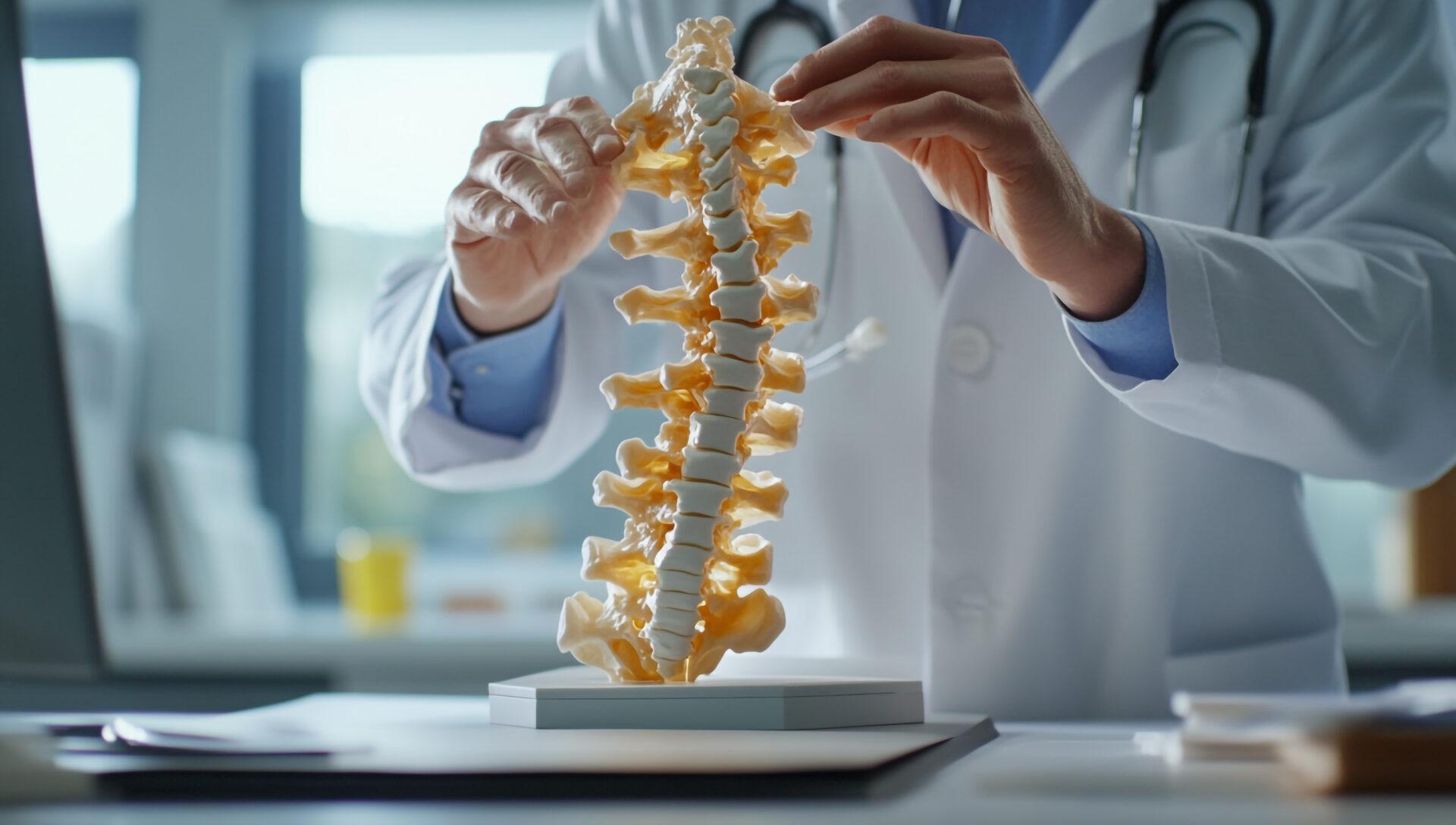
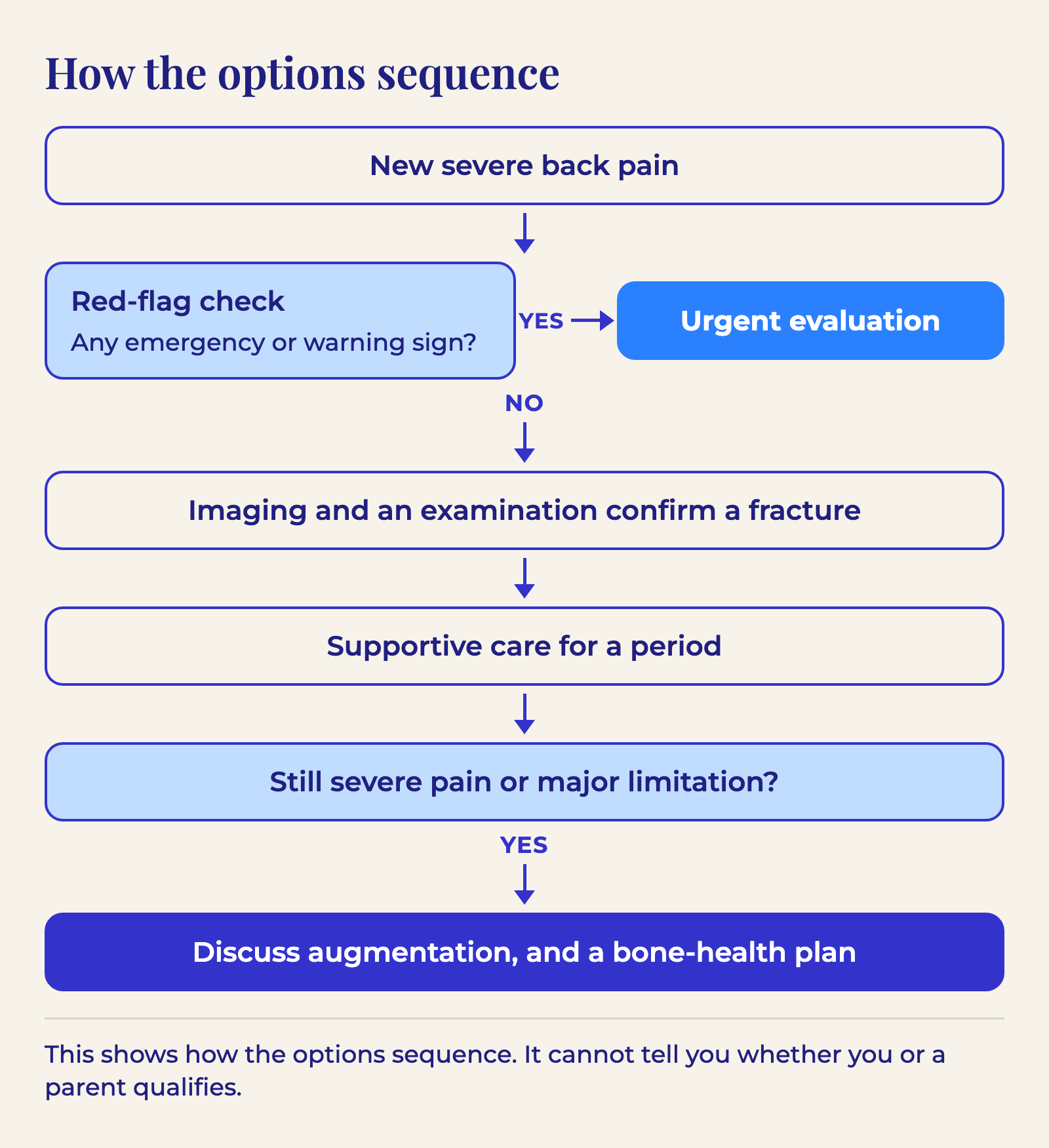
A painful spinal compression fracture usually has more than one reasonable option, and the right one depends on the person. In fact, many heal with time and supportive care. The American Academy of Orthopaedic Surgeons says most people feel better within 3 months without surgery, though about a third still have pain beyond 6 months.
The good news is that pressure on the spinal cord from these fractures is rare, according to MedlinePlus.
Vertebral augmentation, a minimally invasive procedure that injects bone cement into the broken bone, is one option for some people whose pain is severe or does not settle. Experts dispute whether it works better than a sham procedure, or than good care without it.
Disclosure: Gramercy Center offers vertebral augmentation. This article covers the main options, and it notes funding where reported.
Key takeaways
- Many compression fractures improve over weeks to months without a procedure.
- Vertebral augmentation is one option. Sham-controlled trials, usual-care trials and guidelines disagree.
- Treating the fracture does not treat the bone loss behind it. Raise that with your own or your parent’s physician.
- Some symptoms need urgent care. See “When to seek care.”
What is a vertebral compression fracture, and what causes it?
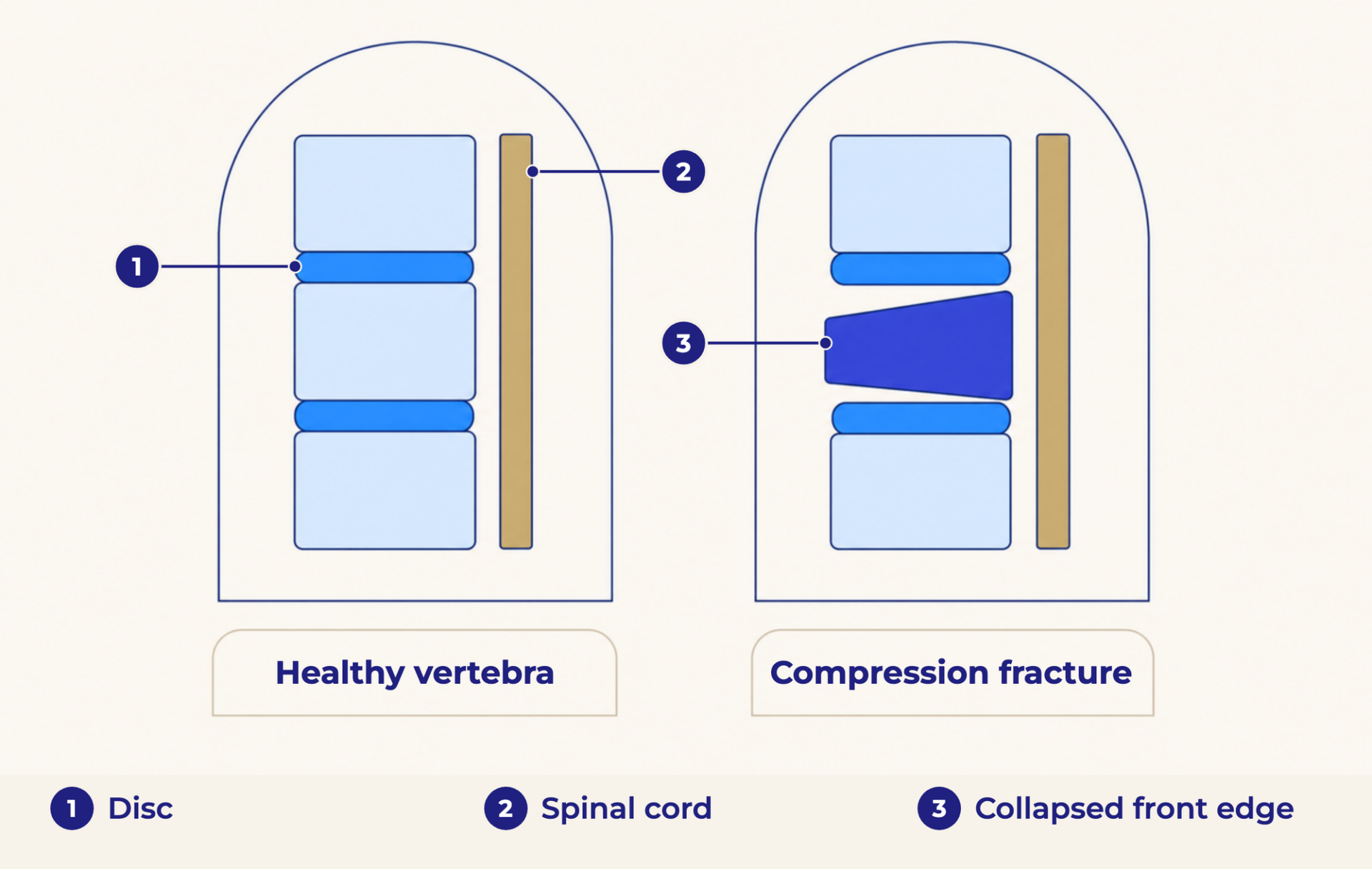
A vertebra is one of the bones that stack to form the spine. In a compression fracture, the front of a vertebra collapses, often into a wedge shape. MedlinePlus says osteoporosis (thinning of the bones) is the most common cause. Less often the cause is a back injury or a tumor.
Some fractures cause no symptoms at first and turn up on an X-ray taken for another reason. In contrast, others bring sudden, sharp mid or lower back pain that can take weeks to months to resolve. Either way, only imaging and a physician’s examination can confirm a fracture. An MRI can show whether it is recent, because OrthoInfo notes a new fracture looks brighter on MRI.
This article covers fractures from osteoporosis. However, doctors manage fractures from cancer or major trauma differently, and they need prompt medical attention.
What happens during vertebral augmentation?
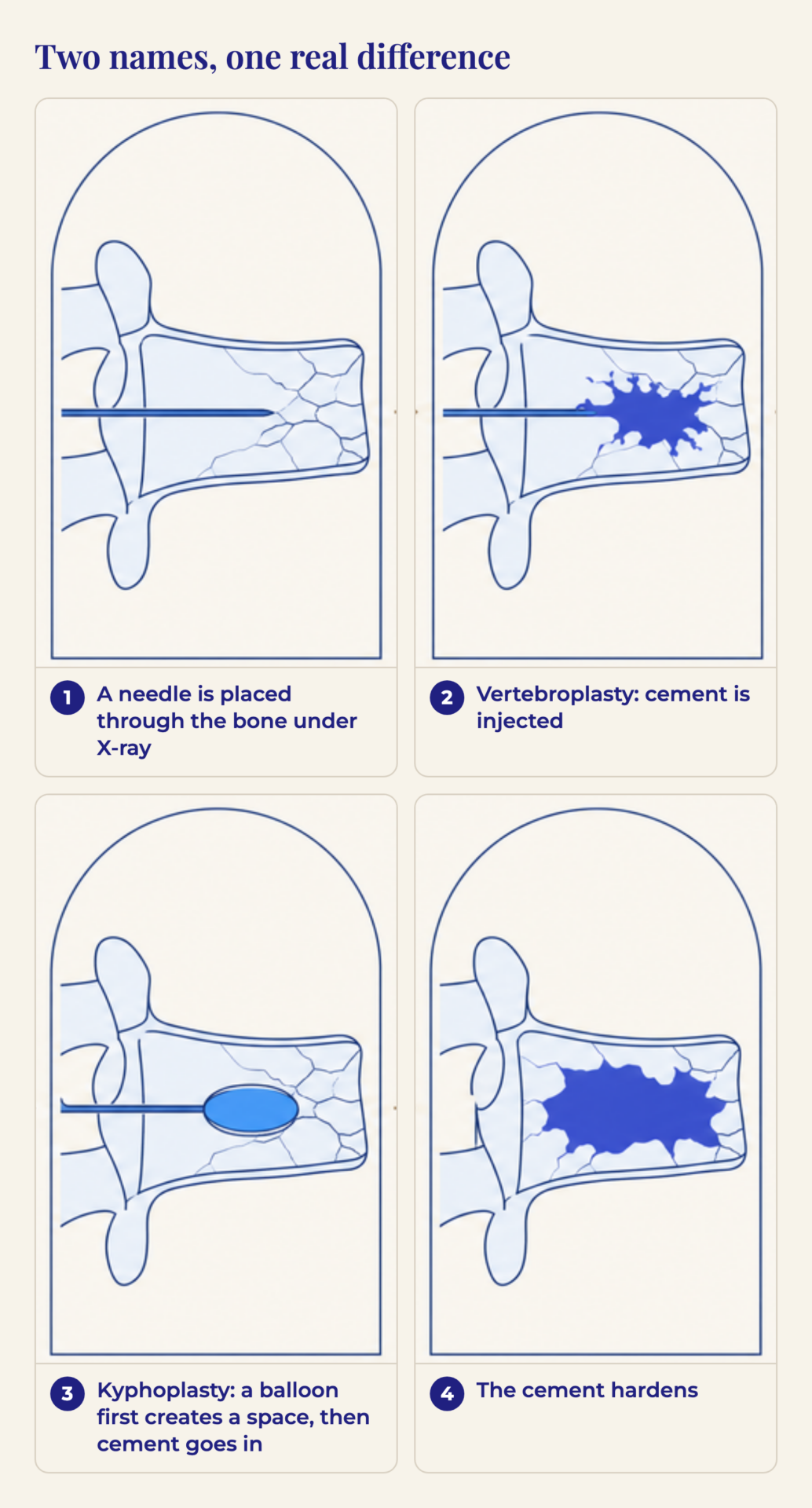
Vertebral augmentation is a broad term that includes two main procedures. In vertebroplasty, a doctor injects bone cement directly into the fractured vertebra. In kyphoplasty, a balloon first creates a cavity, and then the cement goes in. RadiologyInfo describes the steps. Its publishers are the Radiological Society of North America and the American College of Radiology.
- Your doctor evaluates you beforehand, which may include an exam and imaging.
- You lie face down. The skin is numbed with local anesthetic, usually with sedation through an IV. Some people need general anesthesia.
- A hollow needle is guided through the back muscles into the bone under live X-ray (fluoroscopy).
- Cement is injected (after the balloon, in kyphoplasty) and hardens in about 20 minutes.
- You are monitored briefly. There is a bandage and no stitches. Many people go home the same day, and some are admitted.
The procedure takes about an hour, longer for more than one vertebra. In plain terms for recovery, RadiologyInfo says relief may come right away or within about two days, you may walk about an hour afterward, and you should avoid heavy lifting and strenuous activity for at least six weeks. However, this is a published description, not a promise about any one practice.
What are the options for a painful compression fracture, and where does each fit?
Time and supportive care. The NASS 2024 guideline (from the North American Spine Society) says pain typically improves over 3 months to 1 year. Roughly a third of people (range 10% to 40%) still have pain above 3 out of 10 beyond 6 months. Supportive care can include exercise and pain relief from your own physician, who manages those medicines. Evidence for specific measures is thin. For example, a 2019 ASBMR task force (from the American Society for Bone and Mineral Research) found that exercise may improve mobility and reduce pain and fear of falling. NASS says a brace may be considered, but no specific brace is supported.
Vertebral augmentation. It aims at pain from the fracture. The studies disagree (next section), and it carries its own risks.
Surgery. Surgeons generally reserve open surgery, such as fusion or decompression, for unstable fractures, nerve or spinal cord compromise, or significant deformity, according to StatPearls. Still, for some people it is the right answer.
Treating the bone disease. This goes alongside any option above, not in place of it.
Does vertebral augmentation actually work?
The short answer: the studies disagree
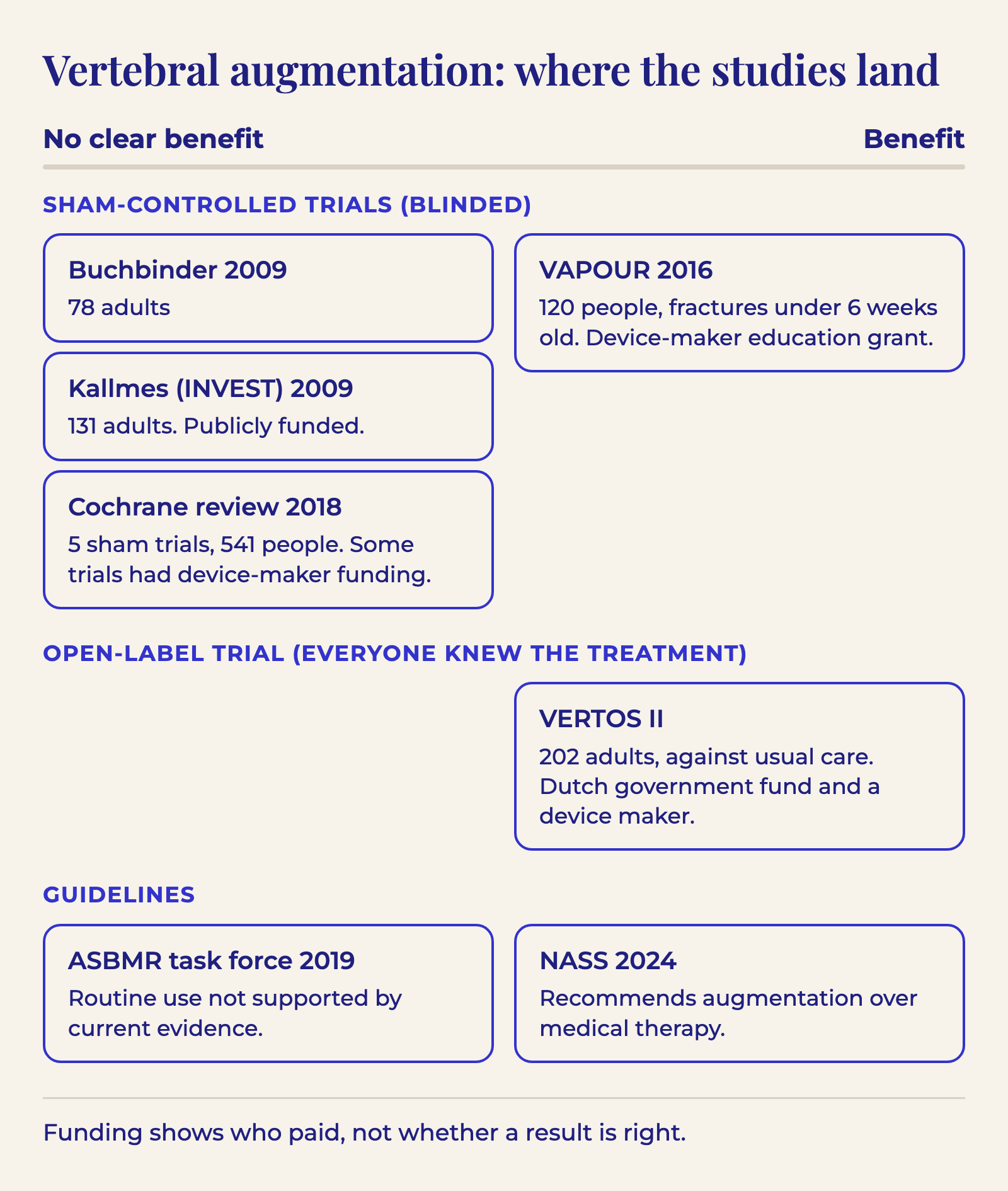
In the best-controlled trials, vertebroplasty did not relieve pain more than a sham procedure. However, some trials against usual care (the standard care without the procedure) found more benefit. In those, everyone knew which treatment they got, which can raise expectations, and some had device-maker support. Funding shows who paid, not whether a result is right, and it cuts both ways. Guidelines also split.
Trials with a sham procedure
In these trials, people were assigned at random (randomization) to the real procedure or a sham, which has the setup but no cement, and nobody knew which they had. Two 2009 trials, Buchbinder et al. (78 adults) and Kallmes et al. (131 adults), found no significant pain benefit from vertebroplasty over sham. The Kallmes trial, called INVEST, had public funding.
A 2018 Cochrane review is a meta-analysis, meaning it pools many trials. It pooled 5 sham-controlled trials (541 people). Its authors rated the evidence high certainty, meaning they are very confident, that vertebroplasty gives no clinically important pain benefit over sham at 1 month. In addition, its authors include investigators of the 2009 trials, and eight of the trials it reviewed had some device-maker funding.
A sham trial that found a benefit
VAPOUR, a 2016 trial of 120 people with severe pain and fractures under 6 weeks old, instead pointed the other way. At 2 weeks, 24 people had pain below 4 out of 10 after vertebroplasty, against 12 after sham, and its authors concluded vertebroplasty was better than placebo. A device maker supported it with an education grant.
Trials against usual care
In an open-label trial, everyone knows which treatment they received. VERTOS II, an open-label trial of 202 adults with recent painful fractures, found vertebroplasty relieved more pain than usual care at 1 month and at 1 year. About half of the eligible people improved on their own before enrolling and were not included. A Dutch government fund and a device maker supported it.
Guidelines point in different directions, from different dates
The ASBMR task force (2019) concluded that current evidence does not support routine use of vertebral augmentation. In contrast, NASS (2024, literature search ending in 2020) recommends augmentation over medical therapy, its top grade.
In addition, none of the sources we reviewed shows that augmentation restores bone strength or treats osteoporosis, and NASS found that correcting vertebral height does not add significant pain relief.
What are the risks, and who is it not for?
The procedure may not relieve your pain. In addition, cement leakage is the most discussed risk. The Ontario Health assessment found leakage in 4% to 39% of treated people, depending on the comparison, and most was without symptoms. RadiologyInfo says leaks are usually harmless unless they reach the spinal canal or lung blood vessels. It lists infection needing antibiotics (fewer than 1 in 1,000), bleeding, increased back pain, numbness or tingling and allergic reactions, and calls paralysis extremely rare.
The Cochrane review also named rare serious events in trials, in small numbers: bone infection, spinal cord compression, injury to the sac around the spinal nerves and respiratory failure. It found no clear difference in new fractures or serious adverse events, though it called the evidence too uncertain to conclude. Serious complications appear uncommon, but none of the sources we reviewed gives a reliable rate for symptomatic leakage, bleeding or nerve injury, so we will not guess one. Whether augmentation raises the risk of fractures in neighboring vertebrae is unsettled; NASS rates the evidence conflicting.
Not everyone is a candidate. StatPearls lists conditions that generally rule it out, including active infection, an uncorrected bleeding disorder, an unstable or burst fracture, a fracture pressing on the spinal cord or nerves, severe heart or lung disease, and allergy to the cement or X-ray dye. For an older adult, sedation or general anesthesia is also a real question to raise with the physician.
Does treating the fracture also treat the osteoporosis?
No. Augmentation addresses a fracture, not the bone loss behind it. In a 2001 pooled analysis of untreated postmenopausal women, a new vertebral fracture was linked to a higher chance of another within a year. However, those data are older. The ASBMR task force reports that osteoporosis medicines reduce later vertebral fractures by 40% to 70%.
Bone-density testing and any bone medicine are decisions for your own or your parent’s physician, and Gramercy does no medication management. “Who is looking after the bone health?” is a good question for that doctor.
Who might be considered for vertebral augmentation, and what should you ask?
Reference texts and trials describe factors such as severe pain from a recent fracture, an MRI showing the fracture is active, pain that matches the fracture’s level, and pain not controlled by other care, as StatPearls notes. Experts also debate timing. NASS associates delayed treatment with worse outcomes, while Cochrane found no difference in effect between pain of 6 weeks or less and longer. This describes factors. It cannot tell you whether you or a parent qualifies.
Example (illustrative only, not a real client): a 78-year-old has sudden mid-back pain and an MRI shows a recent fracture at that level. Whether a procedure comes up depends on how severe the pain stays and how it responds to other care. The scan alone does not decide it.
Questions to ask any physician:
- Is the fracture recent, and does the scan match the pain?
- Does the scan alone mean a procedure is needed, or is there time to try other care first?
- What else could be causing this?
- What do you expect the procedure to do, and what is the evidence?
- What are the risks for me or my parent, including sedation or anesthesia given age, health history and other medicines?
- What does recovery look like, and when can everyday activity resume?
- What happens if we wait?
- Who is checking the bone health?
How Dr. Preet Patel approaches this
Gramercy Center offers vertebral augmentation, one of its minimally invasive spine treatments. Dr. Preet Patel is board-certified by the American Board of Anesthesiology and an ACGME fellowship-trained interventional pain management specialist.
Every client begins with a full diagnostic consultation. Dr. Preet Patel reviews records and imaging before you arrive, examines you and explains your options in plain language. He tells clients honestly whether they are a candidate. When surgery is the better choice, he refers them to an excellent surgeon. A client may bring one support person, such as an adult child. Virtual consultations are available to clients anywhere, and he performs any procedure at the Beverly Hills clinic. Gramercy does no medication management, so medicines and bone-health care stay with your own physician.
When to seek care
If you have loss of bladder or bowel control, numbness in the groin or saddle area, sudden or worsening weakness, fever with back pain, pain after a major fall or accident, chest pain, or a sudden, severe headache, call 911 or go to the nearest emergency room right away.
Contact a physician promptly for:
- back pain that you or your parent think may be a compression fracture, which MedlinePlus says to raise with your provider
- back pain with a history of cancer, unexplained weight loss, or pain that wakes you at night or is worse lying down, which MedlinePlus lists as reasons to contact your provider right away
What should you take away, and what are the next steps?
Many compression fractures heal with time, and augmentation is one option whose benefit is still unresolved. So take the questions above to the treating physician, and ask who owns the bone-health plan.
Schedule a consultation with Dr. Preet Patel. You can also call (310) 439-8009.
Sources
First part of the sources
- Osteoporosis and Spinal Fractures (patient information). OrthoInfo, American Academy of Orthopaedic Surgeons. Review date not shown. https://www.orthoinfo.org/en/diseases–conditions/osteoporosis-and-spinal-fractures/
- Diagnosis and Treatment of Adults with Osteoporotic Vertebral Fractures: summary of questions and recommendations. North American Spine Society. September 24, 2024. https://north-american-spine-society.foleon.com/ebooks-research/osteoporotic-vertebral-fractures-clinical-guidelines/summary-of-questions-recommendations
- Compression fractures of the back. MedlinePlus Medical Encyclopedia, NIH National Library of Medicine. Reviewed September 2, 2025. https://medlineplus.gov/ency/article/000443.htm
- Vertebroplasty and Kyphoplasty (patient information). RadiologyInfo.org, RSNA and ACR. Last reviewed June 1, 2026. https://www.radiologyinfo.org/en/info/vertebro
- The Efficacy and Safety of Vertebral Augmentation: A Second ASBMR Task Force Report (Ebeling et al.). J Bone Miner Res. 2019. https://pubmed.ncbi.nlm.nih.gov/30677181/
- Vertebral Compression Fractures. StatPearls, NCBI Bookshelf. Updated May 4, 2025. https://www.ncbi.nlm.nih.gov/sites/books/n/statpearls/article-19800/
- A randomized trial of vertebroplasty for painful osteoporotic vertebral fractures (Buchbinder et al.). N Engl J Med. 2009. https://pubmed.ncbi.nlm.nih.gov/19657121/
- A randomized trial of vertebroplasty for osteoporotic spinal fractures (Kallmes et al., INVEST). N Engl J Med. 2009. https://pubmed.ncbi.nlm.nih.gov/19657122/
Second part of the sources
- Percutaneous vertebroplasty for osteoporotic vertebral compression fracture (Buchbinder et al.). Cochrane Database of Systematic Reviews. 2018. https://pmc.ncbi.nlm.nih.gov/articles/PMC6494647
- Safety and efficacy of vertebroplasty for acute painful osteoporotic fractures (VAPOUR). Lancet. 2016. https://pubmed.ncbi.nlm.nih.gov/27544377/
- Vertebroplasty versus conservative treatment in acute osteoporotic vertebral compression fractures (Vertos II). Lancet. 2010. https://pubmed.ncbi.nlm.nih.gov/20701962/
- Percutaneous Vertebroplasty and Balloon Kyphoplasty for Painful Osteoporotic Vertebral Compression Fractures: A Health Technology Assessment. Ontario Health (Quality). August 7, 2025. https://pubmed.ncbi.nlm.nih.gov/40950842/
- Percutaneous Vertebroplasty and Kyphoplasty. StatPearls, NCBI Bookshelf. Updated April 6, 2025. https://www.ncbi.nlm.nih.gov/sites/books/NBK525963/
- Risk of new vertebral fracture in the year following a fracture (Lindsay et al.). JAMA. 2001. https://pubmed.ncbi.nlm.nih.gov/11176842/
- Low back pain – acute. MedlinePlus Medical Encyclopedia, NIH National Library of Medicine. Reviewed June 27, 2026. https://medlineplus.gov/ency/article/007425.htm
This content is for general education only and is not medical advice. It does not create a doctor-patient relationship. Treatment decisions should be made with a qualified physician after an individual evaluation. Results vary, and not everyone is a candidate for every treatment.