
Platelet-rich plasma (PRP) and bone marrow aspirate are autologous treatments, made from your own blood or bone marrow and returned to you. The research on them is mixed to early, and it differs by condition.
In a 288-person placebo-controlled knee trial, PRP did not beat saline for pain at 12 months. Several tendon trials were small or negative. Results vary.
If cortisone has stopped helping, or a surgeon has suggested a knee replacement, it is reasonable to ask what else is credible. If your goal is to keep golfing, traveling or training, this guide shows the known and the unknown about these options.
Where the knee evidence stops. The knee trials we verified enrolled people with mild-to-moderate osteoarthritis. We found no verified evidence for severe disease. This article does not tell you whether these treatments help if a surgeon says you need a replacement. Your imaging and an examination at a consultation are how a knee is judged mild, moderate or severe. For the replacement question, ask your surgeon and Dr. Preet Patel.
Disclosure: Gramercy Center offers PRP and bone marrow aspirate.
Key takeaways
- PRP and bone marrow aspirate are made from your own blood or bone marrow.
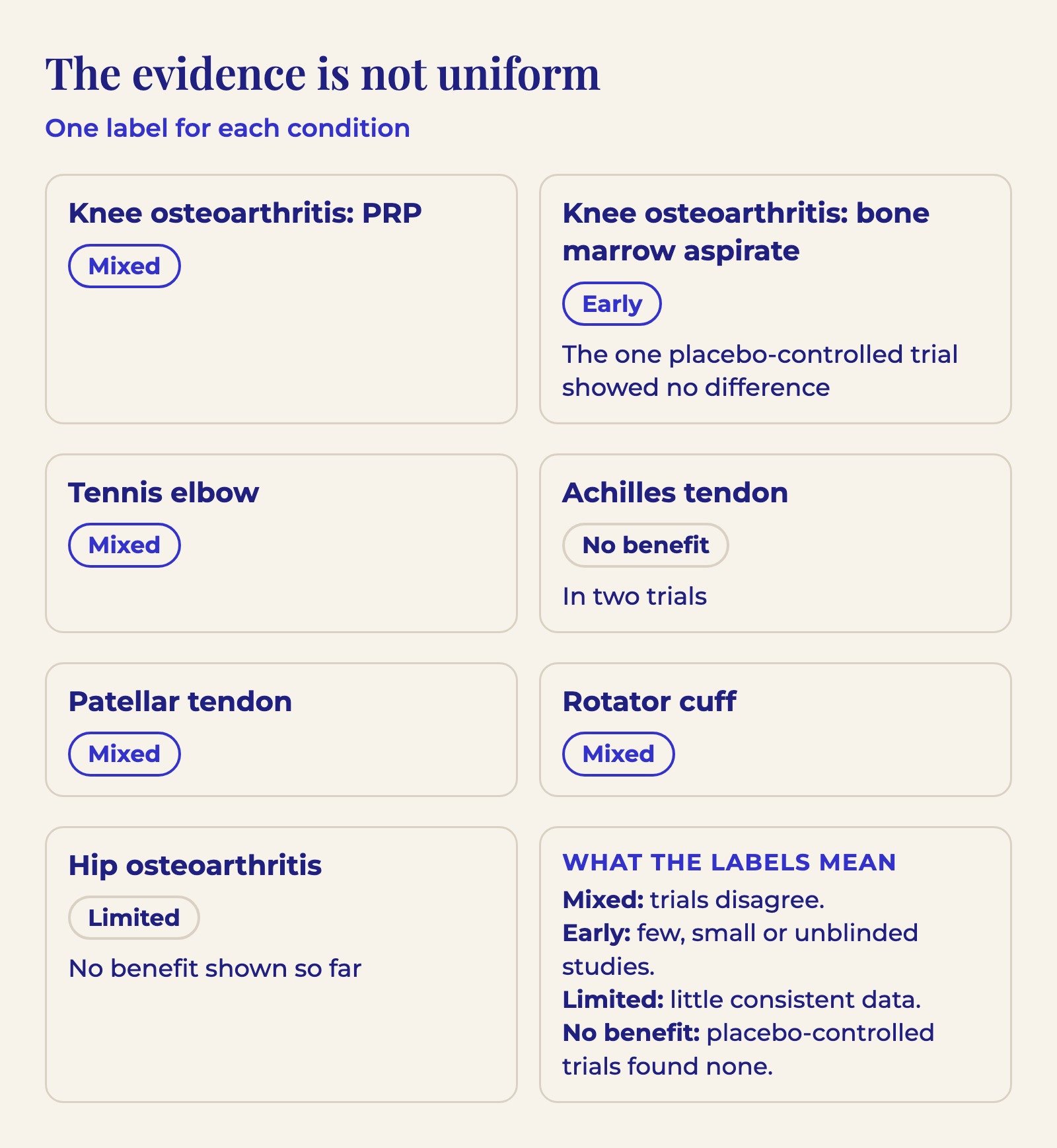
- The evidence is condition-specific: mixed for knee PRP, early for knee bone marrow aspirate (its one placebo-controlled trial showed no difference), limited for the hip (no benefit shown so far), and no benefit in two Achilles tendon trials.
- Trials reported mostly mild, short-lived pain and swelling, and not everyone is a candidate.
- Ask which trials apply to your joint and how advanced your condition is.
In this guide: What they are · The research · Comparisons · Risks · Regulation · Insurance · Our approach · Care
What does “autologous” mean, and what are PRP and bone marrow aspirate?
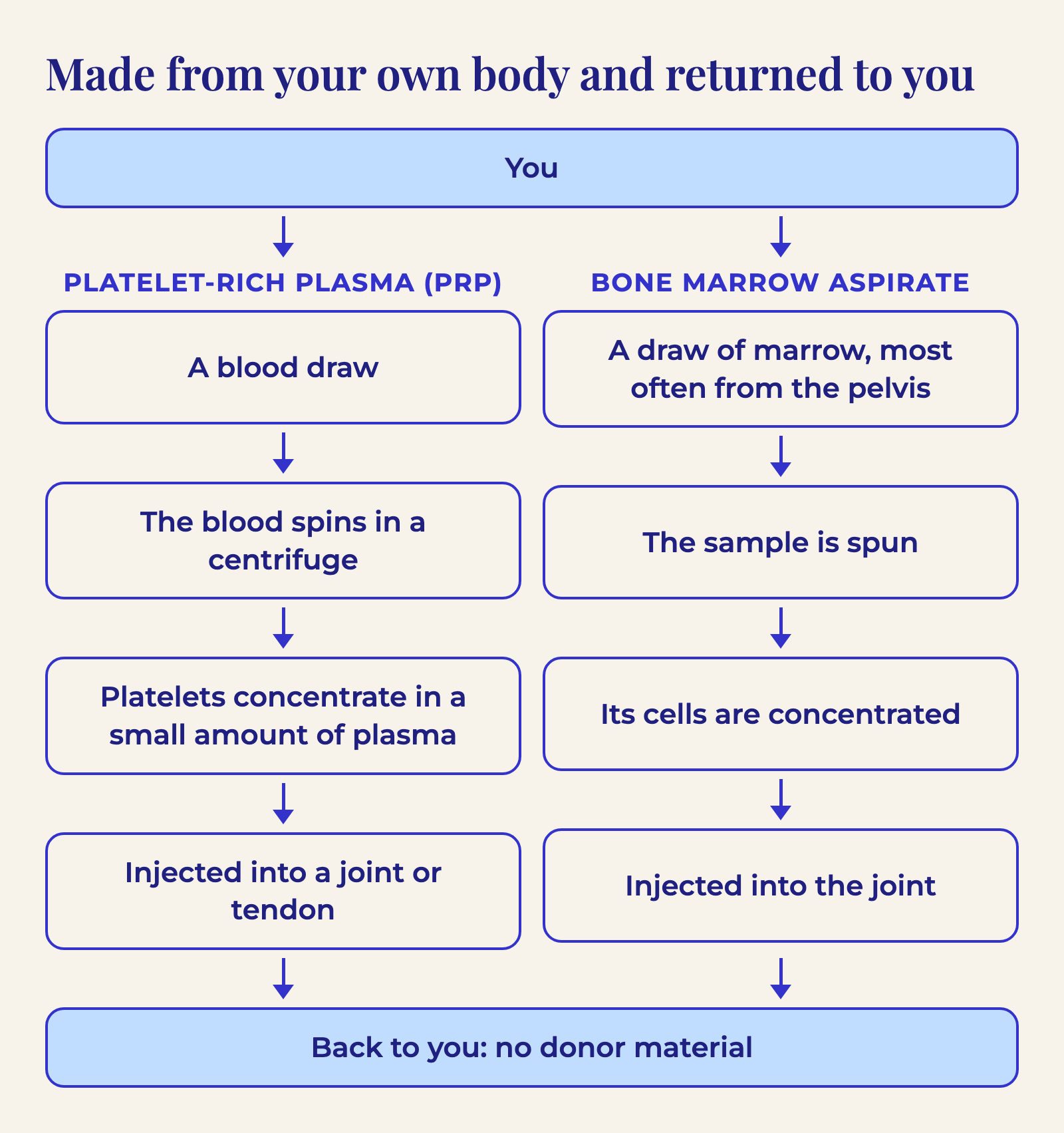
“Autologous” means taken from you, processed, and returned to you. So it involves no donor material.
PRP starts with a blood draw. The blood spins in a centrifuge (a machine that separates its parts) so that platelets concentrate in a small amount of plasma. The physician then injects the result into a joint or tendon. PRP preparations differ and are often described as leukocyte-rich or leukocyte-poor, meaning more or fewer white blood cells.
Bone marrow aspirate concentrate, in contrast, starts with a draw of marrow, most often from the pelvis (the iliac crest). Spinning the sample then concentrates its cells. It contains nucleated cells (cells that have a nucleus), including stem and progenitor cells, though these are a very small fraction of the total. It also has fewer platelets and more white cells than PRP. The same review says no one fully understands how it works.
How do PRP and bone marrow aspirate differ? PRP concentrates platelets from blood. In contrast, bone marrow aspirate concentrate comes from marrow and has more white cells and fewer platelets. One 90-person trial found them similar at 12 months, but it had no placebo group, so we cannot say one is better.
What does the research show, condition by condition?
Evidence for one condition says nothing about another, so each gets its own label:
- Mixed: trials disagree.
- Early: few, small or unblinded studies. It does not mean studies have shown a benefit.
- Limited: little consistent data, and no clear benefit shown so far.
- No benefit: placebo-controlled trials found none.
A few terms. A “placebo” is a look-alike injection, usually saline. A “noticeable difference” (researchers call it a minimal clinically important difference) is a change big enough for a person to feel. Finally, a meta-analysis pools the results of several studies.
Knee osteoarthritis, PRP: mixed
A large, placebo-controlled trial found no benefit over saline for knee pain at 12 months, and the more favorable reviews are mostly low quality. Specifically, the trial, RESTORE, enrolled 288 adults aged 50 and older with mild-to-moderate knee osteoarthritis. Three PRP injections did not beat saline for pain or cartilage volume (how much cartilage is present).
On the other side, an overview of 29 reviews found many reviews of PRP versus other injections (mainly hyaluronic acid, a lubricant-type injection) favored PRP, but 26 of the 29 were rated critically low quality. A 2026 network meta-analysis (a study that compares several treatments at once) of 24 trials and 2,960 people with knee osteoarthritis found bone marrow concentrate had a statistically larger pain benefit than hyaluronic acid. However, PRP’s difference was modest or not significant, and none of the differences reached a noticeable change within 12 months. A 2026 guidance statement from an expert panel of the physical medicine and rehabilitation society (AAPM&R), partly based on expert opinion, says robust, dose-dependent randomized trials are still needed.
Knee osteoarthritis, bone marrow aspirate: early; the one placebo-controlled trial showed no difference
In a small trial of 25 adults with arthritis in both knees, one knee got the concentrate and the other saline. Pain improved in both, with no difference between them at 12 months, and MRI showed no significant cartilage change. In addition, the 90-person trial above had no placebo group and had support from a device company.
Tendons, condition by condition
- Tennis elbow: mixed. In a trial of 60 adults, PRP did not beat saline at three months, and cortisone reduced pain more than PRP at one month. A 2026 meta-analysis of four trials found no clear difference between PRP and the person’s own whole blood.
- Achilles tendon: no benefit. A 2010 trial of 54 adults (24 weeks) and a 2021 trial of 240 adults (6 months) each found PRP no better than a placebo procedure.
- Patellar tendon: mixed. A 2022 meta-analysis of eight studies found no significant difference between PRP and other injections. Across tendons, a 2023 review of 33 trials found no clear differences for most, with low certainty.
- Rotator cuff: mixed. After surgical repair, leukocyte-poor PRP was linked to fewer retears on imaging (about 16% vs 29% in a 2026 meta-analysis). Pain and function improved, but by less than a noticeable amount.
We found no verified trial data for bone marrow aspirate in tendons, so treat that as unproven.
Hip osteoarthritis: limited, no benefit shown so far
A 2026 network meta-analysis of 14 studies of injection treatments, including PRP, found no significant differences from standard care or placebo at 3, 6 or 12 months. In other words, the studies showed no clear benefit, and PRP in the hip has limited evidence.
What the research does not show
An imaging change is not the same as feeling better. Neither RESTORE (PRP) nor the 25-person bone marrow trial found a cartilage benefit on MRI, so we cannot say these treatments rebuild cartilage. In addition, spine, nerve and ligament uses are outside this guide.
How does this compare with cortisone, hyaluronic acid, and surgery?
Exercise and weight management
OARSI lists education and structured exercise, with or without weight management, as core care for knee osteoarthritis. Each option below sits alongside that care, not instead of it.
Cortisone (a steroid)
It targets inflammation. A Cochrane review (Cochrane is an independent group that reviews research) of 27 trials (1,767 people with knee osteoarthritis) found better pain relief at one month, but no evidence the effect lasts to six months, with low certainty. In addition, the 2019 guideline from the American College of Rheumatology (ACR) and Arthritis Foundation strongly recommended cortisone injections for knee osteoarthritis, and the 2021 AAOS guideline lists them for short-term relief. One two-year trial of 140 adults, injected every 12 weeks, found more cartilage thinning on imaging than saline and no pain advantage. That is one trial of frequent dosing, and it does not describe occasional injections.
Hyaluronic acid
The 2019 OARSI guidelines list it as an option for knee osteoarthritis. However, in the 2026 network meta-analysis above, PRP’s difference from it was modest or not significant.
PRP and bone marrow aspirate
Is PRP “just a cortisone shot at a premium price”? In fact, they are different in design. Specifically, cortisone calms inflammation. PRP is designed to support the body’s own repair process, but whether that happens in people is not established. We found no knee head-to-head trial we can cite, so we make no “better than” claim. However, in the tennis elbow trial, cortisone was better at one month. Being a cash-pay practice says nothing about whether an injection works better.
Surgery
For advanced disease, knee replacement is often the appropriate choice. However, a Cochrane review found only one randomized trial (100 adults). Specifically, it compared knee replacement plus a 12-week exercise program with the program alone, at one year. Pain may fall by an amount that offers a real benefit, and serious side effects may be more common, but the evidence is very uncertain. Still, that reflects how few trials exist, not that surgery does not work.
What are the risks, and who may not be a candidate?
PRP. A 2026 safety analysis of 32 PRP trials (1,268 PRP-treated knees) found side effects in 18.7%, about 1 in 5, mostly mild pain and swelling. Leukocyte-rich PRP caused more than hyaluronic acid, and the trials reported no severe events. In addition, bleeding, bruising and infection are possible with any injection.
Bone marrow aspirate. A pooled analysis of six bone marrow aspirate trials (860 people, mostly knees) found complications of any kind in about 41% to 42% of people in both groups, those given bone marrow concentrate and those given comparator injections, over a mean follow-up of about 13 months. Knee swelling was the most common, at about 18% with bone marrow concentrate. These rates come from a different analysis than PRP’s 18.7% and are not directly comparable. Bone marrow aspiration from the pelvis has been described as generally safe, with nerve injury and bleeding recognized concerns. However, we found no reliable rates for the draw itself. The trials we reviewed did not report on age limits, needle discomfort or recovery, so those are questions for Dr. Preet Patel.
Who may not be a candidate. An international expert consensus on PRP, mostly expert opinion, advises against it for active solid cancer and near tumors. It advises investigating blood-count abnormalities first and waiting until a bacterial infection treated with antibiotics is complete. In addition, your physician reviews your medicines individually. Do not change any without asking the physician who prescribed them. Not everyone is a candidate, and neither treatment promises you will avoid surgery.
How are these treatments regulated, and what does that mean for you?
In plain words: both treatments are made from your own body.
Platelet-rich plasma and bone marrow aspirate are autologous therapies, which means they are made from your own body using equipment designed specifically for that purpose. Using them for specific musculoskeletal, spine, joint, and tendon conditions is a physician’s medical decision rather than an FDA-approved indication. Dr. Preet Patel will walk you through this at your initial consultation.
Does insurance cover these treatments?
Gramercy Center is a cash-pay, concierge practice. No prior authorizations, no denied claims, no surprise bills. Just direct access to the treatment you and Dr. Preet Patel decide on.
Dr. Preet Patel is an out-of-network physician. If your plan includes out-of-network benefits, we’re happy to provide a superbill you can submit to your insurer directly for reimbursement. Please note that many treatments, including regenerative options like platelet-rich plasma, are generally not covered by insurers. Many clients use HSA or FSA accounts for eligible medical procedures.
How Dr. Preet Patel approaches this
Both treatments are office-based and ultrasound-guided. Dr. Preet Patel is board-certified by the American Board of Anesthesiology and an ACGME fellowship-trained interventional pain management specialist. Every consultation is with him.
He reviews your records and imaging before you arrive. Then, at the consultation, he examines you, often uses ultrasound in the room, and explains your options in plain language. Part of that conversation is telling you honestly whether you are a good candidate and what the research shows for your condition. If a regenerative treatment suits you, he can often do it the same day. Timing, number of injections and recovery differ by condition, so bring those questions. If you need something outside Gramercy’s scope, such as a surgeon, the team helps arrange it through Dr. Preet Patel’s network of vetted providers. Related pages cover knee pain and shoulder pain.
When to seek care
Seek emergency care for a hot, red, swollen joint with fever and intense pain. A MedlinePlus entry on joint infection warns that delayed treatment may permanently damage the joint. Also seek care if you cannot bear weight after an injury, or have pain after a major fall or accident. After any injection, fever, spreading redness, or severe or rapidly worsening pain or swelling needs prompt attention. In an emergency, call 911 or go to the nearest emergency room.
The answer, the uncertainty, and your next step
Some people choose PRP or bone marrow aspirate for certain conditions after discussing the evidence with a physician. However, they have not been shown to repair or replace a joint, and they are not right for everyone. The evidence is thinnest where long-term and head-to-head data are missing, so the most useful question is what the evidence shows for your condition.
Before a consultation, it helps to gather:
- your imaging and records, and what you have already tried (cortisone, therapy, bracing)
- the condition and joint or tendon you want to ask about, and how advanced it is
- questions: what is known for my condition, what are the alternatives, what are the risks for me, and what to expect for timing, number of injections and recovery
Schedule a consultation with Dr. Preet Patel. You can also call (310) 439-8009.
Sources
First part of the sources
- Effect of Intra-articular Platelet-Rich Plasma vs Placebo Injection on Pain and Medial Tibial Cartilage Volume in Patients With Knee Osteoarthritis: The RESTORE Randomized Clinical Trial. JAMA. 2021. https://pubmed.ncbi.nlm.nih.gov/34812863/
- Current Clinical Recommendations for Use of Platelet-Rich Plasma. Curr Rev Musculoskelet Med. 2018. https://pubmed.ncbi.nlm.nih.gov/30353479/
- A systematic review of the concept and clinical applications of Bone Marrow Aspirate Concentrate in Orthopaedics. SICOT-J. 2017. https://pmc.ncbi.nlm.nih.gov/articles/PMC5966837/
- Bone Marrow Aspirate Concentrate Is Equivalent to Platelet-Rich Plasma for the Treatment of Knee Osteoarthritis at 1 Year: A Prospective, Randomized Trial. Orthop J Sports Med. 2020. https://pubmed.ncbi.nlm.nih.gov/32118081/
- Platelet rich plasma injections for knee osteoarthritis: an overview of systematic reviews. Frontiers in Physiology. 2025. https://pmc.ncbi.nlm.nih.gov/articles/PMC12263938/
- Intra-articular Orthobiologics Show Statistically but Not Clinically Meaningful Improvements Compared With Viscosupplementation in Knee Osteoarthritis: A Network Meta-analysis of RCTs. Arthroscopy. 2026. https://pubmed.ncbi.nlm.nih.gov/42524752/
- AAPM&R guidance statement on platelet rich plasma for knee osteoarthritis. PM&R. 2026. https://pubmed.ncbi.nlm.nih.gov/41989317/
- A Prospective, Single-Blind, Placebo-Controlled Trial of Bone Marrow Aspirate Concentrate for Knee Osteoarthritis. Am J Sports Med. 2017. https://pubmed.ncbi.nlm.nih.gov/27566242/
- Quantitative T2 MRI Mapping and 12-Month Follow-up in a Randomized, Blinded, Placebo Controlled Trial of Bone Marrow Aspiration and Concentration for Osteoarthritis of the Knees. Cartilage. 2019. https://pubmed.ncbi.nlm.nih.gov/30160168/
- Treatment of lateral epicondylitis with platelet-rich plasma, glucocorticoid, or saline. Am J Sports Med. 2013. https://pubmed.ncbi.nlm.nih.gov/23328738/
Second part of the sources
- Plasma versus autologous whole blood in the treatment of lateral epicondylitis: a systematic review and meta-analysis of randomized clinical trials. J Clin Orthop Trauma. 2026. https://pubmed.ncbi.nlm.nih.gov/42499350/
- Platelet-rich plasma injection for chronic Achilles tendinopathy: a randomized controlled trial. JAMA. 2010. https://pubmed.ncbi.nlm.nih.gov/20068208/
- Effect of Platelet-Rich Plasma Injection vs Sham Injection on Tendon Dysfunction in Patients With Chronic Midportion Achilles Tendinopathy. JAMA. 2021. https://pubmed.ncbi.nlm.nih.gov/34255009/
- Platelet-rich plasma injection in the treatment of patellar tendinopathy: a systematic review and meta-analysis. Knee Surg Relat Res. 2022. https://pubmed.ncbi.nlm.nih.gov/35509070/
- Ultrasound-guided injection of platelet-rich plasma for tendinopathies: a systematic review and meta-analysis. Blood Transfus. 2023. https://pubmed.ncbi.nlm.nih.gov/36346880/
- Injection of Leukocyte-Poor Platelet-Rich Plasma During Rotator Cuff Repair Can Increase Healing Rate but Does Not Affect Clinical Outcomes: a systematic review and meta-analysis of randomized controlled trials. Arthroscopy. 2026. https://pubmed.ncbi.nlm.nih.gov/42732080/
- Comparing the Efficacy and Safety of Intra-articular Injection Treatments for Hip Osteoarthritis: A Systematic Review and Network Meta-analysis. Orthop J Sports Med. 2026. https://pubmed.ncbi.nlm.nih.gov/41993104/
- OARSI guidelines for the non-surgical management of knee, hip, and polyarticular osteoarthritis. Osteoarthritis Cartilage. 2019. https://pubmed.ncbi.nlm.nih.gov/31278997/
- Intra-articular corticosteroid for knee osteoarthritis (CD005328). Cochrane Database Syst Rev. 2015. https://www.cochrane.org/CD005328
Third part of the sources
- 2019 ACR/Arthritis Foundation Guideline for the Management of Osteoarthritis of the Hand, Hip, and Knee. Arthritis Rheumatol. 2020. https://pubmed.ncbi.nlm.nih.gov/31908163/
- AAOS updates clinical practice guideline for osteoarthritis of the knee. AAOS. 2021. https://www.aaos.org/aaos-home/newsroom/press-releases/aaos-updates-clinical-practice-guideline-for-osteoarthritis-of-the-knee/
- Effect of Intra-articular Triamcinolone vs Saline on Knee Cartilage Volume and Pain in Patients With Knee Osteoarthritis. JAMA. 2017. https://pubmed.ncbi.nlm.nih.gov/28510679/
- What are the benefits and harms of knee replacement surgery for treating knee osteoarthritis compared to non-surgical treatments? (CD015378). Cochrane. 2026. https://www.cochrane.org/evidence/CD015378_what-are-benefits-and-harms-knee-replacement-surgery-treating-knee-osteoarthritis-compared-non
- Assessment of adverse events and safety associated with intra-articular PRP injections compared to other injectates for knee osteoarthritis. PM&R. 2026. https://pubmed.ncbi.nlm.nih.gov/42101047/
- Complication rates of bone marrow aspirate concentrate injections versus other injectable therapies for knee osteoarthritis: a systematic review and meta-analysis. J Orthop. 2025. https://pubmed.ncbi.nlm.nih.gov/39473874/
- A three-dimensional computed tomography study to determine the ideal method for fluoroscopically-guided bone marrow aspiration from the iliac crest. Bosnian J Basic Med Sci. 2021. https://pmc.ncbi.nlm.nih.gov/articles/PMC8112562
- Indications and contraindications to PRP injections in musculoskeletal diseases in case of infectious, oncological and haematological comorbidities: a 2025 formal consensus from GRIIP. Knee Surg Sports Traumatol Arthrosc. 2025. https://pmc.ncbi.nlm.nih.gov/articles/PMC12104799/
- Septic arthritis. MedlinePlus (NLM/NIH). 2025. https://medlineplus.gov/ency/article/000430.htm
This content is for general education only and is not medical advice. It does not create a doctor-patient relationship. Treatment decisions should be made with a qualified physician after an individual evaluation. Results vary, and not everyone is a candidate for every treatment.