
Do peptides help with inflammation, pain and injury recovery? For the two most often discussed, BPC-157 and TB-500, that is not established yet. Peptides are a broad family, and a few are established medicines, but these two are still at the research stage. A 2026 review of six popular peptides concluded that their claimed musculoskeletal benefits “are not supported by current human trials.” It also found that 67% of the publications it identified used animal models, mostly rats.
If pain is getting in the way of your training and someone you trust has suggested a peptide, it is reasonable to want to know what the research shows. What we know: promising animal findings and a handful of very small human reports. What is uncertain: whether these peptides work in people, what the right use would be, and long-term safety. Gramercy does not prescribe or supply peptides. Instead, Dr. Preet Patel advises and refers out.
Key takeaways
- A peptide is a chemical category, not a treatment. Some peptides are established medicines. The ones popular in wellness and sport are research-stage.
- The evidence for BPC-157 and TB-500 is mostly animal and lab work. Human reports are tiny and uncontrolled, and the one randomized trial we found has no results yet.
- The regulatory picture is unsettled, and “listed” or “discussed” is not “approved.”
- FDA does not treat a “research use only” label as a shield when marketing shows human use, and reviewers warn about contamination, impurities and inaccurate amounts in unregulated injectable peptides. Athletes in tested events face their own rules.
- Other options exist, and you can still discuss peptides with a qualified physician.
In this article
- What are peptides, and why do they come up for inflammation and recovery?
- Which peptides are discussed, and which have established, labeled uses?
- What does the human evidence show, compared with animal and lab studies?
- What can you ask a physician about a peptide product?
- What is the regulatory status, and how reliable are the products?
- What are the safety risks, and what about drug testing in sport?
- What other options exist, and what does the evidence say about each?
- How Dr. Preet Patel approaches peptide questions
- When to seek care
- So do peptides help with inflammation, pain and recovery?
What are peptides, and why do they come up for inflammation and recovery?
A peptide is a short chain of amino acids, typically 2 to 50. Longer chains are polypeptides, and proteins are built from them. “Peptide” describes a chemical type. However, it does not describe a treatment, a safety level or an approval.
Peptides come up for inflammation and healing because of laboratory and animal findings. For example, in a 2025 systematic review of BPC-157 in orthopaedic sports medicine, 35 of the 36 included studies were preclinical (cell and animal work).
Inflammation is also not simply a problem to switch off. A 2022 review describes the inflammatory response as “a cornerstone for effective tissue repair.” So a claim that a product “reduces inflammation” is not the same as a claim that it helps you heal.
Which peptides are discussed, and which have established, labeled uses?
Peptide drugs with labeled uses. Several peptide-class medicines have established uses. Teriparatide, for example, is labeled for osteoporosis in people at high risk of fracture, not for pain or inflammation. Similarly, Ozempic (semaglutide) is labeled for type 2 diabetes. A label for one use does not carry over to another.
Peptides discussed in wellness and sports circles. However, BPC-157 and TB-500 (a laboratory-made fragment of thymosin beta-4) are different. They are research-stage, and the regulatory section below explains what that means.
What does the human evidence show, compared with animal and lab studies?
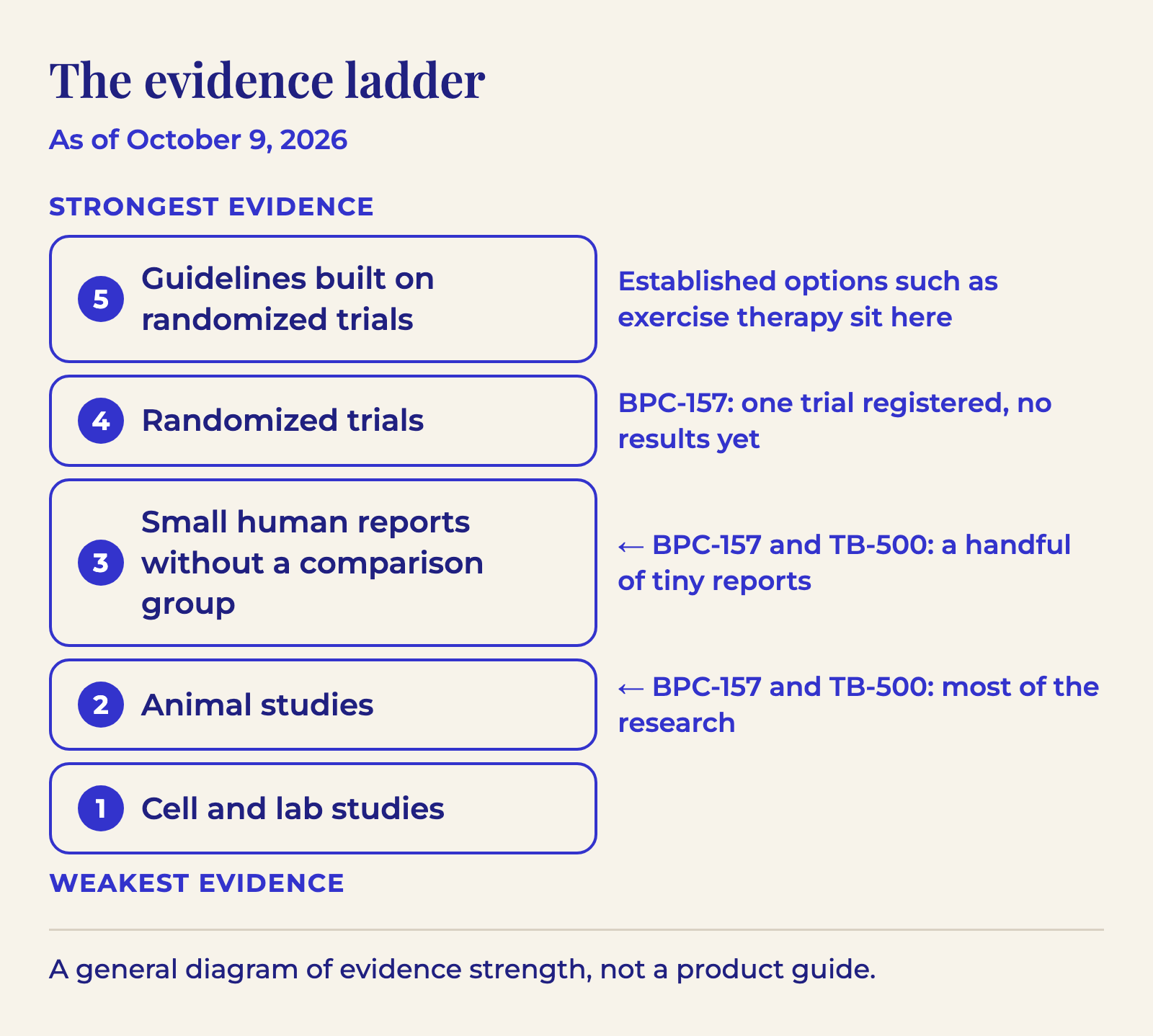
Think of evidence as a ladder: cell and lab studies at the bottom, then animal studies, then small human reports without a comparison group, then randomized trials, then guidelines built on those trials. So far, BPC-157 and TB-500 sit near the bottom.
Animal and lab work
Almost all of the research is in animals. The authors of the 2025 systematic review found “no clinical safety data.” A 2026 review of 12 peptides, including BPC-157 and TB-500, found that many unapproved peptides look favorable in animals while human safety data are scarce. However, promise in animals does not show the same will happen in people.
Human reports
They are small and uncontrolled. The best known is a 2021 case series (a report on a group of people, without a comparison group). It reviewed the charts of 17 people with knee pain at one clinic who received BPC-157 injections into the knee. Of the 16 reached by phone, 14 reported relief. But pain was self-rated, no validated function measure was used, and some people also received thymosin beta-4.
Two other reports are smaller still: an intravenous safety pilot of 2 people for 3 days, and a 2026 review that counted fewer than 30 people across three uncontrolled pilot studies and noted that no approved formulation exists.
A registered controlled trial
An early-stage (phase 2) trial of BPC-157 in acute hamstring strain is randomized and placebo-controlled. In other words, some people get BPC-157 and others an inactive injection, and no one knows who got which. The plan is for about 120 people. In addition, a company sponsors it, it has one site in China, and it is recruiting with no results. Its estimated primary completion is February 2027.
For TB-500, our ClinicalTrials.gov search on October 9, 2026 found no TB-500 or thymosin beta-4 trial in a musculoskeletal or pain condition. Instead, the one TB-500 record we found (NCT07487363) is in cardiovascular biomarkers. A search shows only studies matching its terms, so this is not proof that none exist.
Why the gap matters
Animal studies measure tissue changes and healing in rats. You feel pain, strength and whether you can train. The knee report, for example, relied on self-rated pain by phone.
What can you ask a physician about a peptide product?
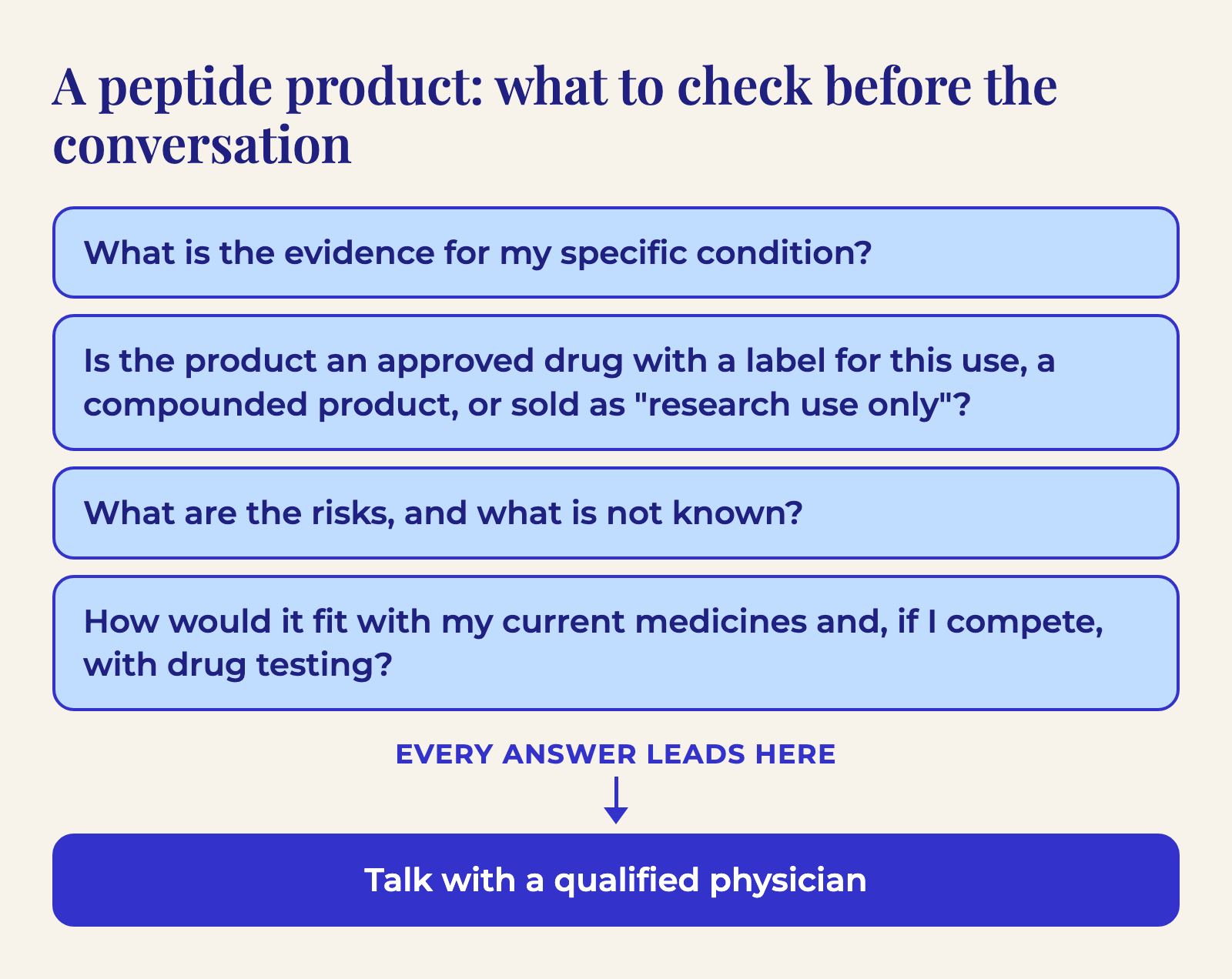
These are general questions to bring to any qualified physician, not advice for your case:
- What is the evidence for my specific condition?
- Is the product an approved drug with a label for this use, a compounded product, or sold as “research use only”?
- What are the risks, and what is not known?
- How would it fit with my current medicines and, if I compete, with drug testing?
Example (illustrative): a 48-year-old Pilates instructor’s trainer mentions a “recovery peptide” sold online. Using the questions above, she would ask whether it is an approved drug with a label for her condition, a compounded product, or labeled “research use only,” and bring the answers to her physician.
If you already use any peptide or supplement, tell every physician who treats you, so they have the full picture.
What is the regulatory status, and how reliable are the products?
Status as of October 9, 2026. This area changes, and the dates below show how current each source is.
In plain terms: we found no FDA decision allowing pharmacies to compound either peptide, and the uses FDA named are not tendon, joint or muscle pain. Here is how that happened.
What FDA’s page says
Compounding means a pharmacy prepares a medicine for an individual rather than a manufacturer making a standard product. The parties that nominated BPC-157 and TB-500 for compounding later withdrew those nominations. FDA’s compounding page, current as of April 22, 2026, lists both among the withdrawn requests. Withdrawal does not make either peptide approved or cleared.
The same page says FDA lacks sufficient information to know whether BPC-157 would cause harm in humans, and that compounded BPC-157 may pose a risk of an immune reaction for certain routes of administration.
The July 2026 advisory meeting
FDA’s Pharmacy Compounding Advisory Committee, a panel of outside experts, met on July 23 and 24, 2026 to discuss adding some peptides to the list FDA allows for pharmacy compounding. In addition, the uses FDA named were BPC-157 for ulcerative colitis and TB-500 for wound healing, not tendon, joint or muscle pain. The committee’s advice is non-binding, so a meeting or any recommendation is not an approval. FDA’s meeting page, current as of August 6, 2026, posts no votes, minutes or decision. We found no final FDA decision as of October 9, 2026, and the status may have changed since.
Product reliability
FDA has said that “research use only” labels do not change its view when a seller’s marketing shows human use, in an August 24, 2026 warning letter to one seller of other peptide products. Reviewers of injectable “biohacking” peptides also warn of contamination, impurities and inaccurate amounts. However, those are the authors’ warnings, not measured rates.
BPC-157 is not approved for human clinical use by the FDA or any other global health authority, according to USADA. For TB-500, FDA has identified no human exposure data for products containing it. Both are research-stage and are not available in California.
What are the safety risks, and what about drug testing in sport?
Safety is not established. That is different from “unsafe,” and different from “safe.” FDA says compounded BPC-157 may involve peptide-related impurities and difficulty characterizing the active ingredient. For TB-500, it also cites a potential for aggregation (clumping of molecules) and impurities.
The only dedicated human safety data we found for BPC-157 come from that small pilot, and the 2025 review found no clinical safety data. USADA adds that it is unknown if there is a safe dose.
A few reviewers, including a 2026 Missouri Medicine review, raise a theoretical concern that these peptides could promote abnormal blood-vessel growth. However, no human data show this, and it is unproven. Whether any therapy suits a person depends on an individual evaluation, including their other medicines and health conditions.
Drug testing. If you compete in an event with anti-doping tests, USADA says BPC-157 falls under World Anti-Doping Agency (WADA) category S0, non-approved substances. USADA also says a therapeutic use exemption (permission for an athlete to use an otherwise banned drug for a medical reason) is unlikely. USADA’s 2027 advisory says “peptides” in general will be named in S0 from January 1, 2027, and urges utmost caution even for peptides not specifically listed. If you do not compete in a tested event, these rules do not apply to you. If you do, confirm the rules with your event’s anti-doping body.
What other options exist, and what does the evidence say about each?
These are condition-specific. The strength of evidence differs for knee osteoarthritis, rotator cuff-related shoulder pain and tendon problems, so none of this generalizes to every injury.
Exercise, load management and physical therapy
For knee osteoarthritis, the 2019 ACR/Arthritis Foundation guideline strongly recommended exercise, with weight loss if indicated. The American College of Rheumatology has since posted a 2026 osteoarthritis guideline summary that we have not reviewed here, so these recommendations may have changed. For rotator cuff-related shoulder pain, a 2024 systematic review examines exercise therapy as a nonoperative approach.
Oral and topical anti-inflammatory medicines (NSAIDs)
The 2019 guideline also strongly recommended topical and oral NSAIDs for knee osteoarthritis. However, NSAIDs are not right for everyone. Benefits and risks depend on the person, their other health conditions and their other medicines, so this is a question for your physician.
Corticosteroid (cortisone) injections
The 2019 guideline also strongly recommended intra-articular corticosteroid injections for knee osteoarthritis. Still, like any injection, they carry risks and limits, which your physician can explain.
Platelet-rich plasma (PRP) and other image-guided procedures
Gramercy Center offers platelet-rich plasma therapy, so treat this paragraph as information, not independent evidence for our service. PRP is made from your own blood. However, evidence varies by condition, and guidance is cautious. A 2014 Cochrane review of 19 small trials (1,088 people) of soft-tissue injuries such as tendinopathy and rotator cuff repair judged the evidence very low quality and insufficient to support use for those injuries. Also, that review dates from 2014 and does not cover knee osteoarthritis. For knee osteoarthritis, a 2026 AAPM&R consensus statement offers recommendations and calls for better randomized trials.
A note on how these therapies are regulated. Autologous means made from your own blood or bone marrow:
Platelet-rich plasma and bone marrow aspirate are autologous therapies, which means they are made from your own body using equipment designed specifically for that purpose. Using them for specific musculoskeletal, spine, joint, and tendon conditions is a physician’s medical decision rather than an FDA-approved indication. Dr. Preet Patel will walk you through this at your initial consultation.
Surgery
Surgery is sometimes the right answer. If a structural problem is suspected, a surgeon’s opinion is worth having.
How Dr. Preet Patel approaches peptide questions
Disclosure: Gramercy Center offers platelet-rich plasma therapy. Gramercy does not prescribe or supply peptides.
Dr. Preet Patel can talk through your questions about peptides as part of your overall plan. He refers clients to trusted specialists for ongoing prescribing and management.
A consultation starts with the cause of your pain. Dr. Preet Patel reviews your records and imaging before you arrive, examines you, often uses ultrasound in the room, and explains your options in plain language, including what the research does and doesn’t show. Gramercy is an opioid-free practice. We treat the source rather than managing symptoms with prescriptions. The options Gramercy offers include platelet-rich plasma therapy and joint injections.
When to seek care
Talk to a physician if pain persists or worsens after a few weeks of sensible care, if pain comes with swelling or redness, or if you notice any reaction after an injection or supplement.
Call 911 or go to the nearest emergency room right away if you have:
- a hot, swollen joint with fever
- inability to bear weight, or pain after a major fall or accident
- sudden or worsening weakness
- swelling of the face or throat, trouble breathing, or hives after an injection or product
- chest pain
So do peptides help with inflammation, pain and recovery?
Not established yet. BPC-157 and TB-500 are promising in laboratory and animal work, but the human evidence is limited to a few tiny uncontrolled reports, and the one randomized trial we found has not reported. The regulatory and quality picture is unsettled, and the status may have changed since October 9, 2026. In addition, safety in people is not established.
Common first steps include diagnosis, load management and rehabilitation, which a physician can assess for your case. If someone suggests a peptide, ask where it comes from and whether it has a label for your use, tell your physician, and check the dated primary pages linked here before relying on anything you see online.
If you would like Dr. Preet Patel to look at the cause of your pain first, that is a good place to start.
Schedule a consultation with Dr. Preet Patel. You can also call (310) 439-8009.
Sources
First part of the sources
- Peptide Supplements and Their Therapeutic Applications in Sports Medicine (Tewari et al.). American Journal of Sports Medicine. 2026. https://pubmed.ncbi.nlm.nih.gov/42578445/
- Peptide (Talking Glossary of Genomic and Genetic Terms). NHGRI/NIH. https://www.genome.gov/genetics-glossary/Peptide
- Emerging Use of BPC-157 in Orthopaedic Sports Medicine: A Systematic Review (Vasireddi et al.). HSS Journal. 2025. https://pubmed.ncbi.nlm.nih.gov/40756949/
- Acute Inflammation in Tissue Healing (Soliman and Barreda). International Journal of Molecular Sciences. 2022. https://pmc.ncbi.nlm.nih.gov/articles/PMC9820461/
- FORTEO (teriparatide) label. DailyMed (NLM). Revised 8/2026. https://dailymed.nlm.nih.gov/dailymed/lookup.cfm?setid=aae667c5-381f-4f92-93df-2ed6158d07b0
- OZEMPIC (semaglutide) label. DailyMed (NLM). Revised 5/2026. https://dailymed.nlm.nih.gov/dailymed/lookup.cfm?setid=adec4fd2-6858-4c99-91d4-531f5f2a2d79
- Safety and Efficacy of Approved and Unapproved Peptide Therapies for Musculoskeletal Injuries and Athletic Performance (Mendias and Awan). Sports Medicine. 2026. https://pubmed.ncbi.nlm.nih.gov/41966639/
- Intra-Articular Injection of BPC 157 for Multiple Types of Knee Pain. Alternative Therapies in Health and Medicine. 2021. https://pubmed.ncbi.nlm.nih.gov/34324435/
Second part of the sources
- Safety of Intravenous Infusion of BPC157 in Humans: A Pilot Study. Alternative Therapies in Health and Medicine. 2025. https://pubmed.ncbi.nlm.nih.gov/40131143/
- BPC-157 as an Investigational Peptide Therapeutic (Mateescu et al.). Pharmaceutics. 2026. https://pubmed.ncbi.nlm.nih.gov/42198317/
- ClinicalTrials.gov record NCT07437547. U.S. NIH/NLM. Retrieved October 9, 2026. https://clinicaltrials.gov/study/NCT07437547
- ClinicalTrials.gov record NCT07487363 (TB-500). U.S. NIH/NLM. Retrieved October 9, 2026. https://clinicaltrials.gov/study/NCT07487363
- Certain Bulk Drug Substances for Use in Compounding that May Present Significant Safety Risks. U.S. FDA. Content current as of April 22, 2026. https://www.fda.gov/drugs/human-drug-compounding/certain-bulk-drug-substances-use-compounding-may-present-significant-safety-risks
- July 23-24, 2026: Meeting of the Pharmacy Compounding Advisory Committee. U.S. FDA. Content current as of August 6, 2026. https://www.fda.gov/advisory-committees/advisory-committee-calendar/july-23-24-2026-meeting-pharmacy-compounding-advisory-committee-07232026
- FDA warning letter to a peptide seller. U.S. FDA. August 24, 2026. https://www.fda.gov/inspections-compliance-enforcement-and-criminal-investigations/warning-letters/peptide-partners-llc-735063-08242026
- Dangers of Injectable Peptides and Other Unregulated “Biohacking” Drugs (Moiz et al.). Missouri Medicine. 2026. https://pubmed.ncbi.nlm.nih.gov/42757290/
Third part of the sources
- BPC-157: Experimental Peptide Creates Risk for Athletes. USADA. Undated. https://www.usada.org/spirit-of-sport/bpc-157-peptide-prohibited/
- Athlete Advisory: What’s New on the 2027 WADA Prohibited List? USADA. Undated. https://www.usada.org/spirit-of-sport/athlete-advisory-2027-prohibited-list/
- 2019 ACR/Arthritis Foundation Guideline for the Management of Osteoarthritis of the Hand, Hip, and Knee. Arthritis Care & Research. 2020. https://pubmed.ncbi.nlm.nih.gov/31908149/
- ACR Osteoarthritis Guideline page (2026 Osteoarthritis Guideline Summary, posted September 14, 2026; contents not reviewed). American College of Rheumatology. https://rheumatology.org/osteoarthritis-guideline
- Efficacy of Exercise Therapy for Rotator Cuff-Related Shoulder Pain According to the FITT Principle. Journal of Orthopaedic & Sports Physical Therapy. 2024. https://www.jospt.org/doi/10.2519/jospt.2024.12453
- Platelet-rich therapies for musculoskeletal soft tissue injuries (Moraes et al.). Cochrane. 2014. https://pubmed.ncbi.nlm.nih.gov/24782334/
- AAPM&R guidance statement on platelet rich plasma for knee osteoarthritis. PM&R. 2026. https://pubmed.ncbi.nlm.nih.gov/41989317/
This content is for general education only and is not medical advice. It does not create a doctor-patient relationship. Treatment decisions should be made with a qualified physician after an individual evaluation. Results vary, and not everyone is a candidate for every treatment.