

Mild to moderate joint pain from a minor tweak, a heavy training week or a familiar arthritis flare can usually be cared for at home first, as long as there are no warning signs, in line with guidance from the UK’s National Health Service (NHS). Ease the load on the joint without stopping all movement, use cold or heat for comfort, and build back gradually. If it isn’t improving after about 2 weeks, or sooner after a new injury (for an ankle sprain, MedlinePlus suggests 5 to 7 days), get it checked. A few warning signs call for same-day or emergency care instead.
Getting this right can help you stay as active as is safe while the joint settles, without overreacting to an ordinary ache or waiting on one that needs attention. Some of the answer is well established: the American College of Rheumatology strongly recommends exercise for knee and hip osteoarthritis (the common, gradual type of arthritis), and guidelines from the Osteoarthritis Research Society International (OARSI) list it as a core treatment. However, some of it is less certain. The evidence for ice and heat, including a 2024 review on ice, is mostly about short-term comfort. In addition, advice on how long to wait varies by source. And home care can’t tell you the cause.
Key takeaways
- Adjust rather than stop. Apart from brief protection after a new injury, ease off what aggravates the joint and keep moving in ways that don’t.
- Get it checked if a training ache or familiar flare hasn’t improved after about 2 weeks (sooner after a new injury), or if the pain keeps coming back or disturbs your sleep, work or sport.
- Same-day care: a joint that is hot and swollen, or joint pain with a fever, chills or feeling generally unwell.
- Emergency care (call 911 or go to the nearest emergency room): very bad joint pain after a fall or injury, being unable to walk on or put weight on a joint (with or without an injury), or any other sign in the full list of emergency signs.
Which joint pain is reasonable to care for at home first?
Home care is a sensible first step when the pain fits a familiar, low-risk pattern, in line with NHS guidance. However, these are common patterns, not a diagnosis.
Reasonable to start at home:
- a clear, minor trigger (a tweak during play, a heavy training week) or a familiar pattern, like your usual arthritis flare or an old injury acting up the way it has before
- mild to moderate pain
- you can still use the joint and put weight on it
- none of the warning signs listed below
Better checked by a doctor first (not urgent):
- joints that stay stiff for more than 30 minutes after you wake up
- pain and swelling in several joints, often on both sides of the body (NIH rheumatoid arthritis guidance)
These can point to inflammatory arthritis, such as rheumatoid arthritis, which often causes joint stiffness that lasts longer than 30 minutes, typically after waking in the morning. Osteoarthritis stiffness, by contrast, usually lasts less than 30 minutes, in the morning or after resting, according to NIH guidance on osteoarthritis.
What can you do at home in the first few days?
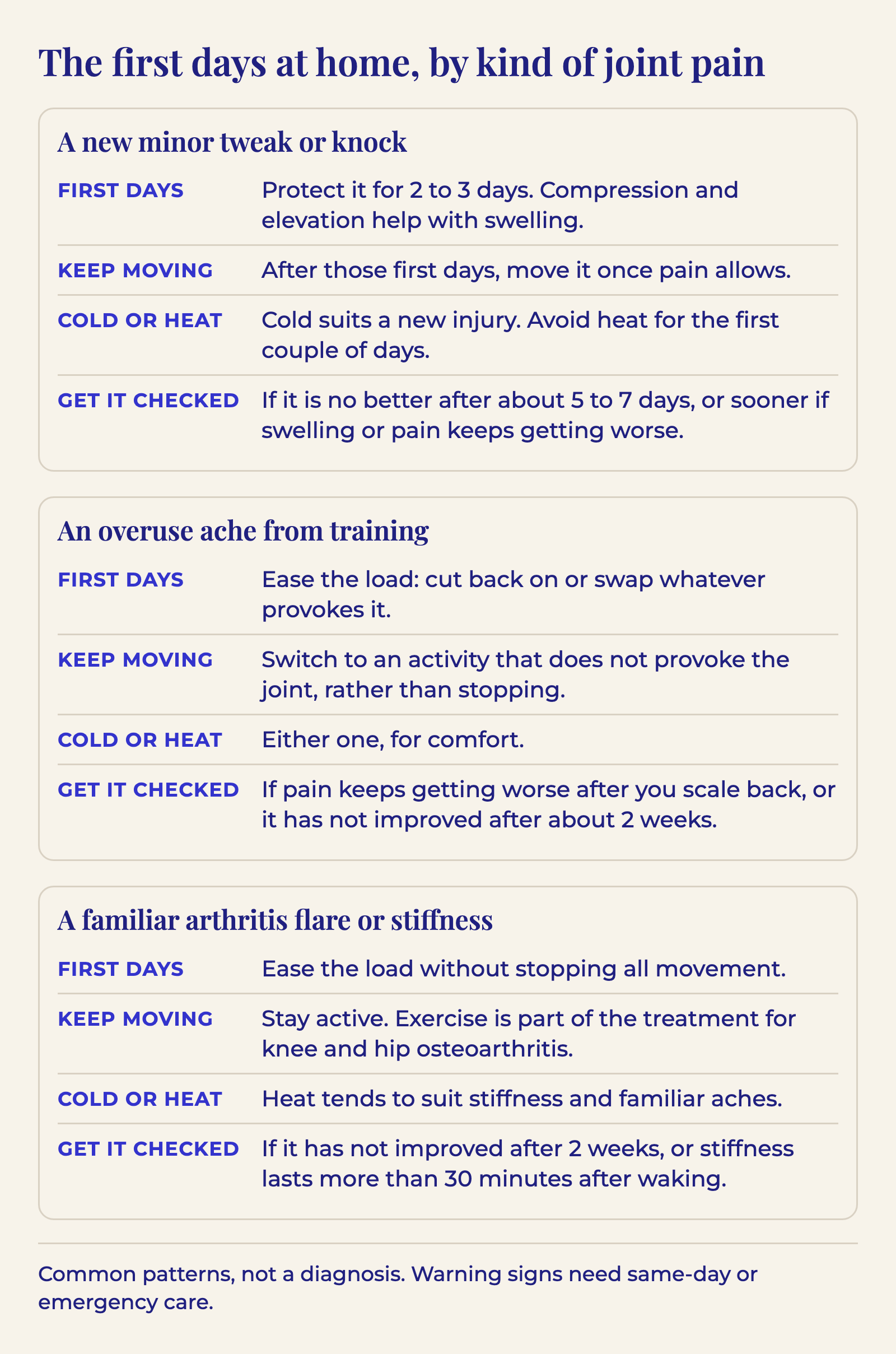
To relieve joint pain at home in the first few days of a new ache or a flare, three steps cover most situations, in line with NHS advice: ease the load, protect a new sprain or strain, and use cold or heat for comfort.
Ease the load, but keep moving. Cut back on or swap whatever provokes the pain. The NHS advises resting a sore joint where you can, without stopping moving it completely. The section on whether to rest the joint or keep moving explains how to do this after a new injury, a training overload or an arthritis flare.
After a new sprain or strain, standard advice for the first 2 to 3 days is to protect it, avoid putting weight on it where you can, and use compression and elevation to help with swelling, according to NHS sprain guidance. Being unable to walk on it or put weight on it is different: that’s one of the emergency signs. After those first days, keep it moving once pain allows.
Supports help in specific cases. The American College of Rheumatology’s 2019 guideline strongly recommends a cane for knee or hip osteoarthritis, and certain knee braces for knee osteoarthritis, when the arthritis significantly affects walking, stability or pain. After an ankle sprain, a 2018 clinical guideline favors tape or a brace combined with exercise. A physician or physical therapist can advise what, if anything, suits your joint.
Should you use ice or heat?
Cold tends to suit a new injury or swelling, and heat tends to suit stiffness and familiar arthritis aches. Heat can ease osteoarthritis pain and improve flexibility, according to NIH osteoarthritis treatment guidance. After a sprain, though, the NHS advises avoiding heat for the first couple of days. This “cold first, heat later” pattern comes from clinical guidance, including an American Academy of Pediatrics sports-injury handout, rather than from trials that test it.
Still, both are comfort measures. The American College of Rheumatology guideline recommends heat or cold for osteoarthritis only conditionally (a weaker recommendation), partly because the benefit is short-lived. Ice can ease pain after an injury. Studies in people haven’t shown that it limits further damage or helps tissue heal, and whether it affects healing at all is still unsettled, a 2024 review on ice found.
For safety, wrap ice in a cloth rather than putting it on bare skin, and use it for short periods, as NHS guidance advises. The American Academy of Pediatrics handout adds two cautions. Skip ice on numb or broken skin or if you have poor circulation. Skip heat on numb skin or an open wound, or when you have a fever.
Do over-the-counter pain relievers help, and who should check first?
Over-the-counter pain relievers can take the edge off for a while, but they don’t treat the cause. The two common types are acetaminophen, which eases pain but not inflammation, and anti-inflammatories (NSAIDs, or nonsteroidal anti-inflammatory drugs), which ease pain and swelling, according to MedlinePlus pain reliever guidance. Anti-inflammatories also come as gels applied to the skin (topical), and guidelines, including the American College of Rheumatology’s, strongly recommend the topical form for knee osteoarthritis.
Even so, they aren’t right for everyone. Anti-inflammatories can upset the stomach or cause ulcers, and the chance of side effects grows the longer they’re used, the MedlinePlus pain reliever guidance notes. Large amounts of acetaminophen can harm the liver, the same guidance adds. Anti-inflammatories other than aspirin may also raise the risk of heart attack or stroke, according to MedlinePlus drug information. Ask a physician or pharmacist which option suits you, as the NHS suggests. MedlinePlus advises checking first, before using one, if you:
- have heart, kidney, liver or stomach problems, or high blood pressure
- take blood thinners or prescription pain medicine
- are pregnant
Should you rest the joint or keep moving?
For most joint pain that isn’t urgent, complete rest isn’t the goal. The usual advice is relative rest (also called activity modification): ease off what aggravates the joint while staying active in ways that don’t, in line with NHS guidance.
After a new injury, a short period of protection is standard, followed by a gradual return, in line with NHS sprain guidance. So far, most of the trial evidence for moving early comes from ankle sprains. In a 2012 review of ankle sprain trials, the five that compared rest with early movement all favored early movement. The authors called this a preliminary conclusion because the trials were low quality. Overall, they found too little evidence to judge the full rest, ice, compression and elevation (RICE) approach.
For a training overload, adjust the load (how much, how hard and how often you train) or switch to an activity that doesn’t provoke the joint, rather than stopping entirely. The Centers for Disease Control and Prevention (CDC) suggests this in its archived advice for people with arthritis. In one small 2007 trial of 38 people with Achilles tendon pain, those who kept running and jumping while monitoring their pain improved about as much over 12 months as those who rested from those activities for 6 weeks. That was one tendon problem, so it’s early support for the principle, not proof for every joint.
For knee and hip osteoarthritis, exercise is part of the treatment. International OARSI guidance ranks it as core care, and the American College of Rheumatology finds supervised programs, often run by physical therapists, work better than exercising alone at home. The CDC states that physical activity is safe for people with arthritis and can reduce joint pain and improve function. If you worry that exercise will wear the joint out faster, research so far, including a 2019 review of trials, suggests that exercise which loads the knee doesn’t harm its cartilage. Those studies are low quality, though, and they measured cartilage on MRI scans rather than pain.
How can you tell if you’re overdoing it?
There is no agreed pain level at which a person with osteoarthritis should or shouldn’t exercise, the American College of Rheumatology says, and some discomfort isn’t necessarily a sign of harm. Early research in people with long-term muscle and joint pain, summarized in a 2017 review, suggests that mildly painful exercise works at least as well as pain-free exercise. With arthritis, some soreness, stiffness or swelling is normal after starting a new activity. It should ease over time, and if it doesn’t, see a doctor, the CDC advises.
So build up gradually, and notice how the joint feels during activity and afterward. If soreness builds from one session to the next, scale back: train less often, for shorter periods or more gently, as the CDC’s archived advice for people with arthritis suggests.
Stop that activity and book an evaluation (this isn’t an emergency) if you notice:
- sharp, stabbing pain that doesn’t let up
- pain that keeps getting worse even after you’ve scaled back (NHS guidance)
- pain that makes you limp
- swelling that builds after each session
- the joint locking, buckling or giving way (MedlinePlus knee guidance)
A joint that is hot and swollen, or joint pain with a fever, chills or feeling generally unwell, is different: it needs a doctor the same day, not a booked evaluation, according to NHS guidance. If you’re not sure whether it’s your usual post-activity swelling, get it checked the same day.
Example (illustrative composite, not a real client): a 56-year-old woman with mild knee arthritis plays doubles tennis three times a week, and her knee has started aching the morning after matches. With no warning signs, she drops to two matches a week, swaps the third for an easy bike ride, uses heat for brief morning stiffness, and notices how the knee feels during play and the next day. If the ache keeps building, hasn’t improved after about 2 weeks, or she starts to limp or feel the knee give way, that’s her cue to book an evaluation.
A physical therapist can build a program around your joint and your sport.
How long should you try home care before getting it checked?
There’s no single rule for when to see a doctor for joint pain, but the NHS gives a simple guide: see a doctor if joint pain hasn’t improved after 2 weeks of home treatment. That guide covers any joint. After a new injury, get it checked sooner. For an ankle sprain, for example, MedlinePlus (from the U.S. National Library of Medicine) suggests contacting a provider if it doesn’t feel any better after 5 to 7 days. Treat these as guides, not deadlines.
Book an evaluation (not urgent) if:
- it hasn’t improved within that window, or an ache or flare with no new injury is getting worse or keeps coming back
- it disturbs your sleep or stops your normal activities, including your sport
- your joints stay stiff for more than 30 minutes after you wake up, or several joints are involved (NIH rheumatoid arthritis guidance)
- you notice any warning sign during training, such as a limp, swelling that builds after each session, or the joint giving way
An evaluation adds what home care can’t: the cause. A doctor takes your history, examines the joint, and orders imaging when it would change the plan. Osteoarthritis with typical symptoms usually doesn’t need imaging to be diagnosed, and when imaging is needed, an X-ray is the first choice, according to 2017 European rheumatology recommendations. For symptoms that can’t wait, see when joint pain needs urgent care.
What can a doctor offer if home care isn’t enough?
The right option depends on the cause and the joint, and not everyone is a candidate for every treatment. In no particular order:
- Physical therapy or supervised exercise: a first-line option. It’s strongly recommended for knee and hip osteoarthritis by the American College of Rheumatology. It’s also a common first step for rotator cuff-related shoulder pain, though its short-term advantage there over other non-surgical care is uncertain, a 2026 review of trials found.
- Medicines a physician may recommend or prescribe, including topical anti-inflammatories, chosen around your health history.
- Corticosteroid (cortisone) injection: short-term relief. It calms pain and inflammation rather than repairing tissue. The American College of Rheumatology guideline strongly recommends it for knee and hip osteoarthritis. In low-quality knee trials, its benefit over a sham (fake) injection or no treatment faded within about 3 to 6 months, a 2015 Cochrane review found. For some people, at the right time, cortisone is the right treatment.
- Cortisone risks. These include a pain flare for 1 to 2 days, a very small risk of infection, a temporary rise in blood sugar in people with diabetes, and a higher chance of tendon rupture if used for tendinitis, the American Academy of Orthopaedic Surgeons notes in its cortisone shot guide. Physicians often limit it to three to four shots a year. In one 2017 trial, injections every 3 months for 2 years thinned knee cartilage slightly more than saline (saltwater) injections on MRI scans, with no difference in pain. A guideline panel from the American College of Rheumatology was unsure this matters clinically.
- Regenerative injections: evidence varies by condition. These are autologous (made from your own blood or bone marrow) and designed to support the body’s own repair process. The examples below are for knee osteoarthritis only.
- Platelet-rich plasma (PRP), made from your own blood: mixed evidence. A large 2021 placebo-controlled trial, in 288 adults aged 50 and over with mild to moderate knee arthritis, found PRP no better than saline injections for pain or cartilage at 12 months. A 2025 analysis of 11 placebo-controlled trials found a weak benefit for pain up to 6 months, none at 12 months, and called its clinical relevance “debatable”. Guidelines disagree: the American College of Rheumatology (2019) strongly recommends against PRP for knee and hip osteoarthritis, while a 2026 American Academy of Physical Medicine and Rehabilitation statement offers recommendations for its use but calls the field “evolving”.
- PRP side effects. In that trial, more people reported knee pain, swelling and stiffness after PRP than after placebo injections, though these were minor and short-lived. A 2025 analysis of 24 trials found side effects more common than with placebo, mostly mild to moderate, and not clearly different from cortisone. Writing about PRP in general, the American Academy of Orthopaedic Surgeons notes in its PRP guide that there may be more pain at the injection site. It says infection, tissue damage and nerve injury appear no more common than with cortisone shots, whose infection risk it calls very small in its cortisone shot guide.
- Bone marrow aspirate (BMA), concentrated from your own bone marrow: early, limited evidence. A 2022 review of eight studies (299 knees) reported improvement from people’s own starting point, mostly in studies without a comparison group, but BMA hasn’t been shown to work better than PRP or a placebo. One 2024 retrospective study (a look back at past cases) of 231 people reported bruising, numbness, skin irritation and one superficial infection where the marrow was taken, plus knee swelling and pain.
- With either treatment, improvement isn’t assured.
- Surgery: the right answer for some structural problems. Knee replacement is usually considered when severe pain or stiffness limits everyday activities, or other treatments haven’t helped enough, and the decision is a shared one with your surgeon, the American Academy of Orthopaedic Surgeons notes in its knee replacement guide. Rotator cuff surgery may be recommended when pain persists despite nonsurgical care, or for some large or injury-related tears, says the academy’s rotator cuff guide. In the same knee replacement guide, the academy puts serious complications of knee replacement, such as infection, at fewer than 2% of patients.
When does joint pain need urgent care?
Most joint pain isn’t an emergency. A few signs need prompt care, because they can point to a joint infection, a broken bone or dislocation, or a problem outside the joint.
See a doctor the same day if you have:
- a joint that is hot and swollen, or joint pain with a fever, chills or feeling generally unwell (NHS guidance). These can be signs of a joint infection (septic arthritis), which the NHS says should be treated as soon as possible. Fever is often only low-grade, so the lack of a high temperature doesn’t rule it out, a 2019 emergency medicine review notes.
- a joint that becomes red, hot and increasingly painful after recent joint surgery or an injection. Recent joint surgery makes infection more likely, the NHS says. Any joint injection carries a very small risk of infection, as the American Academy of Orthopaedic Surgeons notes for cortisone shots.
- sudden, severe pain or swelling in a joint, usually just one
- after a new sprain or strain: a large amount of swelling, or pain or swelling that keeps getting worse despite home care (NHS sprain guidance)
If you can’t see a doctor the same day, go to the nearest emergency room.
Get emergency care if you have:
- very bad joint pain after a fall or injury (NHS joint pain guidance)
- a joint you can’t walk on or put weight on, with or without an injury (NHS joint pain guidance)
- a joint that suddenly looks deformed or out of place, especially after an injury or fall (MedlinePlus dislocation guidance)
- a crack you heard when the injury happened
- numbness, tingling, coldness, or pale or bluish skin below an injured joint
- shoulder, arm or jaw pain together with chest pain or pressure, shortness of breath or sweating (MedlinePlus shoulder guidance), which can be signs of a heart attack, the CDC notes
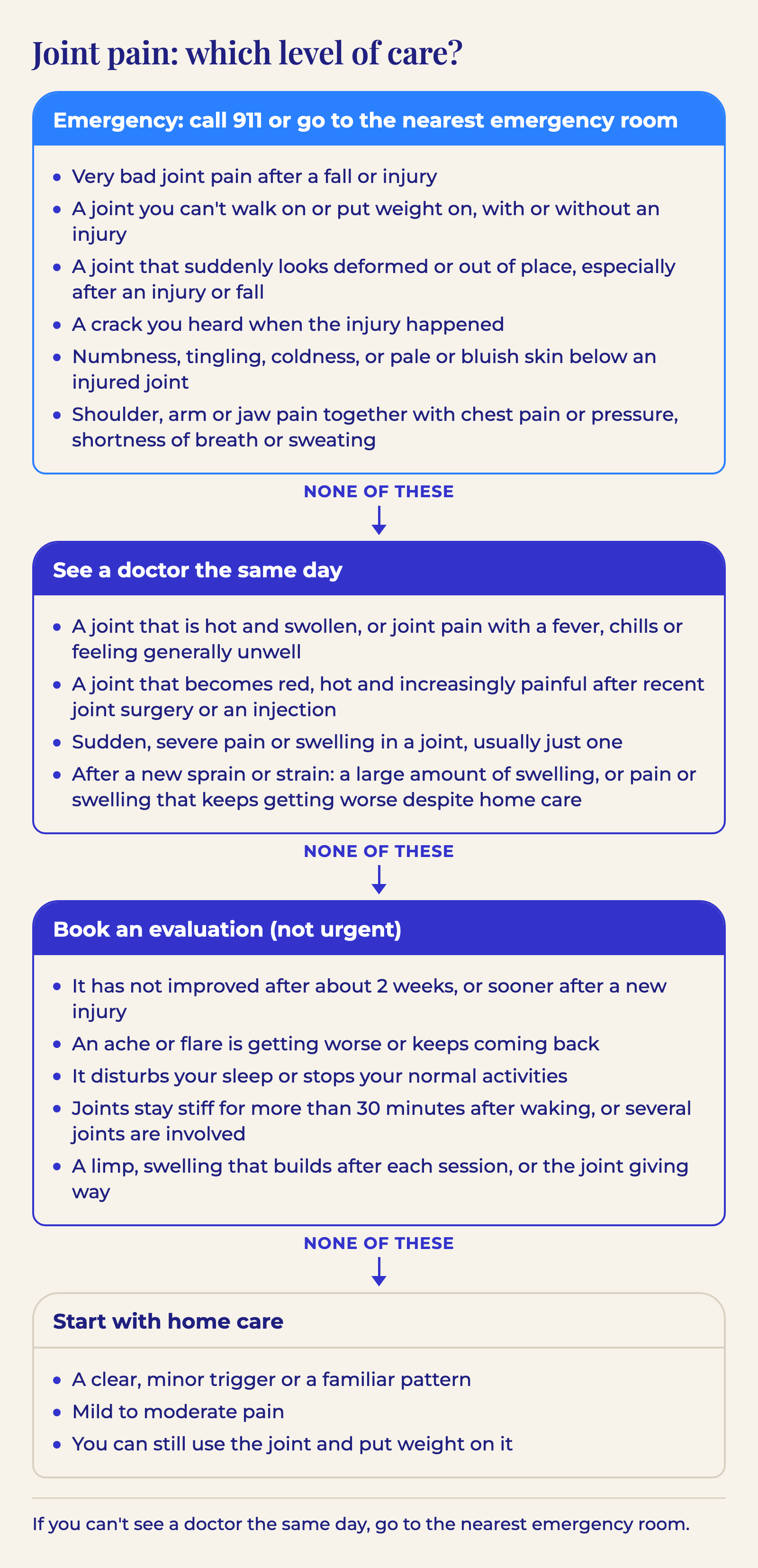
For any of these emergency signs, call 911 or go to the nearest emergency room.
How Dr. Preet Patel approaches joint pain
Gramercy Center offers ultrasound-guided platelet-rich plasma (PRP) and bone marrow aspirate (BMA), as well as intra-articular joint injections (injections into the joint).
Every consultation with Dr. Preet Patel, an ACGME fellowship-trained interventional pain management specialist, is a full diagnostic consultation, not a five-minute triage. He reviews your records and imaging before you arrive, examines the joint, and often uses ultrasound in the room.
His approach is to give you an honest answer about fit. He tells you when home care and physical therapy are enough, when a cortisone injection is the right choice, when a regenerative option may be worth considering, and when surgery is the better answer, with a referral to a trusted surgeon from his network. Because the evidence for regenerative treatments differs by condition, part of the consultation is Dr. Preet Patel telling you plainly what the research shows for yours and whether you’re a good candidate.
He will give you a specific return-to-activity plan, often coordinated with your trainer or physical therapist. At Gramercy, injections are meant to work alongside your training, not in place of it. Results vary, and not everyone is a candidate for every treatment.
Gramercy is an opioid-free practice, and you always see Dr. Preet Patel, a physician specialist, never a physician assistant or nurse practitioner.
Gramercy’s pages on knee pain treatment and shoulder pain treatment cover those joints in more detail, and the full list of conditions Gramercy treats covers the rest.
What’s the bottom line on joint pain at home?
For most everyday joint pain, the sound starting point is to adjust your activity rather than stop it, use cold or heat for comfort, and build back gradually, in line with NHS guidance. With knee and hip osteoarthritis, staying active is part of the treatment, not something to avoid. The American College of Rheumatology strongly recommends exercise. Two things remain uncertain: the waiting window is a guide, not a firm rule, and ice and heat have little evidence beyond short-term comfort. Home care also can’t tell you what’s causing the pain.
For any of the warning signs above, get urgent care rather than waiting. Otherwise, if the pain isn’t improving after about 2 weeks (sooner after a new injury), keeps coming back, or is costing you your sport, your sleep or your travel, the next step is a proper evaluation.
Schedule a consultation with Dr. Preet Patel. You can also call (310) 439-8009.
Sources
First part of the sources
- Joint pain. NHS (UK National Health Service). Last reviewed 2026. https://www.nhs.uk/symptoms/joint-pain/
- Ankle sprain – aftercare. MedlinePlus, U.S. National Library of Medicine (NIH). Reviewed 2024. https://medlineplus.gov/ency/patientinstructions/000574.htm
- Kolasinski SL, et al. 2019 American College of Rheumatology/Arthritis Foundation Guideline for the Management of Osteoarthritis of the Hand, Hip, and Knee. Arthritis Care & Research. 2020. https://pmc.ncbi.nlm.nih.gov/articles/PMC11488261/
- Bannuru RR, et al. OARSI guidelines for the non-surgical management of knee, hip, and polyarticular osteoarthritis. Osteoarthritis and Cartilage (Osteoarthritis Research Society International). 2019. https://pubmed.ncbi.nlm.nih.gov/31278997/
- Racinais S, et al. Cryotherapy for treating soft tissue injuries in sport medicine: a critical review. British Journal of Sports Medicine. 2024. https://pubmed.ncbi.nlm.nih.gov/39237265/
- Rheumatoid Arthritis. NIAMS (NIH). Last reviewed 2022. https://www.niams.nih.gov/health-topics/rheumatoid-arthritis
- Osteoarthritis. NIAMS (NIH). Last reviewed 2023. https://www.niams.nih.gov/health-topics/osteoarthritis
- Sprains and strains. NHS (UK National Health Service). Last reviewed 2024. https://www.nhs.uk/conditions/sprains-and-strains/
- Vuurberg G, et al. Diagnosis, treatment and prevention of ankle sprains: update of an evidence-based clinical guideline. British Journal of Sports Medicine. 2018. https://pubmed.ncbi.nlm.nih.gov/29514819/
- Osteoarthritis: Diagnosis, Treatment, and Steps to Take. National Institute of Arthritis and Musculoskeletal and Skin Diseases (NIAMS, NIH). Last reviewed 2023. https://www.niams.nih.gov/health-topics/osteoarthritis/diagnosis-treatment-and-steps-to-take
Second part of the sources
- Treating Sports Injuries with Ice and Heat. American Academy of Pediatrics (HealthyChildren.org). Page updated 2026. https://www.healthychildren.org/English/health-issues/injuries-emergencies/sports-injuries/pages/Treating-Sports-Injuries-with-Ice-and-Heat.aspx
- Over-the-counter pain relievers. MedlinePlus, U.S. National Library of Medicine (NIH). Reviewed 2024. https://medlineplus.gov/ency/article/002123.htm
- Ibuprofen (drug information). MedlinePlus, U.S. National Library of Medicine (NIH). Last revised 2023. https://medlineplus.gov/druginfo/meds/a682159.html
- van den Bekerom MPJ, et al. What Is the Evidence for Rest, Ice, Compression, and Elevation Therapy in the Treatment of Ankle Sprains in Adults? Journal of Athletic Training. 2012. https://pmc.ncbi.nlm.nih.gov/articles/PMC3396304/
- What Do I Do if I Have Pain During or After Exercise? (archived page). Centers for Disease Control and Prevention (CDC). Last reviewed 2021. https://archive.cdc.gov/www_cdc_gov/arthritis/basics/physical-activity/pain.html
- Silbernagel KG, et al. Continued sports activity, using a pain-monitoring model, during rehabilitation in patients with Achilles tendinopathy: an RCT. American Journal of Sports Medicine. 2007. https://pubmed.ncbi.nlm.nih.gov/17307888/
- About Physical Activity and Arthritis. Centers for Disease Control and Prevention (CDC). Last reviewed 2024. https://www.cdc.gov/arthritis/prevention/index.html
- Bricca A, et al. Impact of exercise on articular cartilage in people at risk of, or with established, knee osteoarthritis: a systematic review of RCTs. British Journal of Sports Medicine. 2019. https://pubmed.ncbi.nlm.nih.gov/29934429/
- Smith BE, et al. Should exercises be painful in the management of chronic musculoskeletal pain? A systematic review and meta-analysis. British Journal of Sports Medicine. 2017. https://pubmed.ncbi.nlm.nih.gov/28596288/
- Knee pain. MedlinePlus, U.S. National Library of Medicine (NIH). Reviewed 2024. https://medlineplus.gov/ency/article/003187.htm
Third part of the sources
- Sakellariou G, et al. EULAR recommendations for the use of imaging in the clinical management of peripheral joint osteoarthritis. Annals of the Rheumatic Diseases (EULAR). 2017. https://pubmed.ncbi.nlm.nih.gov/28389554/
- Liu J, et al. Effectiveness of exercise therapy versus passive conservative treatments for rotator cuff-related shoulder pain: SR and MA of RCTs. Musculoskeletal Science and Practice. 2026. https://pubmed.ncbi.nlm.nih.gov/41990400/
- Jüni P, et al. Intra-articular corticosteroid for knee osteoarthritis. Cochrane Database of Systematic Reviews. 2015. https://pmc.ncbi.nlm.nih.gov/articles/PMC8884338/
- Cortisone Shot (Steroid Injection). American Academy of Orthopaedic Surgeons (AAOS) OrthoInfo. Review date not shown. https://www.orthoinfo.org/en/treatment/cortisone-shot-steroid-injection
- McAlindon TE, et al. Effect of Intra-articular Triamcinolone vs Saline on Knee Cartilage Volume and Pain in Patients With Knee Osteoarthritis: An RCT. JAMA. 2017. https://pubmed.ncbi.nlm.nih.gov/28510679/
- Bennell KL, et al. Effect of Intra-articular PRP vs Placebo Injection on Pain and Medial Tibial Cartilage Volume in Knee OA: The RESTORE RCT. JAMA. 2021. https://pubmed.ncbi.nlm.nih.gov/34812863/ (full text: https://pmc.ncbi.nlm.nih.gov/articles/PMC8611484/)
- Auroux M, et al. Efficacy of intra-articular platelet-rich plasma compared with placebo in knee osteoarthritis: SR and MA. Joint Bone Spine. 2025. https://pubmed.ncbi.nlm.nih.gov/40653151/
- Borg-Stein J, et al. AAPM&R guidance statement on platelet rich plasma for knee osteoarthritis. PM&R (American Academy of Physical Medicine and Rehabilitation). 2026. https://pubmed.ncbi.nlm.nih.gov/41989317/
- Fucaloro SP, et al. Complications of Platelet-Rich Plasma Injection for Knee Osteoarthritis Are Similar to Those of Corticosteroids and Hyaluronic Acid but Are Significantly Greater Than Those of Placebo Injections: A Meta-analysis of Randomized Controlled Trials. Arthroscopy. 2025. https://pubmed.ncbi.nlm.nih.gov/40409439/
- Platelet-Rich Plasma (PRP). American Academy of Orthopaedic Surgeons (AAOS) OrthoInfo. Review date not shown. https://www.orthoinfo.org/en/treatment/platelet-rich-plasma-prp/
Fourth part of the sources
- Keeling LE, et al. Bone Marrow Aspirate Concentrate for the Treatment of Knee Osteoarthritis: A Systematic Review. American Journal of Sports Medicine. 2022. https://pubmed.ncbi.nlm.nih.gov/34236913/
- Baek JH, et al. Effectiveness and Complications of BMAC in Patients with Knee OA of Kellgren–Lawrence Grades II–III. Medicina (Kaunas). 2024. https://pmc.ncbi.nlm.nih.gov/articles/PMC11206007/
- Total Knee Replacement. American Academy of Orthopaedic Surgeons (AAOS) OrthoInfo. Review date not shown. https://www.orthoinfo.org/en/treatment/total-knee-replacement/
- Rotator Cuff Tears. American Academy of Orthopaedic Surgeons (AAOS) OrthoInfo. Review date not shown. https://www.orthoinfo.org/en/diseases–conditions/rotator-cuff-tears/
- Septic arthritis. NHS (UK National Health Service). Last reviewed 2026. https://www.nhs.uk/conditions/septic-arthritis/
- Long B, Koyfman A, Gottlieb M. Evaluation and Management of Septic Arthritis and its Mimics in the Emergency Department. Western Journal of Emergency Medicine. 2019. https://pmc.ncbi.nlm.nih.gov/articles/PMC6404712/
- Dislocation. MedlinePlus, U.S. National Library of Medicine (NIH). Reviewed 2026. https://medlineplus.gov/ency/article/000014.htm
- Shoulder pain. MedlinePlus, U.S. National Library of Medicine (NIH). Reviewed 2025. https://medlineplus.gov/ency/article/003171.htm
- Heart Attack Symptoms, Risk, and Recovery. Centers for Disease Control and Prevention (CDC). Last reviewed 2024. https://www.cdc.gov/heart-disease/about/heart-attack.html
This content is for general education only and is not medical advice. It does not create a doctor-patient relationship. Treatment decisions should be made with a qualified physician after an individual evaluation. Results vary, and not everyone is a candidate for every treatment.