

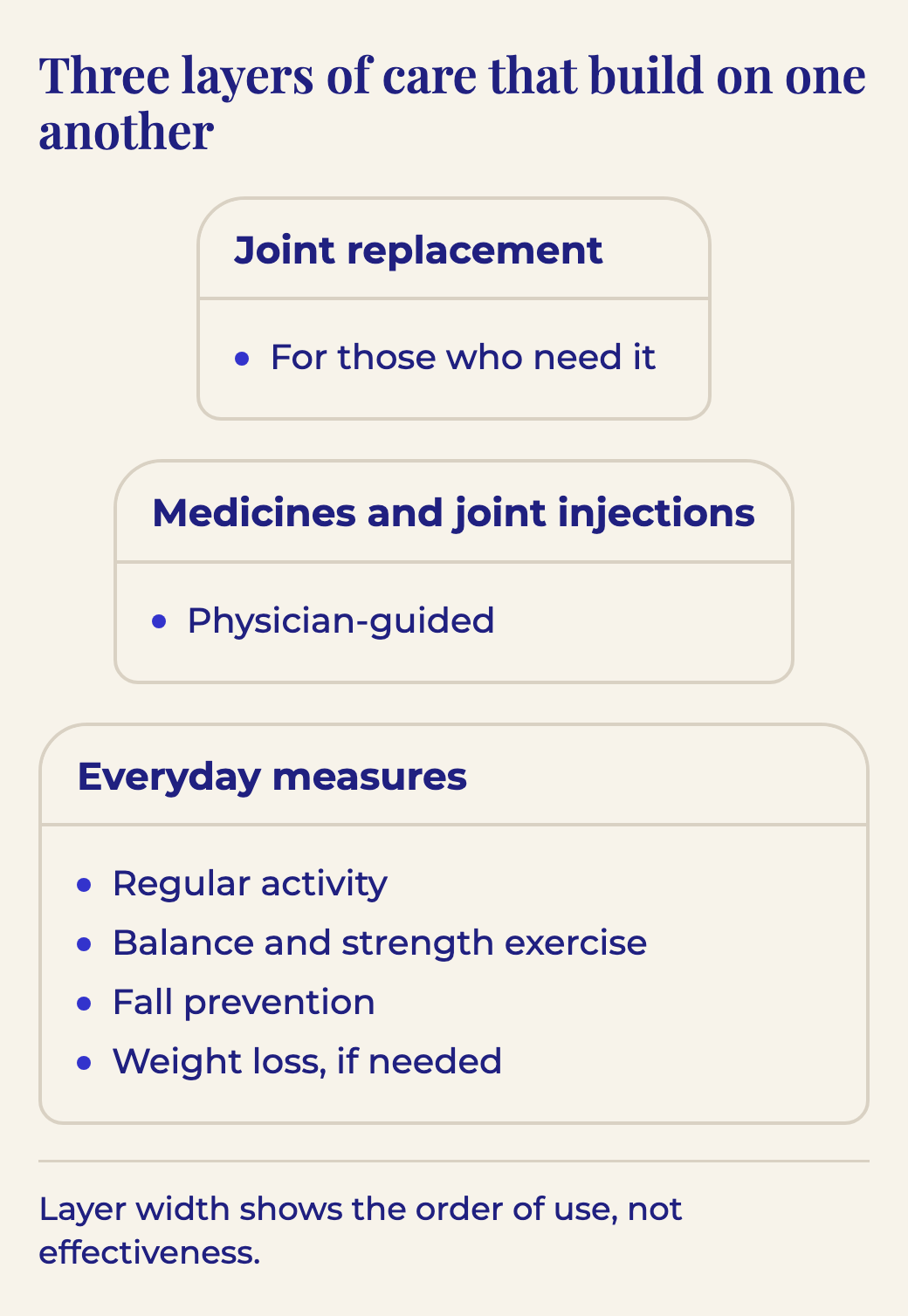
Staying mobile as you age with chronic pain starts with a few everyday measures: regular physical activity, balance exercise and steps to help prevent falls. Medicines, injections and surgery can help the right person. However, none of them replaces the everyday measures.
Joint pain may make you less active, which can lead to muscle weakness, the National Institutes of Health explains. That matters for golf, travel and time with grandchildren.
The everyday measures were studied in adults 65 and older in general, not in people selected for chronic pain. Even so, the American College of Rheumatology (ACR) strongly recommends exercise for knee and hip osteoarthritis (joint tissue that breaks down over time).
The treatment evidence here covers knee and hip osteoarthritis only. Whether injections of platelet-rich plasma (PRP) or bone marrow aspirate (BMA) change long-term mobility is not established. Results vary, and nothing here guarantees a result.
Key takeaways
- The pattern: long-standing pain is linked to moving less and new difficulty getting around.
- Best evidence: regular activity (walking ability) and balance exercise (fewer falls), in older adults generally.
- Also recommended: fall-proofing, and weight loss if overweight with knee or hip osteoarthritis.
- Helps some people: anti-inflammatory medicines, cortisone injections and joint replacement.
- Mixed or early evidence: PRP and BMA for knee osteoarthritis.
- After a fall: tell your physician, and know the emergency signs below.
Does chronic pain make you lose mobility as you age?
Chronic pain is linked to losing mobility, but the loss is not inevitable. In a 2014 Boston study of 634 adults aged 65 and older living at home, 7% of those with no pain reported new difficulty getting around 18 months later, compared with 39% of those with widespread pain. The study is observational, so it shows a link, not a cause. It also covers muscle, bone and joint pain in general, not knee or hip osteoarthritis.
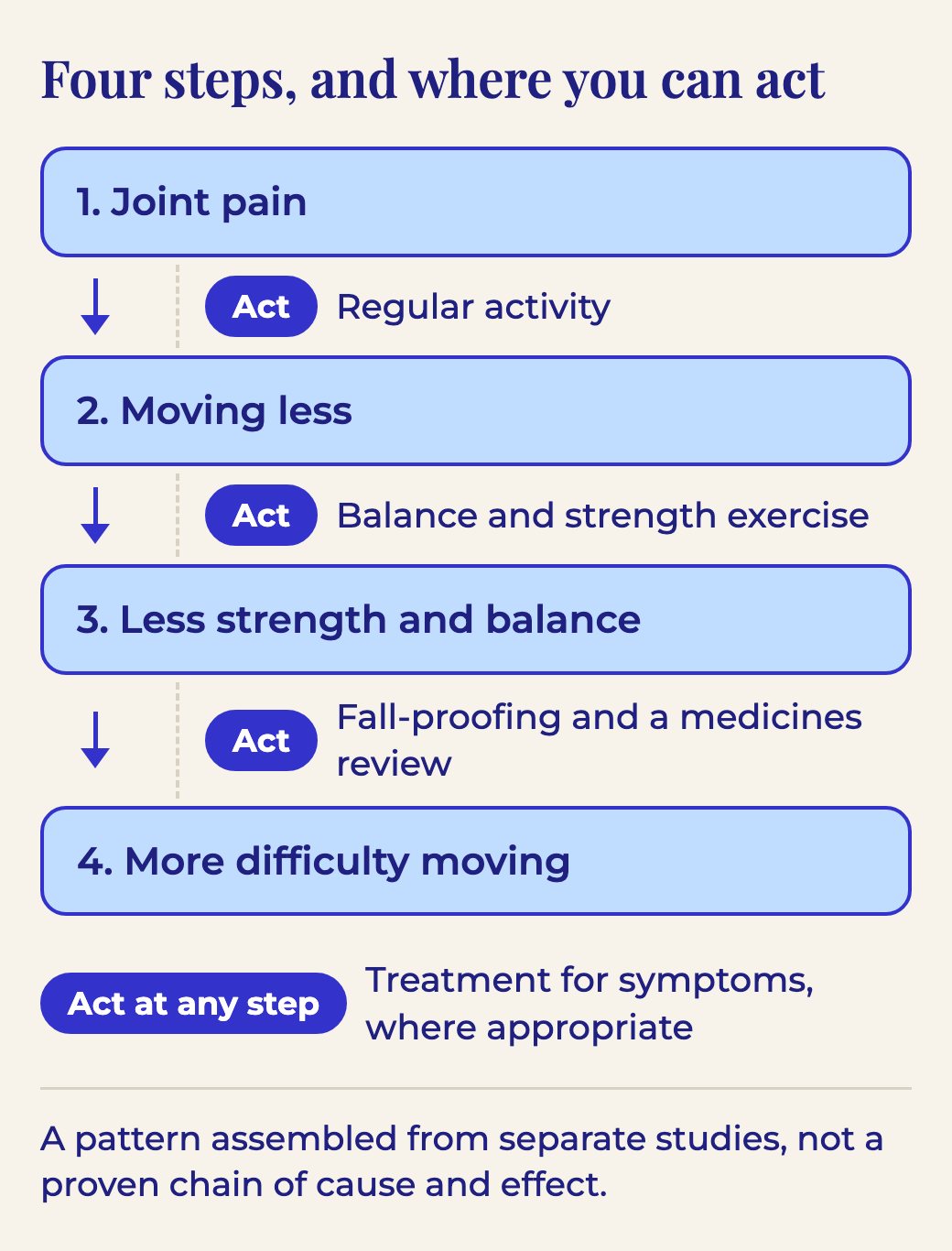
Together with other sources, this suggests a sequence: pain, moving less, less strength and balance, more difficulty moving. A single study does not prove it, but each step is a place to act.
What has the strongest evidence for keeping you mobile?
Regular physical activity and balance exercise do: activity for keeping the ability to walk, and balance exercise for fewer falls.
How much does regular physical activity matter?
Guidance from the Centers for Disease Control and Prevention (CDC) for adults 65 and older calls for at least 150 minutes of moderate activity a week, muscle-strengthening activity on at least 2 days, and activities that improve balance. If that is hard to meet, the CDC says to be as active as your abilities allow.
The 2014 LIFE trial enrolled 1,635 sedentary adults aged 70 to 89 with some physical limitation. Over an average of 2.6 years, 30.1% of those in a structured activity program lost the ability to walk about a quarter mile, compared with 35.5% of those in health education classes. That is about 5 fewer people in every 100.
Which kind of exercise lowers the risk of falling?
Exercise for balance and everyday function has the clearest evidence. A 2019 Cochrane review of people living at home, average age 76, found that exercise cut the rate of falls by about a quarter (23%; 59 randomized trials, 12,981 people), compared with no fall-prevention exercise. Programs that added resistance (strength) exercise also reduced falls, on somewhat weaker evidence. For strength training alone, there was too little evidence to say.
Is it safe to stay active when a joint hurts?
The CDC says physical activity is safe for people with arthritis, and that some pain, stiffness or swelling is normal after starting a new activity. It advises contacting your physician if symptoms do not ease or are severe.
Does movement wear a sore joint out faster? Limited evidence suggests not, at least for the knee. A 2019 review of nine randomized trials concluded that exercise programs that load the knee did not appear to harm its cartilage on imaging. The reviewers rated that evidence low quality, and it does not cover the hip.
Do body weight and fall prevention make a difference?
Both are recommended: weight loss if you are overweight with knee or hip osteoarthritis, and practical fall-prevention steps.
Does body weight change how joints fare?
For people with knee or hip osteoarthritis who are overweight, the ACR’s 2026 update strongly recommends weight loss. For the knee only, the American Academy of Orthopaedic Surgeons (AAOS) recommended sustained weight loss in 2021, to improve pain and function. How to approach weight is a decision for you and your physician.
What lowers the risk of a fall?
About 1 in 4 US adults aged 65 and older (27.6%) reported a fall in the previous year, in a CDC telephone survey using 2020 data. The CDC’s prevention steps:
- Ask your physician to assess your risk of falling.
- Ask your physician or pharmacist to review your medicines, including over-the-counter ones.
- Do exercises that strengthen your legs and improve your balance, such as tai chi.
- Have your eyes checked at least once a year.
- Remove trip hazards, and add grab bars, stair railings and good lighting.
Where do medicines, injections and surgery fit?
Disclosure: Gramercy Center offers PRP, BMA and intra-articular (into the joint) injections.
These options add to the everyday measures. Two terms recur below: “strongly” describes how firm a panel’s advice is, and “certainty” the quality of the studies behind it.
What role do pain medicines play?
Their role is symptom relief. The ACR’s 2026 update strongly recommends oral anti-inflammatory medicines for knee and hip osteoarthritis, and forms applied to the skin (topical) for the knee. For the knee, the AAOS 2021 guideline recommends both unless a health condition or another medicine rules them out. For oral forms, it notes serious heart and stomach risks. These medicines work alongside activity, and the choice belongs with your physician.
Do glucosamine and chondroitin help?
The ACR’s 2026 update strongly recommends against glucosamine and chondroitin for knee and hip osteoarthritis. For mild to moderate knee osteoarthritis only, the AAOS 2021 guideline says they “may be helpful” but calls the evidence inconsistent and limited.
What can cortisone and other joint injections do?
Cortisone-type (corticosteroid) injections can ease pain for a time. The ACR’s 2026 update strongly recommends them for knee and hip osteoarthritis, on low-certainty evidence.
A 2015 Cochrane review of 27 trials in knee osteoarthritis found no evidence that the effect lasts to 6 months, and rated its evidence low quality. In one knee trial, people had an injection every 12 weeks for 2 years. MRI showed slightly more cartilage thinning than with saline (salt water) injections, an imaging finding. Knee pain did not differ significantly between the cortisone and saline groups.
That makes cortisone a short-term option. Ask your physician how often to repeat it, and about the risks of the injection itself.
Hyaluronic acid (gel) injections have less support: the ACR advises against them for most people with knee or hip osteoarthritis, and the AAOS knee guideline against routine use.
Where do PRP and bone marrow aspirate fit?
PRP (made from your own blood): the societies do not agree. The American College of Rheumatology’s 2026 update strongly recommends against it for knee and hip osteoarthritis, on low-certainty evidence. For the knee, the American Academy of Orthopaedic Surgeons’ 2021 guideline says it “may reduce pain and improve function”, with limited support.
In 2026, the American Academy of Physical Medicine and Rehabilitation recommended considering it for mild to moderate (less advanced) knee osteoarthritis that still causes symptoms despite non-surgical care. For advanced hip or knee osteoarthritis (often called “bone on bone”), the American Association of Hip and Knee Surgeons says neither PRP nor BMA can currently be recommended for routine treatment.
In a 2021 placebo-controlled trial of 288 adults with mild to moderate knee osteoarthritis, one type of PRP gave no greater pain relief than saline at 12 months.
BMA (concentrated from your own bone marrow): evidence for knee osteoarthritis is early and limited, and none of these guidelines recommends it. A 2024 review of eight randomized trials in 937 people found improvement from the starting point. Improvement from the starting point alone cannot be credited to the treatment, and BMA showed no noticeable advantage over other injections.
Neither has an established long-term mobility benefit: these studies ran 12 months and none measured walking or falls. The hip and knee surgeons’ association lists injection-site pain, a collection of blood, an inflammatory reaction and joint infection as reported risks, and some people see no improvement. These are risks of the injection itself. Collecting bone marrow is a separate step; ask about its risks. Weigh both with a physician after the everyday measures, not as a first step.
When is joint replacement the right choice?
Some people have surgery when other treatments are not helping and joint damage is extensive, the National Institutes of Health says. The decision rests on pain and disability, not age, according to AAOS’s knee replacement guidance.
The only randomized comparison, a 2015 trial, followed 100 adults with moderate to severe knee osteoarthritis for 12 months. It used a 100-point score for pain, symptoms, daily activities and quality of life. Knee replacement followed by non-surgical care improved the score by 32.5 points. Non-surgical care alone improved it by 16.0 points, and 13 of those 50 people (26%) had the operation within the year. The surgery group had more serious health problems during the study: 24 events compared with 6 (events, not people).
For knee replacement, AAOS lists infection, blood clots, implant problems and continued pain as possible complications, and says most normal daily activities can resume within 3 to 6 weeks. Surgery is sometimes necessary, sometimes uncertain, and sometimes not the best choice.
What Gramercy Center offers
This section describes Gramercy’s services, not research evidence.
Gramercy Center offers three of the options above: platelet-rich plasma (PRP) therapy, bone marrow aspirate (BMA) and intra-articular joint injections. Not everyone is a candidate for every treatment, and results vary.
Gramercy is a cash-pay, concierge, physician-led practice in Beverly Hills, founded and led by Dr. Preet Patel, MD. He is board-certified by the American Board of Anesthesiology and an ACGME fellowship-trained interventional pain management specialist. Clients always see an MD specialist.
Questions to ask any physician who offers an injection:
- What is the evidence for my joint and stage of arthritis?
- What does the procedure involve, including the needle?
- What are the risks, and how much downtime is likely?
When should you see a physician, and when is it an emergency?
Contact a physician the same day:
- A joint becomes hot, red and swollen. If it is an infection, delay may cause permanent damage (MedlinePlus: joint infection).
- You hit your head in a fall, especially if you take blood thinners (CDC: older adults).
If you cannot reach one that day, go to urgent care or an emergency room.
Book an appointment:
- You have fallen without injury, feel unsteady, or are afraid of falling (CDC: older adults).
- Pain now affects daily tasks, standing or moving around (AAOS: orthopaedic care).
Emergency:
If you have loss of bladder or bowel control, numbness in the groin or saddle area, sudden or worsening weakness, fever with back pain, pain after a major fall or accident, chest pain, or a sudden, severe headache, call 911 or go to the nearest emergency room right away.
Do the same if:
- You suspect a broken bone, or have intense pain or another concerning symptom, such as a fever or being unable to bear weight or move a limb (AAOS: orthopaedic care), for example after a fall.
- A hot, swollen joint comes with a fever (AAOS: orthopaedic care and MedlinePlus: joint infection).
- After a hit to the head, you have danger signs such as a worsening headache, repeated vomiting, confusion, slurred speech, weakness, numbness, a seizure, drowsiness or loss of consciousness (CDC: caregivers).
If you are unsure which group a symptom belongs in, treat it as an emergency.
What is the most useful next step?
Put most of your effort into regular activity, balance exercise and fall prevention. Treat medicines, injections and surgery as additions for the right person.
Results vary: no habit or treatment guarantees mobility, and neither PRP nor BMA has an established long-term mobility benefit.
A reasonable next step is to discuss one everyday measure, and a medicines review, with your physician. If knee pain or hip pain is limiting what you do, seek an evaluation.
Schedule a consultation with Dr. Preet Patel.
Sources
Activity, exercise and mobility
- Osteoarthritis (health topic overview). National Institute of Arthritis and Musculoskeletal and Skin Diseases, National Institutes of Health. Reviewed 2023. https://www.niams.nih.gov/health-topics/osteoarthritis
- 2026 Update of the American College of Rheumatology Recommendations for the Management of Osteoarthritis of the Knee, Hip, and Hand (Guideline Summary). American College of Rheumatology. 2026. https://assets.contentstack.io/v3/assets/bltee37abb6b278ab2c/bltb3d12c34020da842/oa-guideline-summary-2026.pdf
- Pain characteristics associated with the onset of disability in older adults: the MOBILIZE Boston Study (Eggermont LH et al.). Journal of the American Geriatrics Society. 2014. https://pubmed.ncbi.nlm.nih.gov/24823985/
- Older Adult Activity: An Overview. Centers for Disease Control and Prevention. 2025. https://www.cdc.gov/physical-activity-basics/guidelines/older-adults.html
- Effect of structured physical activity on prevention of major mobility disability in older adults: the LIFE study randomized clinical trial (Pahor M et al.). JAMA. 2014. https://pubmed.ncbi.nlm.nih.gov/24866862/
- Exercise for preventing falls in older people living in the community (Sherrington C et al.). Cochrane. 2019. https://www.cochrane.org/CD012424/MUSKINJ_exercise-preventing-falls-older-people-living-community
- About Physical Activity and Arthritis. Centers for Disease Control and Prevention. 2024. https://www.cdc.gov/arthritis/prevention/index.html
- Impact of exercise on articular cartilage in people at risk of, or with established, knee osteoarthritis: a systematic review of randomised controlled trials (Bricca A et al.). British Journal of Sports Medicine. 2019. https://pubmed.ncbi.nlm.nih.gov/29934429/
Weight, falls, medicines and injections
- Management of Osteoarthritis of the Knee (Non-Arthroplasty) Evidence-Based Clinical Practice Guideline. American Academy of Orthopaedic Surgeons. 2021. https://aaos.org/oak3cpg
- Nonfatal and Fatal Falls Among Adults Aged 65 Years and Older, United States, 2020-2021 (Kakara R et al.). Centers for Disease Control and Prevention, Morbidity and Mortality Weekly Report. 2023. https://www.cdc.gov/mmwr/volumes/72/wr/mm7235a1.htm
- Preventing Falls and Hip Fractures. Centers for Disease Control and Prevention. 2026. https://www.cdc.gov/falls/prevention/index.html
- Intra-articular corticosteroid for knee osteoarthritis (Jüni P et al.). Cochrane. 2015. https://www.cochrane.org/CD005328/MUSKEL_intra-articular-corticosteroid-for-knee-osteoarthritis
- Effect of Intra-articular Triamcinolone vs Saline on Knee Cartilage Volume and Pain in Patients With Knee Osteoarthritis: A Randomized Clinical Trial (McAlindon TE et al.). JAMA. 2017. https://pubmed.ncbi.nlm.nih.gov/28510679/
- AAPM&R Guidance Statement on PRP for Knee Osteoarthritis Released (society announcement; the full guidance statement was not available to us). American Academy of Physical Medicine and Rehabilitation. 2026. https://www.aapmr.org/members-publications/newsroom/member-news/2026/04/16/aapm-r-guidance-statement-on-prp-for-knee-osteoarthritis-released
- Position Statement on Biologics for Advanced Hip and Knee Arthritis. American Association of Hip and Knee Surgeons. Revised 2025. https://www.aahks.org/wp-content/uploads/2025/06/AAHKS-Position-Statement-on-Biologics-2025.pdf
- Effect of Intra-articular Platelet-Rich Plasma vs Placebo Injection on Pain and Medial Tibial Cartilage Volume in Patients With Knee Osteoarthritis: The RESTORE Randomized Clinical Trial (Bennell KL et al.). JAMA. 2021. https://pubmed.ncbi.nlm.nih.gov/34812863/
- Bone Marrow Aspirate Concentrate Injections for the Treatment of Knee Osteoarthritis: A Systematic Review of Randomized Controlled Trials (Han JH et al.). Orthopaedic Journal of Sports Medicine. 2024. https://pubmed.ncbi.nlm.nih.gov/39640186/
Joint replacement and when to get care
- Osteoarthritis: Diagnosis, Treatment, and Steps to Take. National Institute of Arthritis and Musculoskeletal and Skin Diseases, National Institutes of Health. Reviewed 2023. https://www.niams.nih.gov/health-topics/osteoarthritis/diagnosis-treatment-and-steps-to-take
- Total Knee Replacement. American Academy of Orthopaedic Surgeons, OrthoInfo. No stated review date. https://www.orthoinfo.org/en/treatment/total-knee-replacement/
- A Randomized, Controlled Trial of Total Knee Replacement (Skou ST et al.). New England Journal of Medicine. 2015. https://pubmed.ncbi.nlm.nih.gov/26488691/
- Septic arthritis (MedlinePlus Medical Encyclopedia). National Library of Medicine, National Institutes of Health. 2025. https://medlineplus.gov/ency/article/000430.htm
- Still Going Strong: Information for Older Adults. Centers for Disease Control and Prevention. 2025. https://www.cdc.gov/still-going-strong/older-adults/index.html
- Orthopaedics. American Academy of Orthopaedic Surgeons, OrthoInfo. No stated review date. https://www.orthoinfo.org/treatment/orthopaedics/
- Still Going Strong: Information for Caregivers. Centers for Disease Control and Prevention. 2025. https://www.cdc.gov/still-going-strong/caregivers/index.html
This content is for general education only and is not medical advice. It does not create a doctor-patient relationship. Treatment decisions should be made with a qualified physician after an individual evaluation. Results vary, and not everyone is a candidate for every treatment.