
Chronological age is the number of years since you were born. Biological age is an estimate of how well your body is working compared with other people, built from blood markers, chemical tags on your DNA, or physical performance. People of the same age can differ widely in strength, fitness and health risk, which is why the idea is appealing. But “biological age” is not one agreed measurement.
An epigenetic clock is a formula that uses chemical tags on DNA, called DNA methylation, to estimate age. Across large groups, higher readings on some of these clocks are linked to higher risk of heart-disease death.
What remains unsettled is how precise one result is for one person, whether tests agree with each other, and whether changing a number changes how long or how well you live. In fact, a 2024 Nature Medicine review found no consensus on how to validate aging biomarkers before clinical use. So treat a result as a curiosity, not a decision.
Key takeaways
- Biological age is a family of estimates, not a single fact.
- A clock result can signal risk across a large group yet be imprecise for one person.
- Simple function checks are repeatable. In large studies they are linked to later health outcomes.
- In the research we reviewed, no study has shown that changing a biological-age reading improves how long or how well people live.
- If pain stops you from training or walking, a consultation is reasonable.
How is biological age measured?
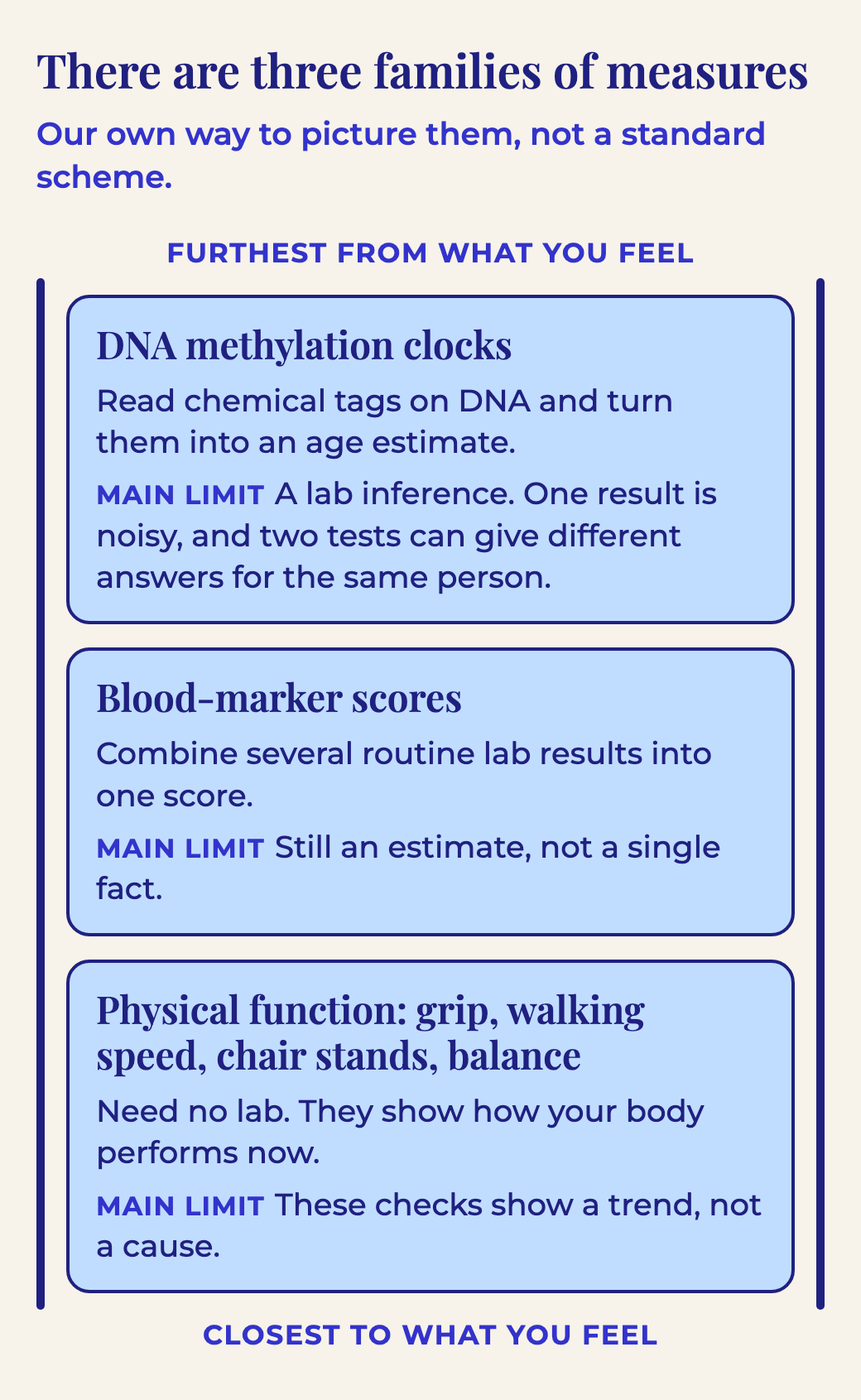
There are three families of measures.
- Blood-marker composites combine several routine lab results into one score.
- DNA methylation clocks read chemical tags on DNA, in these studies from a blood sample, and turn them into an age estimate. PhenoAge, Horvath, Hannum, GrimAge and DunedinPACE are all named clocks of this type.
- Physical-function checks (grip strength, walking speed, chair stands, balance) need no lab. They show how your body performs now.
The ladder below is our own way to picture them, not a standard scheme.
Clocks also measure different things, so two tests can give different answers for the same person. For example, in 1,175 UK adults, some pairs of clocks agreed only weakly on who was aging faster.
How reliable are biological-age tests for one person?
In a 2022 Nature Aging study of 36 blood samples from adults aged 37 to 75, the same sample measured twice gave readings on the PhenoAge clock typically 2.4 years apart (the median), and as much as 8.6 years apart.
A rebuilt version of the clock, which smooths out lab noise, cut those gaps to 0.6 and 1.6 years. That is more repeatable, but not necessarily more accurate or useful. Also, these were research clocks measured twice in a lab, and we could not verify which versions consumer companies use.
Group results look different, though. In a study of 1,606 older US adults, people who scored one step above average on one clock had about 1.9 times the rate of heart-disease death. (A “step” here is one standard deviation, the usual spread of scores around the average.) On the PhenoAge clock, by contrast, the link was small, about 1.1 times.
Studies like this watch groups, so they cannot show that a reading causes anything. We did not find a peer-reviewed, independent comparison of consumer tests, so we cannot say how far vendors differ.
So read one result as a rough signal, and do not compare results across different tests. A result also cannot diagnose anything, and it is not a reason to start, stop or change a medication or treatment without your physician.
Example (illustrative, not real data): two tests on the same day give a 52-year-old two different “ages”. Neither says which is right, and neither says anything about the knee that keeps cutting her runs short. Instead of buying a third test, a reasonable next step is to ask a clinician about the knee.
Which habits are linked to healthier aging, and what is still unproven?
In two long-running US studies that followed nurses and other health professionals (observational, 2018), people with all five low-risk factors had a projected life expectancy at age 50 about 12 to 14 years longer than people with none. The five were never smoking, a healthy weight, at least 30 minutes of daily activity, a good-quality diet and moderate alcohol intake (this post does not suggest drinking for health). But the study measured survival, not clocks, and shows an association only.
Trials that change clock readings are few, and results are mixed. In a two-year randomized trial of 220 adults assigned to a 25% calorie-restriction target, one clock that tracks pace of aging slowed slightly. Others, though, did not change significantly. A clock reading is a stand-in measure, not an outcome you feel, such as living longer or moving better.
The best-supported basics are the familiar ones. For example, the CDC recommends 150 minutes of moderate activity a week plus muscle-strengthening on at least 2 days.
What can you measure yourself that says more about healthy aging?
Each figure below is a group finding with its population stated, not a score to aim for.
- Walking speed. Across 9 studies of 34,485 adults aged 65 and older, each 0.1 meter per second faster was linked to a 12% lower rate of death.
- Grip strength. In 139,691 adults aged 35 to 70, each 5 kg lower grip was linked to a 16% higher rate of death over a typical follow-up of 4 years.
- Single-leg balance. In 1,702 adults aged 51 to 75, mostly men, not holding a one-leg stand for 10 seconds was linked to about 1.8 times the death rate over a typical follow-up of 7 years (95% confidence range: 1.2 to 2.8 times). The study adjusted for age, sex, BMI and other conditions, but not for recent falls or activity.
- Chair stands. No pooled figure for this check alone was available in what we reviewed. Low scores on a combined walking, chair-stand and balance test were linked to higher mortality in a meta-analysis of 17 studies (mean age 76).
What does “low” mean? In a meta-analysis of community-dwelling adults, the weakest-grip group had about 1.7 times the death rate of the strongest group. That compares study groups, so it is not a score you can give yourself. Instead, a trainer or clinician can supply age- and sex-specific norms.
These are associations, and they do not prove that improving a score lengthens life. Even so, training has its own evidence, for function rather than lifespan: resistance training improved function tests in a pooled analysis of 151 trials in adults 60 and older. The goal is not a better number. It is staying strong enough to keep training, walking and traveling the way you want.
How can you try these checks with care?
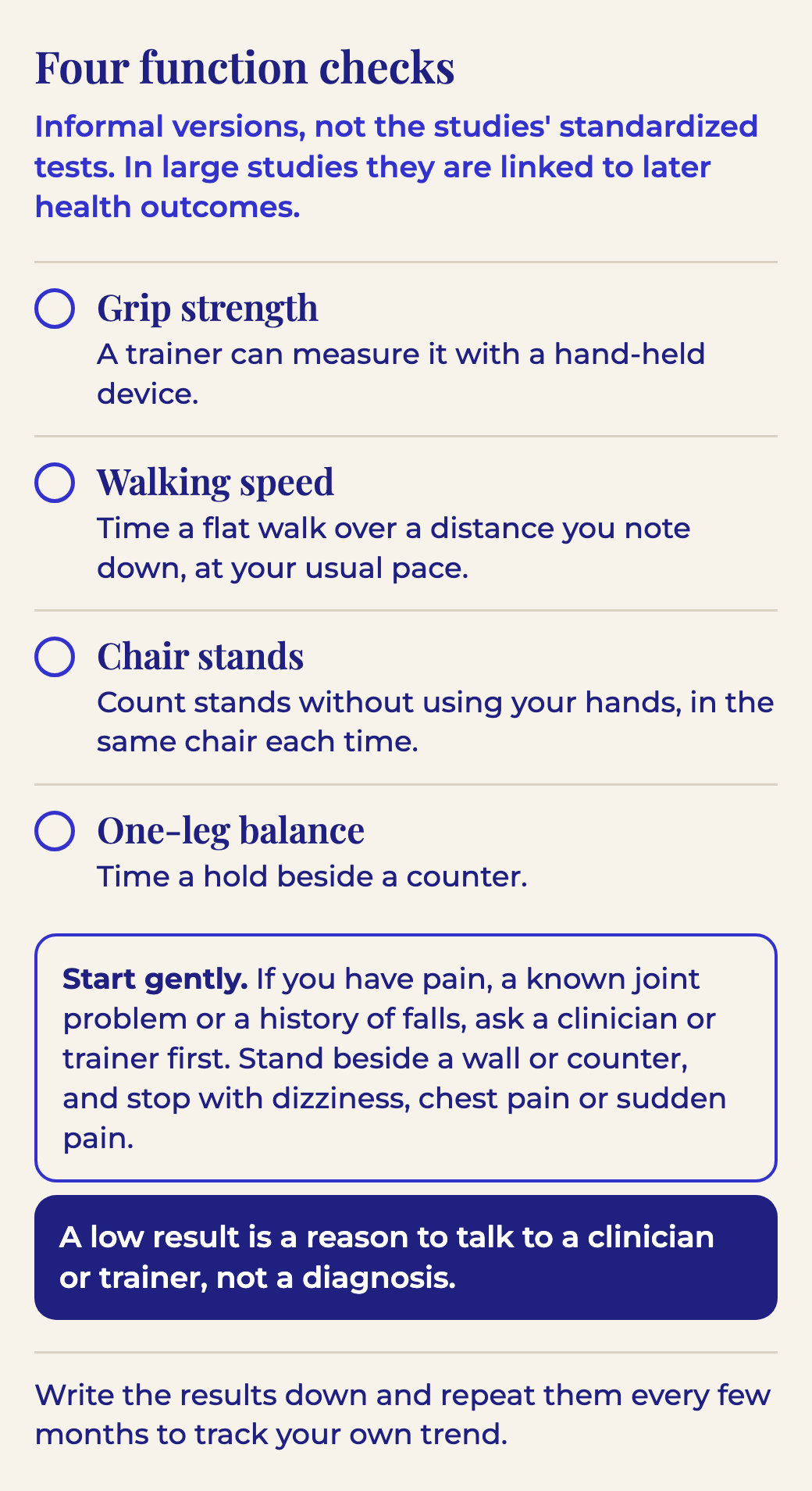
Start gently. Strength and balance work can cause injury if you begin too hard, so if you have pain, a known joint problem or a history of falls, ask a clinician or trainer first. While you test, stand beside a wall or counter, and stop with dizziness, chest pain or sudden pain.
To try informal versions at home (not the studies’ standardized tests):
- Grip: a trainer can measure it with a hand-held device.
- Walking speed: time a flat walk over a distance you note down, at your usual pace.
- Chair stands: count stands without using your hands, in the same chair each time.
- One-leg balance: time a hold beside a counter.
Then write the results down and repeat them every few months to track your own trend. A low result is a reason to talk to a clinician or trainer, not a diagnosis. Pain and stiffness can also pull these numbers down, which is one reason they are worth checking.
Do you need a biological-age test, and what are your other options?
Keep the basics. The US Preventive Services Task Force gives its top grades to services such as blood pressure screening for adults 18 and older and colorectal cancer screening at 50 to 75.
Track your function. Repeatable, and a trainer can help. These checks show a trend, not a cause.
A consumer test. Fine as curiosity. But one result is noisy, providers differ, and no result should change a medication.
A physician-led longevity assessment. What these include varies, so ask which markers are measured, what evidence supports them and what decision a result would change. The Nature Medicine review says the clinical utility of aging biomarkers remains to be validated in prospective trials.
An evaluation for joint or tendon pain. For knee, hip and hand osteoarthritis, the 2019 American College of Rheumatology (ACR) and Arthritis Foundation guideline strongly recommends exercise. Even so, injections or surgery are sometimes the right choice, and that decision is individual.
How Dr. Preet Patel approaches this
Disclosure: Gramercy Center offers consultations with Dr. Preet Patel for joint, tendon, spine and nerve conditions. Gramercy does not claim that any treatment changes a biological-age reading.
Dr. Preet Patel’s principle is that movement is a powerful medicine. Gramercy Center is a Beverly Hills practice. When pain stops you from strength training or walking, it can interrupt the habits linked to healthier aging. So pain that limits your training is a fair reason for an evaluation. The consultation is a full diagnostic one, not a five-minute triage. He reviews your records and imaging beforehand, examines you, often uses ultrasound in the room, and explains your options in plain language, including non-surgical ones. If surgery is the right answer, he refers you to a trusted surgeon. He can also connect you with trusted trainers in his network. Not every cause of joint or tendon pain needs a procedure. Learn more about Dr. Preet Patel.
When to seek care
If you have loss of bladder or bowel control, numbness in the groin or saddle area, sudden or worsening weakness, fever with back pain, pain after a major fall or accident, chest pain, or a sudden, severe headache, call 911 or go to the nearest emergency room right away.
For trouble speaking, loss of balance, a hot swollen joint with fever, or being unable to bear weight, also call 911 or go to the nearest emergency room.
See a primary care physician for whole-body changes such as unexplained weight loss, persistent fatigue or shortness of breath, and for any result that worries you. Do not ignore symptoms because a test came back “young”. If joint, tendon or back pain is stopping you from strength training or walking, a consultation is reasonable.
Bottom line: what to trust, what is uncertain, and what to do next
Biological age is an estimate, and in the research we reviewed, no study has shown that changing it improves how long or how well people live. Skip the test unless you can name what you would do differently with the result. Instead, track two or three function checks with a trainer or clinician, and keep your routine care. If pain is what limits you, have it evaluated.
Schedule a consultation with Dr. Preet Patel.
Sources
- Biological Age Predictors. EBioMedicine. 2017. https://europepmc.org/article/MED/28396265
- Associations of DNA Methylation Algorithms of Aging With Cardiovascular Disease and Mortality Risk Among US Older Adults. Journal of the American Heart Association. 2025. https://europepmc.org/article/MED/40314394
- Validation of biomarkers of aging. Nature Medicine. 2024. https://pmc.ncbi.nlm.nih.gov/articles/PMC11090477/
- DunedinPACE, a DNA methylation biomarker of the pace of aging. eLife. 2022. https://pmc.ncbi.nlm.nih.gov/articles/PMC8853656/
- A computational solution for bolstering reliability of epigenetic clocks. Nature Aging. 2022. https://pmc.ncbi.nlm.nih.gov/articles/PMC9586209/
- Impact of Healthy Lifestyle Factors on Life Expectancies in the US Population. Circulation. 2018. https://europepmc.org/article/MED/29712712
- Effect of long-term caloric restriction on DNA methylation measures of biological aging in healthy adults from the CALERIE trial. Nature Aging. 2023. https://doi.org/10.1038/s43587-022-00357-y
- Adult Activity: An Overview. Centers for Disease Control and Prevention. 2023. https://www.cdc.gov/physical-activity-basics/guidelines/adults.html
- Gait speed and survival in older adults. JAMA. 2011. https://doi.org/10.1001/jama.2010.1923
- Prognostic value of grip strength: findings from the Prospective Urban Rural Epidemiology (PURE) study. The Lancet. 2015. https://europepmc.org/article/MED/25982160
- Successful 10-second one-legged stance performance predicts survival in middle-aged and older individuals. British Journal of Sports Medicine. 2022. https://doi.org/10.1136/bjsports-2021-105360
- Short Physical Performance Battery and all-cause mortality: systematic review and meta-analysis. BMC Medicine. 2016. https://europepmc.org/article/MED/28003033
- Objectively measured physical capability levels and mortality: systematic review and meta-analysis. BMJ. 2010. https://europepmc.org/article/MED/20829298
- Effects of Resistance Training Volume on Physical Function, Lean Body Mass and Lower-Body Muscle Hypertrophy and Strength in Older Adults: network meta-analysis of 151 randomised trials. Sports Medicine. 2025. https://europepmc.org/article/MED/39405023
- USPSTF A and B Recommendations. U.S. Preventive Services Task Force. https://www.uspreventiveservicestaskforce.org/uspstf/recommendation-topics/uspstf-a-and-b-recommendations
- 2019 ACR/Arthritis Foundation Guideline for the Management of Osteoarthritis of the Hand, Hip, and Knee. Arthritis Care & Research. 2020. https://europepmc.org/article/MED/31908149
This content is for general education only and is not medical advice. It does not create a doctor-patient relationship. Treatment decisions should be made with a qualified physician after an individual evaluation. Results vary, and not everyone is a candidate for every treatment.