

Some slowing is common as people age. But reduced mobility that comes on suddenly, or a slow change that now limits daily life, is a reason to see a doctor and get checked. If you are worried about a parent or yourself, start with the emergency signs in the section right after Key takeaways. If none apply, call a primary care physician.
Many conditions can sit behind moving less, and noticing a change is not overreacting. No article can tell you whether one person’s change is routine. That takes an examination. The timings below are our own guidance, as is starting with primary care.
Key takeaways
- Call 911 or go to the nearest emergency room if any sign on the emergency list below is present.
- For a sudden or worrying change that is not on that list, contact a physician today.
- For a slow change over weeks or months with none of those signs, book a visit within days to weeks.
Is this an emergency, or can it wait?
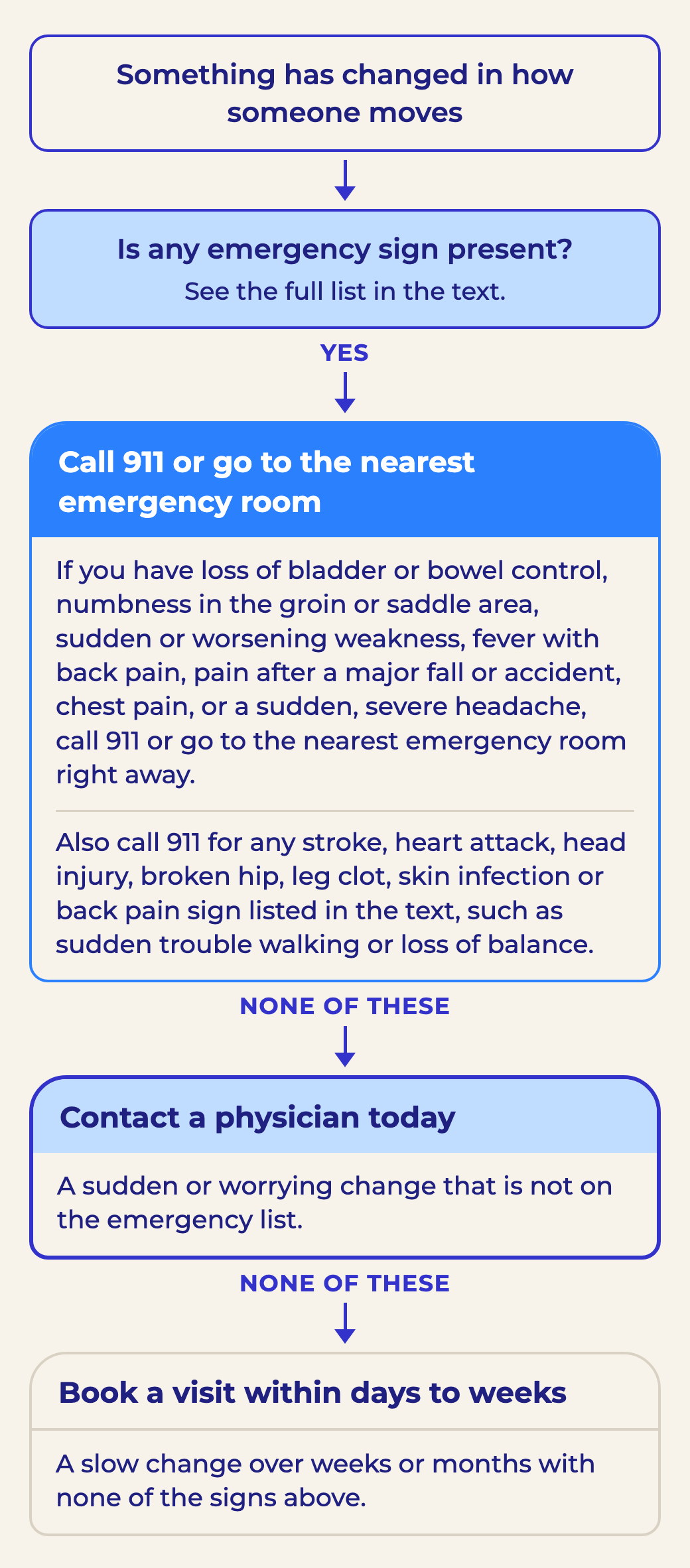
Three outcomes, from most to least urgent. This is reader guidance, not a diagnosis. No guideline gives timings for slowing walking, so the two lower outcomes are our own guidance. The NHS is England’s public health service, so we have adapted its advice to US services.
Tier 1: Call 911 or go to the nearest emergency room
If any sign in this tier is present, use Tier 1, whatever the speed of the change.
If you have loss of bladder or bowel control, numbness in the groin or saddle area, sudden or worsening weakness, fever with back pain, pain after a major fall or accident, chest pain, or a sudden, severe headache, call 911 or go to the nearest emergency room right away.
The saddle area is the area that would touch a saddle, around the genitals and anus. Weakness on that line counts whenever it is new or getting worse, however slowly it came on. If your parent seems weaker than before, treat it as a sign on this list and call 911 or go to the nearest emergency room. A major fall or accident means, for example, a fall from more than 1 meter (about 3 feet) or 5 stairs, or a high-speed accident such as a road crash (NHS head-injury wording).
Which stroke, heart and head signs need 911?
The CDC and NHS also list these signs as emergencies. Call 911 or go to the nearest emergency room:
- Stroke signs. The CDC lists sudden numbness or weakness, especially on one side, sudden trouble walking or loss of balance, sudden confusion or trouble speaking, and sudden trouble seeing. If they came and went, still call: the NHS says signs within the last 24 hours need an emergency call.
- Heart attack signs. Beyond chest pain, the CDC lists shortness of breath, which can come before chest discomfort, and feeling faint. The NHS adds chest pain spreading to the arms, neck or jaw.
- Head injury signs. After a blow to the head, the NHS lists being unable to stay awake, a seizure, a fall from more than 1 meter or 5 stairs, a high-speed injury, problems with vision or hearing, and new numbness, weakness, or problems with walking, balance or speech. The CDC adds a headache that gets worse and does not go away, and repeated vomiting.
Which hip, clot, skin and back signs need 911?
- A suspected broken hip. The NHS lists severe hip pain after a fall, or being unable to put weight on the leg.
- A leg clot with breathing trouble. A clot here means a blood clot in a vein, usually in the leg. The NHS says leg clot symptoms with shortness of breath or chest pain need an emergency call.
- A skin infection with body-wide signs. For hot, swollen, painful skin, the NHS lists a very high temperature or feeling hot, cold or shivery; a fast heartbeat or fast breathing; purple patches (which may be less obvious on brown or black skin); feeling dizzy or faint; confusion or disorientation; cold, clammy or pale skin; or unresponsiveness.
- Back pain with both legs. With back pain, the NHS lists pain, tingling, weakness or numbness in both legs.
These lists are not complete. If you think any of these signs may apply, call 911 or go to the nearest emergency room. For any other worry, call your doctor’s office or an urgent care center right away.
Tier 2: Contact a physician today
A sudden or worrying change that is not on the emergency list: contact a physician today. If you cannot reach one the same day, go to urgent care or an emergency room. Examples:
- Walking that has become slower or harder over a few days, for example after an illness or a new medicine.
- A leg that hurts to put weight on. The NHS lists this as urgent advice. If the person cannot put weight on the leg at all, use Tier 1. That step up is our guidance.
- A fall that leaves pain or an injury, such as a sore wrist or a bruise. After a major fall or a blow to the head, use Tier 1.
- A hot, swollen or red joint, leg or other skin area. The NHS says a hot, swollen, red joint needs urgent medical help, even without fever, and lists painful, hot, swollen skin as urgent advice. With any skin-infection sign in Tier 1, use Tier 1.
- Calf pain or swelling. This can be a clot. The CDC says to see your doctor “as soon as possible”. With shortness of breath or chest pain, use Tier 1.
- New numbness or tingling. With back pain and both legs affected, use Tier 1.
Tier 3: Book a visit within days to weeks
A slow change over weeks or months with none of the signs above: book a visit within days to weeks. Examples are getting tired sooner, finding everyday tasks harder, avoiding stairs, or a fall that left no injury. If a change has gone on longer than you expected, do not wait for a routine visit.
Illustrative example, not a real case: a daughter notices her father, 74, has taken the elevator for two months instead of climbing two flights. Nothing was sudden and no emergency sign applies, so this is Tier 3: a call to his primary care physician within days to weeks. Had he slowed over three days after a cold, it would be Tier 2: a call today.
How much slowing down is normal with age?
A 2023 review of 51,248 apparently healthy adults found that comfortable walking speed slows with age, on average. That is no target for any one person.
Common does not mean harmless. MedlinePlus lists arthritis, nerve disease, vision problems and infection, among others, as reasons walking can change. “It’s just age” is a conclusion for a physician to reach after an examination.
What can lie behind moving less?
Joint pain. The American Academy of Orthopaedic Surgeons says knee arthritis can make walking and climbing stairs hard. The NIH says osteoarthritis is mild for some people and causes significant pain and disability for others.
Back, spine or nerve problems. With spinal stenosis (a narrowing in the spine), symptoms can worsen with walking and ease with sitting.
Other causes. Heart failure can first show up as shortness of breath climbing stairs, which is on the emergency list above, and the CDC notes that medicines can have side effects that raise the risk of a fall.
Stroke, heart and lung disease, fractures, infection, vision problems and medicine effects belong with emergency care or primary care, not a pain practice.
What should you note before you see a doctor?
These notes help:
- when the change began, and whether it came suddenly or over months
- what has changed in daily life
- any falls, near-falls or worry about falling
- any new numbness, swelling or dizziness
- the full list of medicines and supplements
If you are helping a parent, start with what you have noticed (“You have been taking the elevator lately”) rather than what you fear, and ask what they have noticed too. Offer to go with them. They decide.
What are the treatment options once the cause is clearer?
Primary care evaluation. In our view, this is the place to start. It can check the notes above and decide which tests or specialists are needed. Causes such as stroke, heart disease or infection sit outside Gramercy’s scope.
Physical therapy and exercise. A Cochrane review of studies in older people living in the community found that exercise reduced falls, with high-certainty evidence. But that evidence is about falls, not walking speed or pain.
Medicine review. Ask a doctor or pharmacist to review current medicines. MedlinePlus says not to stop any medicine unless your provider tells you to.
Injections. For knee arthritis, the American Academy of Orthopaedic Surgeons lists pain medicines and corticosteroid injections (steroid shots that reduce inflammation) as ways to relieve pain. It notes that relief does not last indefinitely and that repeated injections carry a potential for long-term joint damage or infection.
Surgery. For knee arthritis, the same society says replacement may be recommended when pain and disability continue despite other treatment, not because of age alone. It lists infection and leg blood clots among the known risks.
What Gramercy Center offers
This section describes Gramercy’s services. It is not research evidence.
Gramercy Center offers consultations with Dr. Preet Patel for joint, tendon, spine and nerve conditions, including image-guided injections, such as injections into a joint. Dr. Preet Patel is board-certified by the American Board of Anesthesiology and an ACGME fellowship-trained interventional pain management specialist. Read more on the Meet Dr. Preet Patel page.
A client care coordinator gathers records and imaging for Dr. Preet Patel to review beforehand. One support person, such as an adult child, is welcome, and virtual consultations are available. If the cause is outside this focus, the team helps arrange care with trusted, vetted providers in Dr. Preet Patel’s network. Gramercy sees clients by appointment only, so urgent signs belong with 911 or an emergency room. Not everyone is a candidate, and results vary.
What is a sensible next step?
Check the emergency signs first. If none apply, speak with a primary care physician, today for a sudden or worrying change and within days to weeks for a slow one, and bring your notes. The cause decides who treats it.
If joint, tendon, spine or nerve pain is what holds someone back, a consultation is one reasonable option.
Schedule a consultation with Dr. Preet Patel.
Sources
Emergency and warning signs
- Signs and Symptoms of Stroke. CDC. 2026. https://www.cdc.gov/stroke/signs-symptoms/index.html
- Stroke: Symptoms. NHS. 2024. https://www.nhs.uk/conditions/stroke/symptoms/
- About Heart Attack Symptoms, Risk, and Recovery. CDC. 2024. https://www.cdc.gov/heart-disease/about/heart-attack.html
- Heart attack. NHS. 2026. https://www.nhs.uk/conditions/heart-attack/
- Head injury and concussion. NHS. 2025. https://www.nhs.uk/conditions/head-injury-and-concussion/
- Signs and Symptoms of Traumatic Brain Injury. CDC. 2025. https://www.cdc.gov/traumatic-brain-injury/signs-symptoms/index.html
- Broken hip. NHS. 2026. https://www.nhs.uk/conditions/broken-hip/
- Deep vein thrombosis (DVT). NHS. 2026. https://www.nhs.uk/conditions/deep-vein-thrombosis-dvt/
- Cellulitis. NHS. 2024. https://www.nhs.uk/conditions/cellulitis/
- Back pain. NHS. 2026. https://www.nhs.uk/conditions/back-pain/
- About Venous Thromboembolism. CDC. 2025. https://www.cdc.gov/blood-clots/about/index.html
- Septic arthritis. NHS. 2026. https://www.nhs.uk/conditions/septic-arthritis/
- Broken leg. NHS. 2025. https://www.nhs.uk/conditions/broken-leg/
Walking, falls and aging
- Walking abnormalities. MedlinePlus (NIH). 2025. https://medlineplus.gov/ency/article/003199.htm
- Andrews AW et al. Normal gait speed varies by age and sex but not by geographical region: a systematic review. Journal of Physiotherapy. 2023. https://pubmed.ncbi.nlm.nih.gov/36528509/
- Sherrington C et al. Exercise for preventing falls in older people living in the community. Cochrane Database of Systematic Reviews. 2019. https://pubmed.ncbi.nlm.nih.gov/30703272/
Causes of reduced mobility, medicines and treatment options
- Arthritis of the Knee. OrthoInfo, American Academy of Orthopaedic Surgeons. https://www.orthoinfo.org/en/diseases–conditions/arthritis-of-the-knee/
- Osteoarthritis. NIAMS (NIH). 2023. https://www.niams.nih.gov/health-topics/osteoarthritis
- Spinal Stenosis. NIAMS (NIH). 2023. https://www.niams.nih.gov/health-topics/spinal-stenosis
- Heart Failure: Symptoms. NHLBI (NIH). 2022. https://www.nhlbi.nih.gov/health/heart-failure/symptoms
- Medicines Risk Fact Sheet. CDC. 2024. https://www.cdc.gov/older-adult-drivers/medicine/index.html
- Taking multiple medicines safely. MedlinePlus (NIH). 2024. https://medlineplus.gov/ency/patientinstructions/000883.htm
- Total Knee Replacement. OrthoInfo, American Academy of Orthopaedic Surgeons. https://www.orthoinfo.org/en/treatment/total-knee-replacement/
This content is for general education only and is not medical advice. It does not create a doctor-patient relationship. Treatment decisions should be made with a qualified physician after an individual evaluation. Results vary, and not everyone is a candidate for every treatment.