
Hip pain is a location, not a diagnosis, and it does not always come from the hip. An ache around the hip can come from the joint itself, the tendons beside it, or the lower back and sacroiliac (SI) joint, where the spine meets the pelvis. These sources are managed differently, and a few signs need care right away.
Where it hurts is a clue, not a verdict. Groin pain is the classic site of hip-joint trouble. Yet in one small retrospective study of 51 adults with pain thought to come from the hip joint, buttock pain (71%) was reported more often than groin pain (55%). “It’s just aging” is not a diagnosis, and pain that limits your walking, golf or travel is worth examining. An examination, and sometimes imaging, ties the clues together.
Key takeaways
- Location is a clue, not a verdict.
- Groin pain often points to the hip joint, outer-hip pain to the tendons, and buttock pain to the hip, lower back or SI joint.
- Scans often show changes in people with no pain, and a finding does not make your pain unreal.
- Some signs need the emergency room, and some need a physician today.
Does hip pain always come from the hip joint?
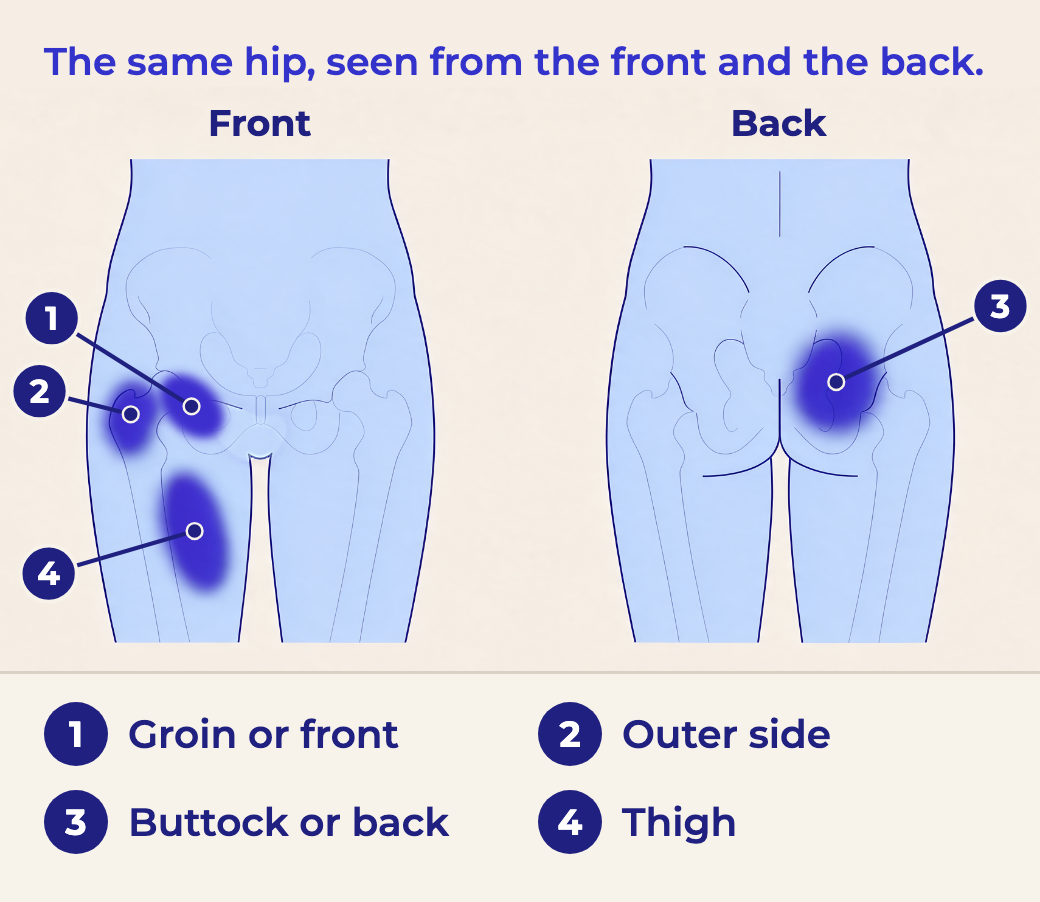
No. The hip is a ball-and-socket joint surrounded by tendons, bursae (small fluid-filled cushions), muscle and nerves, and it sits close to the lower back and SI joint. People say “hip” for pain in the groin, the side, the buttock or the thigh, and each can have a different source. Pain felt away from its source is called referred pain.
Examination tests are imperfect too: a 2013 systematic review of tests for sports-related hip problems found most had weak diagnostic properties. The diagram shows the four zones where hip-area pain is usually felt.
What does pain in the groin or front of the hip usually mean?
Hip osteoarthritis (wear and loss of the cartilage that cushions the joint) is the best-known cause. The American Academy of Orthopaedic Surgeons (AAOS) hip osteoarthritis guidance lists groin pain as the most common symptom, which can spread to the buttock, thigh or knee, with stiffness worse in the morning or after sitting. It occurs most often in people 50 and older.
Femoroacetabular impingement (FAI) means extra bone along the ball or socket makes the joint rub. AAOS impingement guidance says the pain is often in the groin, and that over time the rubbing can tear the labrum, the rim of cartilage around the socket.
Rarer, but worth knowing. Avascular necrosis (bone damage from lost blood supply) often starts with hip pain, and AAOS osteonecrosis guidance notes that early changes “may not show up on an x-ray”. Long-term corticosteroid use, heavy alcohol use and hip injury are named risk factors.
What causes pain on the outer side of the hip?
Pain over the bony point on the outer hip is called greater trochanteric pain syndrome (GTPS). It was once labeled trochanteric bursitis, but in a retrospective ultrasound review of 877 people referred to one US institution for outer-hip pain, bursitis was present in 20% and damage in the gluteal tendons, the tendons that anchor the buttock muscles, in about half. The tendons were involved more often than the bursa.
AAOS bursitis guidance describes pain that is worse lying on the affected side at night and may worsen with prolonged walking, stairs or squatting. It is more common in women and in middle-aged or older adults.
Could buttock or back-of-hip pain come from the spine or sacroiliac joint?
Yes. The lower spine can send pain to the buttock and legs. In lumbar spinal stenosis (narrowing of the spinal canal), AAOS stenosis guidance describes burning pain in the buttocks or legs that is worse standing and walking and eases with sitting or leaning forward.
Example (illustrative, not a real client): a 62-year-old golfer is treated for hip “bursitis.” The ache is mostly in the buttock, returns on long walks and eases when he sits. An examination finds the source is the lower back, not the hip.
The SI joint is harder still to confirm. A 2013 review notes that no single examination finding reliably identifies it, and a systematic review reports that confirming it relies on controlled numbing-injection blocks. Hip and spine problems can also overlap. Sometimes it’s both, and an examination is needed to tell.
Can a hip problem be felt in the thigh or knee?
Yes. According to AAOS hip osteoarthritis guidance, hip osteoarthritis can show up as thigh or knee pain.
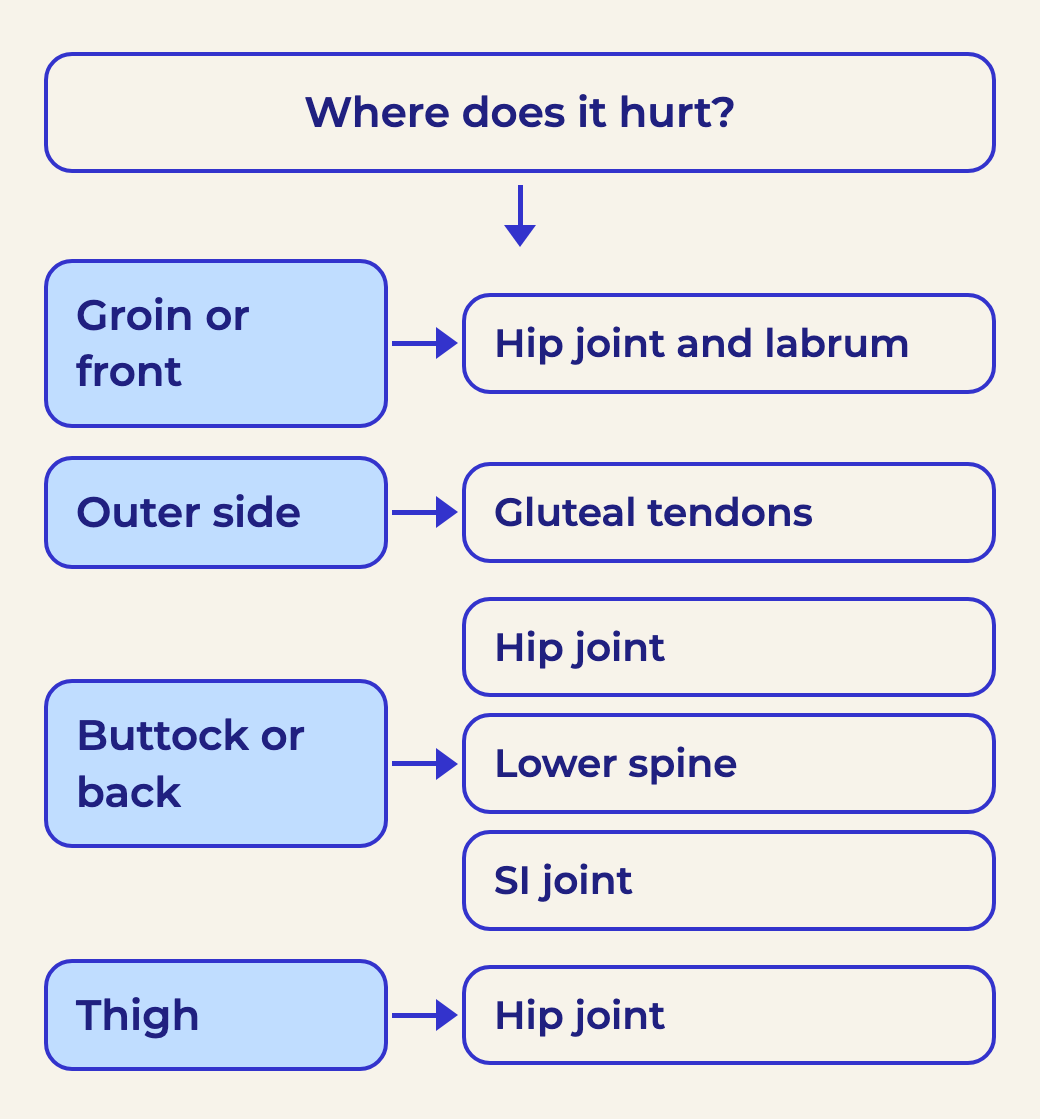
Clues, not a diagnosis: these are the usual sources, and more than one can be present.
Can a scan tell me what is causing my hip pain?
Sometimes, but a finding is a candidate explanation, not proof. A finding can be present without pain, and some findings are more common with pain, so a scan helps most when it is matched to an examination.
The American College of Radiology’s appropriateness criteria say plain X-ray is usually the first imaging test for chronic hip pain, with MRI or other scans depending on the clinical picture. Whether you need a scan before a consultation is a question for the physician.
The evidence runs both ways. A 2018 review of 29 studies found labral tears (the rim damage described above) on imaging in 54% of people without pain and 62% of those with pain. Cartilage defects (areas of damaged cartilage) were far more common with pain, 64% versus 12%, though that figure rests on limited evidence. Most studies had a moderate-to-high risk of bias.
In a Framingham cohort of 946 older adults, only 15.6% of hips with frequent pain showed osteoarthritis on X-ray, so a normal X-ray does not rule it out.
None of this means your pain is imagined or unimportant.
What are the main ways hip problems are treated?
The right option depends on the diagnosis, so the diagnosis comes first.
- Exercise and physical therapy come first in guidelines. The American College of Rheumatology (ACR) 2019 guideline strongly recommends exercise for hip osteoarthritis. A 2026 Cochrane update called the average benefit slight, about 7 points on a 0 to 100 pain scale compared with no treatment, which the authors judged unlikely to be clinically meaningful. Guidelines still list exercise first.
- For outer-hip tendon pain, a 2018 randomized trial of 204 adults with gluteal tendinopathy found a physiotherapist-led education and exercise program did better than a single steroid injection or waiting at 8 weeks.
- Steroid injection is a choice some clients make. A 2016 review of five small trials in hip osteoarthritis found short-term relief but called the evidence weak, and a 2019 radiology review reports serious joint problems, frequency unknown.
- Platelet-rich plasma (PRP), made from your own blood, has limited, mixed evidence in hip osteoarthritis, and the ACR recommends against it. One placebo-controlled trial of 79 people with long-standing outer-hip pain found no difference.
- Surgery helps selected people. In a UK trial of 348 adults with FAI, keyhole (arthroscopic) surgery improved hip scores more than a therapy program at 12 months, with more unwanted events, and more serious ones in the surgery group (6 versus 1). AAOS describes total hip replacement as “one of the most successful operations in all of medicine,” with risks including infection (under 2%), blood clots, dislocation and wear.
How Dr. Preet Patel approaches hip pain
Gramercy Center offers joint injections and ultrasound-guided platelet-rich plasma. Sacroiliac joint injections are also available.
Dr. Preet Patel’s consultation is a full diagnostic one. He reviews your records and imaging before you arrive, examines you, often uses ultrasound in the room, and explains your options in plain language. If an injection is recommended: for ultrasound-guided procedures, the area is numbed first with a local anesthetic, and most clients return to light activity within a day or two. Any injection carries risks, including soreness, infection, bleeding and no improvement, and not everyone is a candidate. If surgery is the right answer, Dr. Preet Patel will advise you and make sure you are referred to an excellent surgeon.
When should hip pain be checked right away?
If you are unsure which step fits, choose the more urgent one.
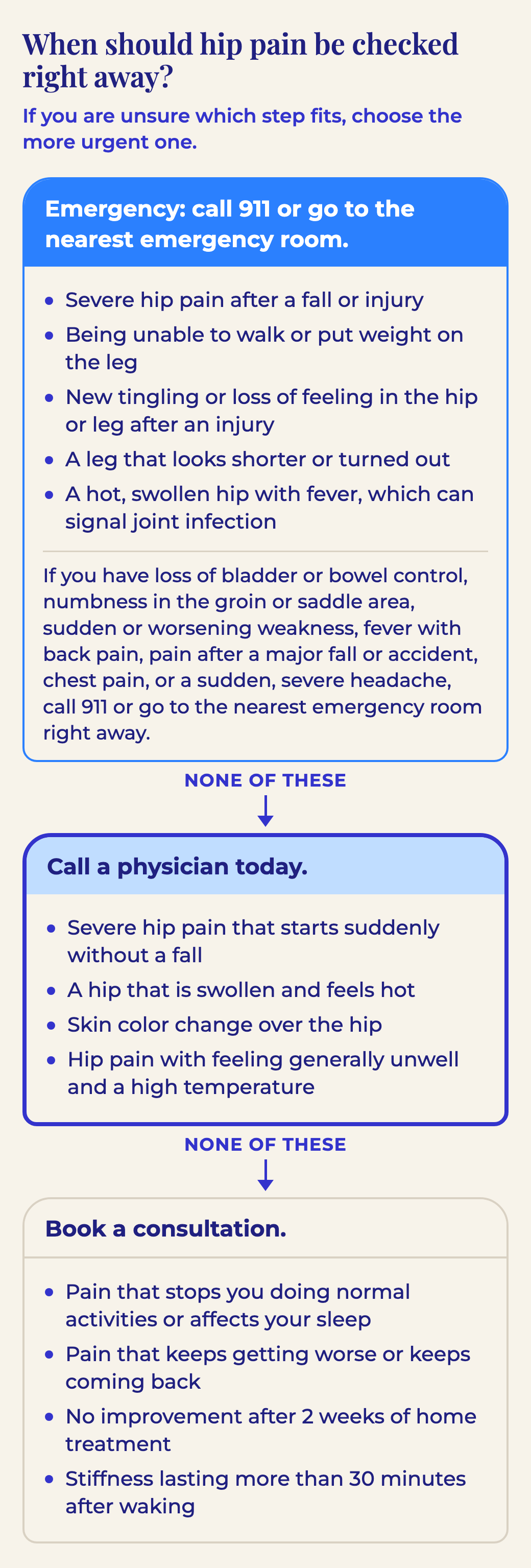
Emergency: call 911 or go to the nearest emergency room.
- The UK National Health Service (NHS) lists severe hip pain after a fall or injury, being unable to walk or put weight on the leg, and new tingling or loss of feeling in the hip or leg after an injury. A leg that looks shorter or turned out is also a sign of hip fracture, per AAOS.
- A hot, swollen hip with fever, which can signal joint infection. Treat this as an emergency; the NHS places it one step lower, at “urgent”.
- If you have loss of bladder or bowel control, numbness in the groin or saddle area, sudden or worsening weakness, fever with back pain, pain after a major fall or accident, chest pain, or a sudden, severe headache, call 911 or go to the nearest emergency room right away.
Call a physician today. The NHS (reviewed November 2025) places these at urgent, meaning urgent medical advice, so call your physician today:
- severe hip pain that starts suddenly without a fall
- a hip that is swollen and feels hot
- skin color change over the hip
- hip pain with feeling generally unwell and a high temperature
Book a consultation. The same NHS page lists these as reasons to see a doctor:
- pain that stops you doing normal activities or affects your sleep
- pain that keeps getting worse or keeps coming back
- no improvement after 2 weeks of home treatment
- stiffness lasting more than 30 minutes after waking
This post is written for adults. In teenagers, hip, groin, thigh or knee pain or a limp can signal slipped capital femoral epiphysis, a hip condition that needs prompt diagnosis.
Where does your hip pain come from, and what should you do next?
The joint, the tendons beside it, and the lower back or SI joint are the usual places to look. Location and scans are both imperfect. Before you book, note where it hurts and what triggers it, and bring any prior imaging.
Schedule a consultation with Dr. Preet Patel. You can also call (310) 439-8009.
Sources
- Hip joint pain referral patterns: a descriptive study (Lesher et al.). Pain Medicine. 2008. https://pubmed.ncbi.nlm.nih.gov/18254763/
- Diagnostic accuracy of clinical tests of the hip: a systematic review with meta-analysis (Reiman et al.). Br J Sports Med. 2013. https://pubmed.ncbi.nlm.nih.gov/22773321/
- Osteoarthritis of the Hip. AAOS OrthoInfo. No review date shown (accessed October 13, 2026). https://www.orthoinfo.org/en/diseases–conditions/osteoarthritis-of-the-hip/
- Femoroacetabular Impingement. AAOS OrthoInfo. No review date shown (accessed October 13, 2026). https://www.orthoinfo.org/en/diseases–conditions/femoroacetabular-impingement/
- Osteonecrosis of the Hip. AAOS OrthoInfo. No review date shown (accessed October 13, 2026). https://www.orthoinfo.org/en/diseases–conditions/osteonecrosis-of-the-hip/
- Sonography of greater trochanteric pain syndrome and the rarity of primary bursitis (Long et al.). AJR Am J Roentgenol. 2013. https://pubmed.ncbi.nlm.nih.gov/24147479/
- Hip Bursitis. AAOS OrthoInfo. No review date shown (accessed October 13, 2026). https://www.orthoinfo.org/en/diseases–conditions/hip-bursitis/
- Lumbar Spinal Stenosis. AAOS OrthoInfo. No review date shown (accessed October 13, 2026). https://www.orthoinfo.org/en/diseases–conditions/lumbar-spinal-stenosis/
- Sacroiliac joint pain: a comprehensive review of epidemiology, diagnosis and treatment (Cohen et al.). Expert Rev Neurother. 2013. https://pubmed.ncbi.nlm.nih.gov/23253394/
- Evaluation of sacroiliac joint interventions: a systematic appraisal of the literature (Rupert et al.). Pain Physician. 2009. https://pubmed.ncbi.nlm.nih.gov/19305487/
- ACR Appropriateness Criteria Chronic Hip Pain: 2022 Update (Jawetz et al.). J Am Coll Radiol. 2023. https://pubmed.ncbi.nlm.nih.gov/37236751/
- What is the prevalence of imaging-defined intra-articular hip pathologies in people with and without pain? A systematic review and meta-analysis (Heerey et al.). Br J Sports Med. 2018. https://pubmed.ncbi.nlm.nih.gov/29540366/
- Association of hip pain with radiographic evidence of hip osteoarthritis: diagnostic test study (Kim et al.). BMJ. 2015. https://pubmed.ncbi.nlm.nih.gov/26631296/
- 2019 ACR/Arthritis Foundation Guideline for the Management of Osteoarthritis of the Hand, Hip, and Knee (Kolasinski et al.). Arthritis Care Res. 2020. https://pubmed.ncbi.nlm.nih.gov/31908149/
- Exercise for osteoarthritis of the hip (Hall et al.). Cochrane Database Syst Rev. 2026. https://pubmed.ncbi.nlm.nih.gov/42486497/
- Education plus exercise versus corticosteroid injection use versus a wait and see approach on global outcome and pain from gluteal tendinopathy (Mellor et al.). BMJ. 2018. https://pubmed.ncbi.nlm.nih.gov/29720374/
- The efficacy of intra-articular steroids in hip osteoarthritis: a systematic review (McCabe et al.). Osteoarthritis Cartilage. 2016. https://pubmed.ncbi.nlm.nih.gov/27143362/
- Intra-articular Corticosteroid Injections in the Hip and Knee: Perhaps Not as Safe as We Thought? (Kompel et al.). Radiology. 2019. https://pubmed.ncbi.nlm.nih.gov/31617798/
- Effectiveness of platelet-rich plasma in the management of hip osteoarthritis: a systematic review and meta-analysis (Medina-Porqueres et al.). Clin Rheumatol. 2021. https://pubmed.ncbi.nlm.nih.gov/32607659/
- American College of Rheumatology and Arthritis Foundation release updated treatment guideline for osteoarthritis (press release). American College of Rheumatology. January 7, 2020. https://rheumatology.org/press-releases/american-college-of-rheumatology-arthritis-foundation-release-updated-treatment-guideline-for-osteoarthritis
- Efficacy of Platelet-Rich Plasma Versus Placebo for the Treatment of Greater Trochanteric Pain Syndrome: A Double-Blinded RCT (Atchia et al.). J Bone Joint Surg Am. 2025. https://pubmed.ncbi.nlm.nih.gov/39804899/
- Hip arthroscopy versus best conservative care for the treatment of femoroacetabular impingement syndrome (UK FASHIoN) (Griffin et al.). Lancet. 2018. https://pubmed.ncbi.nlm.nih.gov/29893223/
- Total Hip Replacement. AAOS OrthoInfo. No review date shown (accessed October 13, 2026). https://www.orthoinfo.org/en/treatment/total-hip-replacement/
- Hip pain in adults. NHS (UK). Reviewed November 20, 2025. https://www.nhs.uk/conditions/hip-pain-adults/
- Hip Fractures. AAOS OrthoInfo. No review date shown (accessed October 13, 2026). https://www.orthoinfo.org/en/diseases–conditions/hip-fractures/
- Slipped Capital Femoral Epiphysis (SCFE). AAOS OrthoInfo. No review date shown (accessed October 13, 2026). https://www.orthoinfo.org/en/diseases–conditions/slipped-capital-femoral-epiphysis-scfe/
This content is for general education only and is not medical advice. It does not create a doctor-patient relationship. Treatment decisions should be made with a qualified physician after an individual evaluation. Results vary, and not everyone is a candidate for every treatment.