
Knee pain going up stairs, at home or in a hotel or airport, is common and has several possible sources. The useful question is what the pattern suggests and what to do first. Stairs put more force through the joint between the kneecap and thighbone than level walking does. Where it hurts is a clue, not a diagnosis, and only an examination can tell the sources apart.
Common sources include the kneecap joint, the meniscus (a cartilage cushion), arthritis and an irritated tendon. Gradual strengthening of the thigh and hip is the best-supported first step, although the trial evidence behind it is of very low certainty. What remains uncertain is how well pain location predicts the cause, and how much of what a scan shows is the source of the pain.
In short
- Stair pain has several possible sources. Where it hurts suggests, but does not name, the source.
- Gradual thigh and hip strengthening is the best-supported first step. Load changes are common advice, but not graded evidence.
- A knee that locks, gives way or swells after an injury needs urgent advice, and some signs need emergency care.
Why do stairs make a sore knee hurt?
A 2022 pooled analysis of modelled estimates put the force through the kneecap joint (the patellofemoral joint) at roughly 2.5 to 3.2 times body weight going up stairs, against about 1 for level walking. Going down also loads the joint with similar force. These are estimates in healthy adults and in people with patellofemoral pain, not measures of pain.
What can cause knee pain on stairs, and where does it tend to hurt?
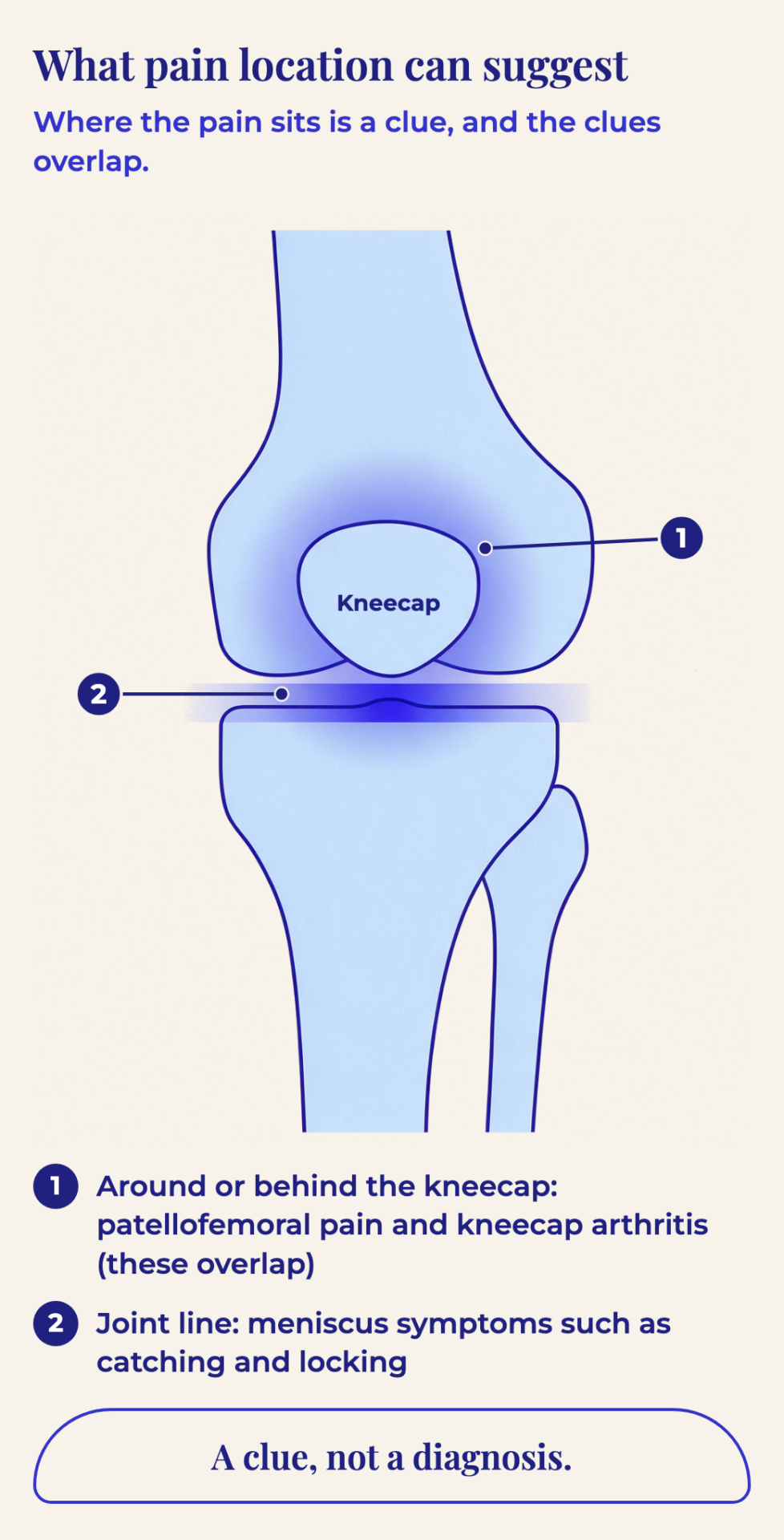
Where the pain sits is a clue, and the clues overlap.
Around or behind the kneecap (patellofemoral pain). A 2016 expert consensus defines it as pain around or behind the kneecap that stairs, squatting or running provoke. A 2019 physical therapy clinical practice guideline adds that it can worsen with prolonged sitting and persist for years.
Catching or locking (the meniscus). The meniscus is the cartilage cushion between the thighbone and shinbone. The American Academy of Orthopaedic Surgeons (AAOS) lists pain, swelling, catching, locking and giving way as symptoms, and degenerative tears as more common with age. But its list does not mention stairs.
Arthritis (osteoarthritis). Osteoarthritis is wear of the joint cartilage, and it can affect the underside of the kneecap. AAOS describes kneecap arthritis as hurting with stairs, sitting with bent knees and squatting. The American College of Radiology names osteoarthritis the most common cause of chronic knee pain.
Tendon irritation (patellar tendinopathy). MedlinePlus lists tendinitis among causes of knee pain. Loading exercise is central to its care, although a 2026 review rated that evidence low certainty. No source reviewed for this post ties it to stairs.
Pain behind the kneecap on stairs fits both patellofemoral pain and kneecap arthritis, so location alone does not separate them. Catching or locking is a listed meniscal symptom, so it is worth mentioning at an examination. Beyond that, an examination and sometimes imaging are needed. No single test diagnoses patellofemoral pain, and the radiology panel says examination alone cannot reliably identify the cause.
Does an MRI or X-ray tell you which one it is?
Not on its own. In the Framingham study of adults aged 50 to 90, 61% of people with a meniscal tear had no pain, aching or stiffness in the previous month. A pooled MRI analysis of pain-free, uninjured adults found meniscal tears in 4% in studies averaging under 40 and 19% in studies averaging 40 or older.
So a line such as “degenerative meniscal tear” on a report is an imaging finding that may not be the cause of the pain. Imaging answers a specific question after an examination. It is not a verdict. If you already have a report, bring it to the examination rather than treating its wording as the answer.
What does the evidence support, and where does each option fit?
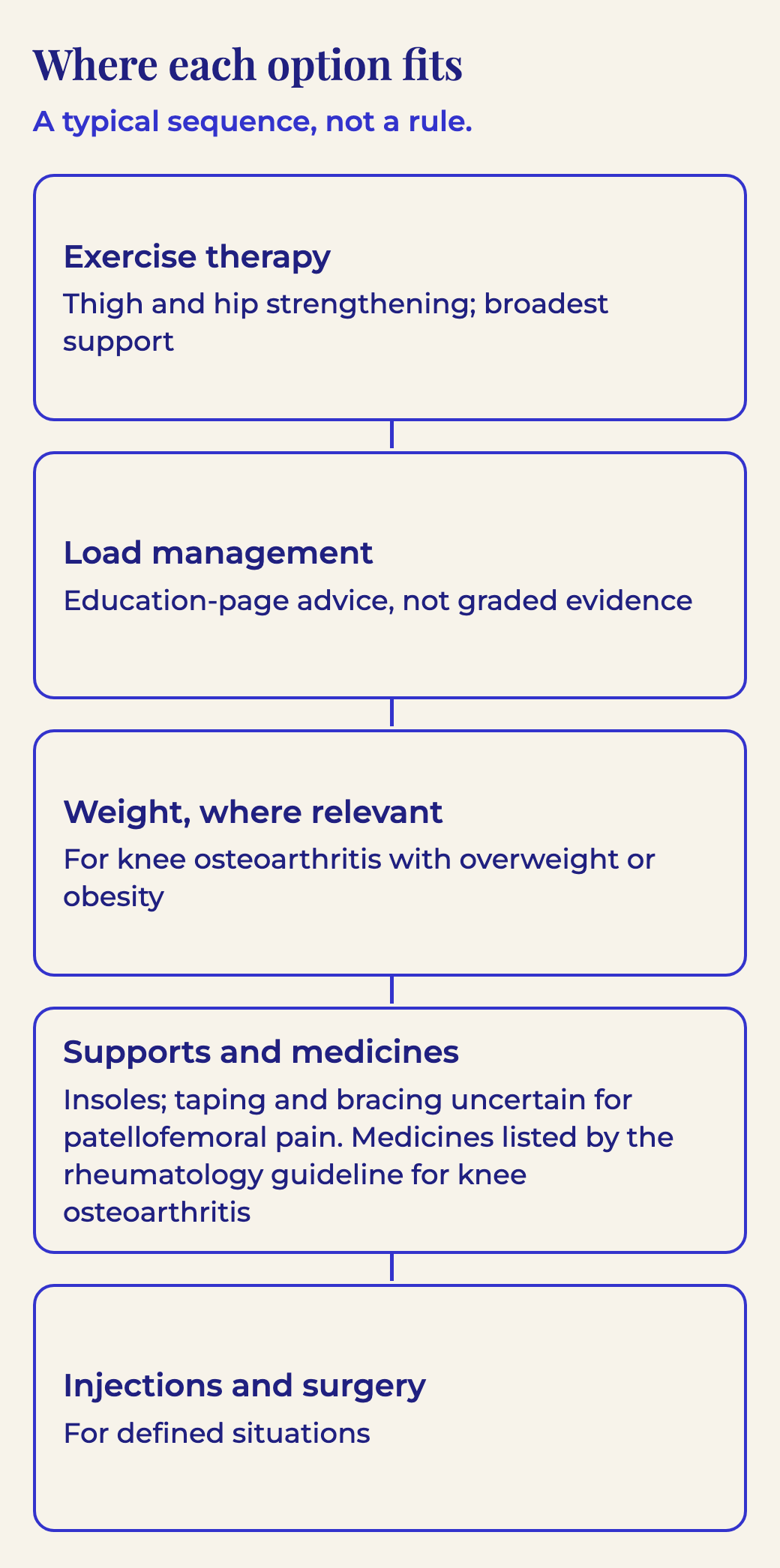
Exercise has the broadest support. The first step most sources point to is gradual strengthening of the thigh (quadriceps) and hip muscles, ideally guided by a physical therapist. Which exercises, and how much, depends on your examination. To judge whether it is working, the NHS advises seeing a doctor if knee pain does not improve within a few weeks.
How certain is the evidence? The 2018 patellofemoral consensus supports exercise therapy, especially hip and knee exercises combined. A 2015 Cochrane review (a pooled analysis of trials) of 31 trials rated the certainty of the trial evidence very low, so the size of the benefit is uncertain, although the direction was consistent and the consensus panels recommend exercise.
For knee osteoarthritis, the American College of Rheumatology and Arthritis Foundation 2019 guideline strongly recommends exercise. A 2024 Cochrane review found short-term pain relief that was modest. Adverse events were more common with exercise, so ask your physical therapist how to pace the load.
What about rest, weight, supports and medicines?
Rest, load and stairs depend on the situation. “Load” is the work the knee takes on: stairs, squats, running, and how quickly training increases. For new, minor pain, the NHS advises putting as little weight on the knee as possible. When pain lingers rather than settles, the consensus statements emphasize exercise. For arthritis, AAOS education pages suggest limiting activities that aggravate it, such as stairs, and choosing lower-impact options. That is education-page advice, not graded evidence.
Weight, where relevant. The same rheumatology guideline also strongly recommends weight loss for people with knee osteoarthritis and overweight or obesity.
Supports and medicines. For patellofemoral pain, a 2016 consensus recommended foot orthoses (insoles) for short-term pain relief only, with large individual variability. Taping and bracing remain uncertain. The rheumatology guideline also lists topical and oral anti-inflammatory medicines for knee osteoarthritis, so ask a physician whether any suit you.
Where do injections and surgery fit?
Injections. For knee osteoarthritis, a 2015 Cochrane review of 27 trials found corticosteroid (cortisone) injections eased pain more than a dummy injection or none in the first weeks, with the benefit no longer detectable by 26 weeks, on low-quality evidence.
The rheumatology guideline still strongly recommends them for knee osteoarthritis, so they are a reasonable option where they fit. AAOS notes the effects are temporary and that repeated injections may increase joint damage. For patellofemoral pain, the 2018 consensus lists exercise, orthoses and other physical options and does not list injections.
Surgery. A 2017 BMJ guideline strongly recommends against arthroscopy (keyhole surgery) for nearly all degenerative knee disease, with an exception for a knee that cannot be fully straightened. It excludes symptoms that follow a major knee injury with sudden swelling.
In a trial of 140 adults with a degenerative meniscal tear, 12 weeks of supervised exercise gave similar knee function to keyhole surgery at 2 years, although 19% of the exercise group later had surgery.
AAOS says knee replacement may be recommended when arthritis causes disability that other treatment has not relieved. In those situations, surgery may be the right option, decided after an individual evaluation. Surgery carries risks of its own, which a surgeon should explain before any decision.
How Dr. Preet Patel approaches knee pain on stairs
This section describes Gramercy’s services. It is not research evidence.
Gramercy Center offers intra-articular joint injections.
Clients receive a full diagnostic consultation. Dr. Preet Patel reviews your records and imaging before you arrive, examines you, often uses ultrasound in the room, and explains your options in plain language. The aim is to work out which source fits and what the plan is. That can include exercise coordinated with your physical therapist or trainer. If surgery is the right answer, he can connect you with vetted surgeons in his network. Not everyone is a candidate for every treatment, and results vary. See Gramercy’s knee pain page.
When should you get a knee checked, and when is it an emergency?
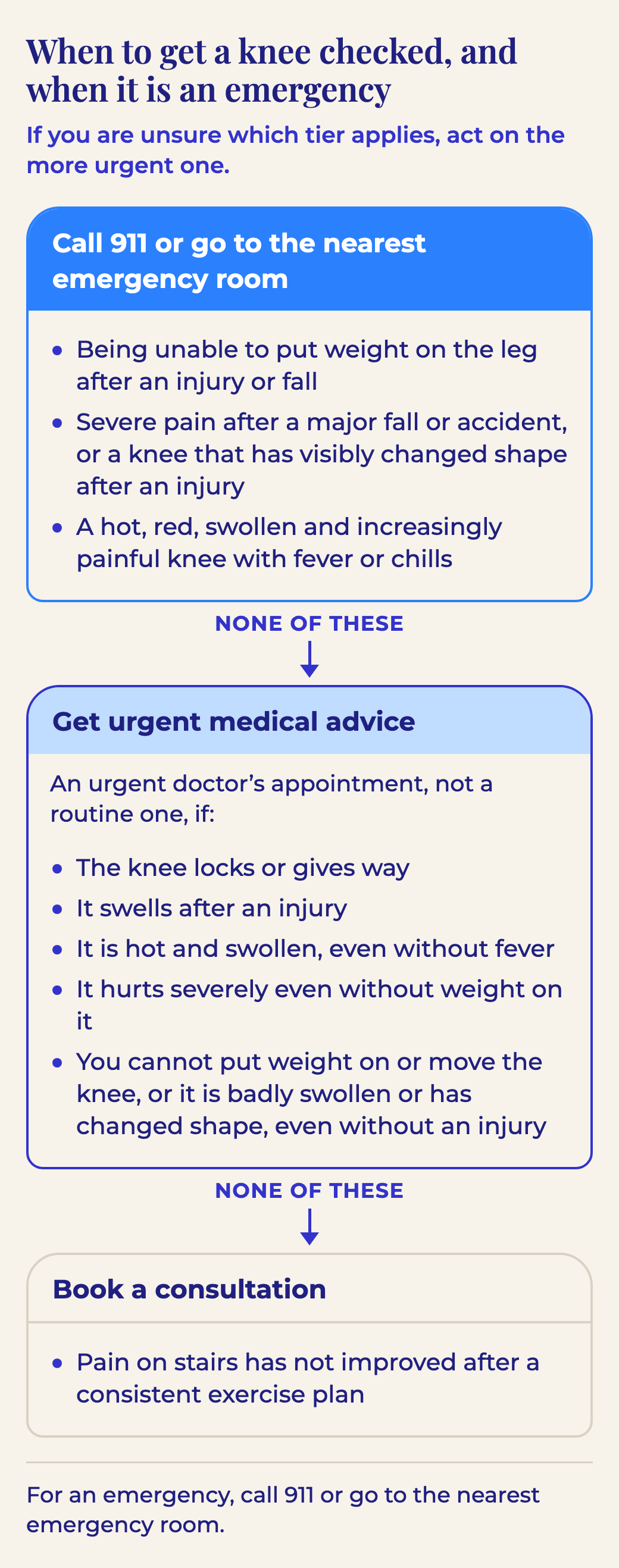
Call 911 or go to the nearest emergency room for:
- being unable to put weight on the leg after an injury or fall;
- severe pain after a major fall or accident, or a knee that has visibly changed shape after an injury;
- a hot, red, swollen and increasingly painful knee with fever or chills.
The NHS knee pain page and MedlinePlus list these signs. Those pages word them as urgent advice. This post sends them to emergency care to be cautious. The NHS page on septic arthritis names joint pain with a high temperature.
Get urgent medical advice (an urgent doctor’s appointment, not a routine one) if the knee locks or gives way, swells after an injury, is hot and swollen, or hurts severely even without weight on it. The same applies if you cannot put weight on or move the knee, or it is badly swollen or has changed shape, even without an injury. Fever is common with a joint infection but not always present, so a hot, swollen knee needs urgent advice even without fever.
Book a consultation if pain on stairs has not improved after a consistent exercise plan. The NHS frame is a few weeks. MedlinePlus says to contact a provider if new, mild pain lasts 3 days despite home care.
If you are unsure which tier applies, act on the more urgent one. For an emergency, call 911 or go to the nearest emergency room.
What is a sensible next step?
Where stair pain hurts is a clue, not a diagnosis. Gradual thigh and hip strengthening is the best-supported first step; injections or surgery are for defined situations. Pain location does not reliably identify the cause, scan findings are common without pain, and evidence for taping and bracing is limited. Start with a physical therapist or trainer, and keep the warning signs in mind.
Schedule a consultation with Dr. Preet Patel. You can also call (310) 439-8009.
Sources
- A systematic review and meta-analysis of patellofemoral joint reaction force across everyday activities, therapeutic exercises, and physical interventions. Br J Sports Med. 2022. https://pubmed.ncbi.nlm.nih.gov/35115309/
- 2016 Patellofemoral pain consensus statement from the 4th International Patellofemoral Pain Research Retreat, Part 1. Br J Sports Med. 2016. https://pmc.ncbi.nlm.nih.gov/articles/PMC4975817/
- Patellofemoral Pain: Clinical Practice Guidelines. J Orthop Sports Phys Ther. 2019. https://pubmed.ncbi.nlm.nih.gov/31475628/
- Meniscus Tears. AAOS OrthoInfo. https://www.orthoinfo.org/en/diseases–conditions/meniscus-tears/
- Patellofemoral Arthritis. AAOS OrthoInfo. https://www.orthoinfo.org/en/diseases–conditions/patellofemoral-arthritis/
- ACR Appropriateness Criteria: Chronic Knee Pain, Update 2026. American College of Radiology. J Am Coll Radiol. 2026. https://pubmed.ncbi.nlm.nih.gov/42340275/
- Knee pain. MedlinePlus. https://medlineplus.gov/ency/article/003187.htm
- Exercise Loading Strategies for Patellar Tendinopathy: a systematic review and meta-analysis. J Funct Morphol Kinesiol. 2026. https://pubmed.ncbi.nlm.nih.gov/42783641/
- Incidental meniscal findings on knee MRI in middle-aged and elderly persons. N Engl J Med. 2008. https://pubmed.ncbi.nlm.nih.gov/18784100/
- Prevalence of knee osteoarthritis features on magnetic resonance imaging in asymptomatic uninjured adults. Br J Sports Med. 2019. https://pubmed.ncbi.nlm.nih.gov/29886437/
- Knee pain. NHS. https://www.nhs.uk/conditions/knee-pain/
- 2018 Consensus statement on exercise therapy and physical interventions to treat patellofemoral pain. Br J Sports Med. 2018. https://pubmed.ncbi.nlm.nih.gov/29925502/
- Exercise for treating patellofemoral pain syndrome. Cochrane Database Syst Rev. 2015. https://pubmed.ncbi.nlm.nih.gov/25603546/
- 2019 American College of Rheumatology/Arthritis Foundation Guideline for the Management of Osteoarthritis of the Hand, Hip, and Knee. 2019. https://pubmed.ncbi.nlm.nih.gov/31908149/
- Exercise for osteoarthritis of the knee. Cochrane Database Syst Rev. 2024. https://pubmed.ncbi.nlm.nih.gov/39625083/
- Arthritis of the Knee. AAOS OrthoInfo. https://www.orthoinfo.org/en/diseases–conditions/arthritis-of-the-knee/
- 2016 Patellofemoral pain consensus statement, Part 2: recommended physical interventions. Br J Sports Med. 2016. https://pmc.ncbi.nlm.nih.gov/articles/PMC4975825/
- Intra-articular corticosteroid for knee osteoarthritis. Cochrane Database Syst Rev. 2015. https://pubmed.ncbi.nlm.nih.gov/26490760/
- Arthroscopic surgery for degenerative knee arthritis and meniscal tears: a clinical practice guideline. BMJ. 2017. https://pubmed.ncbi.nlm.nih.gov/28490431/
- Exercise therapy versus arthroscopic partial meniscectomy for degenerative meniscal tear in middle aged patients. BMJ. 2016. https://pubmed.ncbi.nlm.nih.gov/27440192/
- Septic arthritis. NHS. https://www.nhs.uk/conditions/septic-arthritis/
This content is for general education only and is not medical advice. It does not create a doctor-patient relationship. Treatment decisions should be made with a qualified physician after an individual evaluation. Results vary, and not everyone is a candidate for every treatment.