

Neck pain that runs down the arm has a common cause: a nerve root in the neck being squeezed or irritated. The clinical name is cervical radiculopathy (a pinched or irritated nerve root in the neck).
If it wakes you at night or cuts into your flights and training, you want to know whether it is serious and what moves it along. What is less certain is how well a scan explains one person’s pain and how long injections help.
Key takeaways
- Arm pain with chest pressure, shortness of breath, sweating or nausea is an emergency. If you are unsure whether it could be your heart, call 911.
- Clumsy hands, unsteady walking or new weakness need prompt medical attention, not a wait-and-see approach.
- Most people improve over weeks to months without surgery, and some take longer.
- In the trials reviewed, no single non-surgical treatment stood out. An exam, not a scan alone, decides what fits.
Why does neck pain travel down the arm?
Nerves leave the spinal cord through gaps between the neck vertebrae and carry signals to the shoulder, arm and hand. When a root is squeezed or irritated, you feel it along the nerve’s path, not only at the neck. Pain usually starts in the neck and follows the nerve into the shoulder and arm, as a UK primary-care review describes. Tingling, numbness or weakness can also come with it. Symptoms are usually on one side, and the three lowest nerve roots in the neck (labeled C5 to C7) are most often affected. But where you feel symptoms varies from person to person.
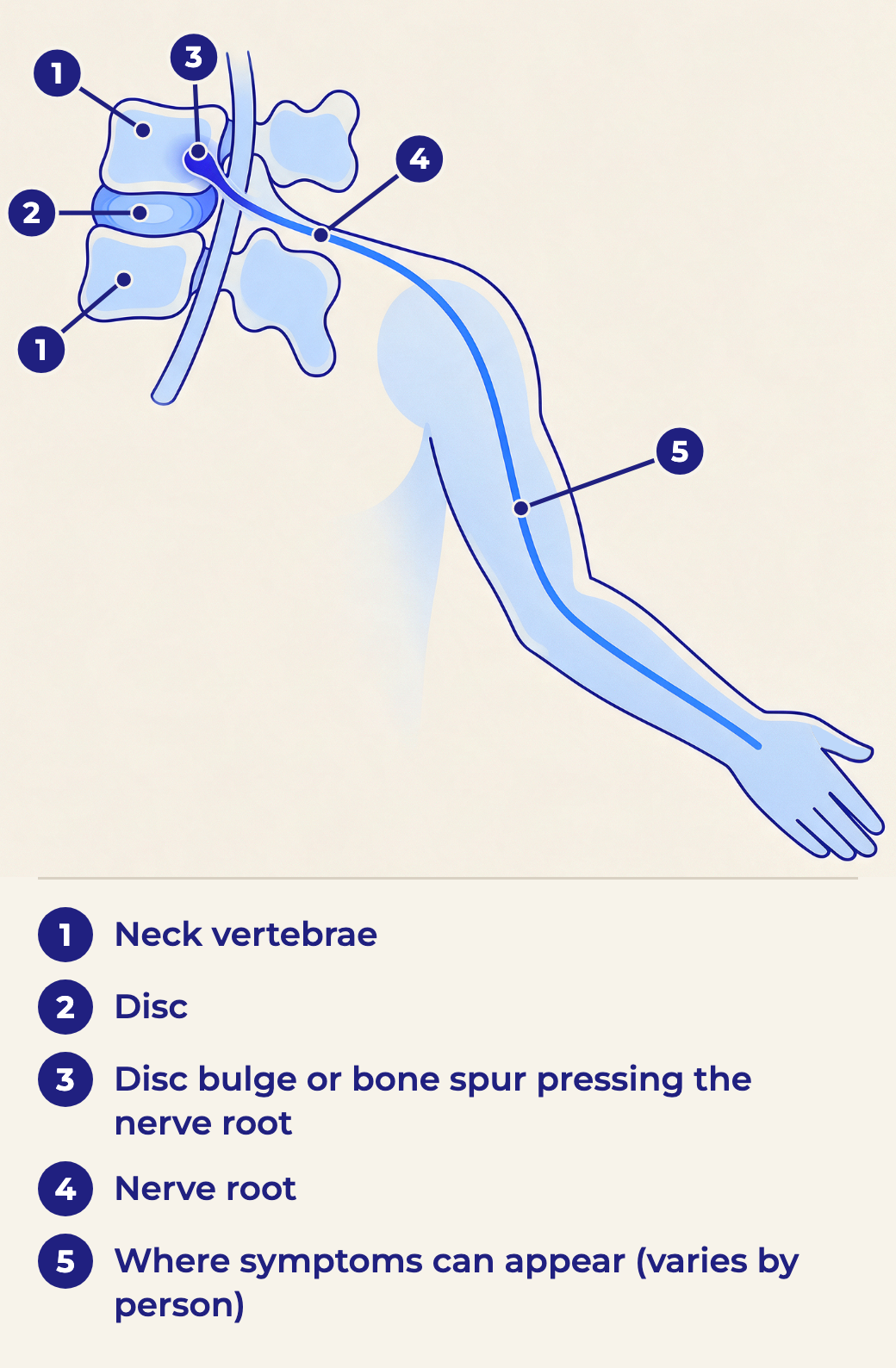
What is a common cause?
A common cause is a disc, age-related wear, or both. In a Rochester, Minnesota study of 561 people with cervical radiculopathy (1976 to 1990), 68.4% had spondylosis (age-related wear of the spine), disc disease or both. But that describes one community, not the cause of any one person’s pain.
Could it be something else, including the heart?
Yes. The shoulder, elbow, wrist and heart can all send pain into the arm, and an exam sorts out most of these. Tingling in both hands or feet has several causes, including peripheral neuropathy, which this post does not cover. If it comes with clumsy hands or unsteady walking, see the urgent tier below.
The heart matters most. The CDC lists pain or discomfort in one or both arms or shoulders, chest discomfort, shortness of breath, nausea and cold sweat among heart attack symptoms, and says to call 911 immediately, even if you are not sure.
How is it diagnosed, and do you need an MRI?
Evaluation starts with your history and an exam of neck movement, arm strength, reflexes and sensation. In a review of five diagnostic studies, a positive Spurling’s test (the examiner tilts and presses on the head to see whether arm symptoms return) was rarely found in people without radiculopathy. However, a negative result does not rule it out: across studies the test missed between 3 and 62 out of every 100 people who had radiculopathy.
If your symptoms are new and there are no red flags, you may not need an MRI right away. The American College of Radiology rates neck MRI “may be appropriate” in that case, and “usually appropriate” once the problem is chronic.
A scan must be matched to the exam, because abnormal findings are common without symptoms. In a Japanese study of 1,211 volunteers with no neck symptoms, 87.6% had bulging discs and 5.3% had spinal cord compression. So a bulge on an MRI is not, by itself, the cause of your pain.
Example (illustrative): a 50-year-old frequent flyer has tingling down one arm, and an exam that points to one nerve root. A bulge at that level fits. A bulge at another level, with no matching symptoms, may not explain the pain.
Will it get better on its own, and how long does it take?
Most people improve over weeks to months, but some take much longer and symptoms can return. Studies measure different groups and define “recovered” differently, so these figures should not be blended.
- A systematic review of disc herniation with radiculopathy found substantial improvement within 4 to 6 months, with complete recovery taking 24 to 36 months in about 83% of people. However, only three of its eight studies had low risk of bias.
- In the Rochester community cohort, about 90% were symptom-free or mildly limited at a median of 4.9 years, and about 32% had a recurrence.
What are the treatment options, and how do they compare?
A 2013 systematic review of 11 randomized trials found no single non-surgical treatment clearly better than the others in the trials it reviewed. Evidence quality was low to very low.
What about time, exercise and medication?
Time and staying active. Danish national guidelines suggest staying active and learning the usual course and warning signs, based on low-quality evidence or consensus.
Physical therapy and exercise. A 2019 meta-analysis of 10 trials in 871 people found exercise reduced pain and disability compared with control, with low certainty. In a trial of 205 adults with recent symptoms, a collar or physiotherapy gave about 12 points more arm-pain relief on a 100-point scale at six weeks, a modest difference. Arm pain also fell in the group that simply waited.
Medications. The Danish guideline lists anti-inflammatory medicines “after careful consideration.” In one small placebo-controlled trial of 59 adults, more people on a 10-day oral steroid course had clinically important pain improvement than on placebo (22 of 29 versus 9 of 30). But it was short, and long-term safety was not studied. Any medication decision belongs with your physician.
What about an epidural steroid injection?
Gramercy Center offers epidural steroid injections. We describe them here alongside the other options, including ones we don’t provide. The injection places a steroid near the irritated nerve root.
An American Academy of Neurology review of 90 trials, mostly in the lower back, found these injections probably reduce radiculopathy pain and disability in the short term. Roughly 1 in 7 to 1 in 4 more people had meaningful relief than with a comparison treatment. The paper gives different figures in different sections, so that range is approximate. Few trials were in the neck, so neck-specific evidence is thin, and long-term effects were less certain. A meta-analysis of cervical injections placed through the nerve’s exit opening (transforaminal) found about half of treated people had at least 50% pain relief at one to three months. None of its studies had a control group, so natural recovery cannot be separated out.
Risks come with the benefits. For epidural steroid injections in general, the neurology review cites complication rates of 2.4% to 16.8% across studies, mostly increased pain, injection-site pain or persistent numbness. Serious complications are rare and described mainly in case reports. In April 2014, an FDA safety communication (Spanish-language page) said that, in rare cases, steroid injections into the epidural space can cause serious problems including vision loss, stroke, paralysis and death, with or without X-ray guidance.
What about surgery, PRP or bone marrow aspirate?
Surgery is the right answer for some people. A clinical guideline recommends it for moderate and severe cervical myelopathy (pressure on the spinal cord itself). But for a pinched nerve alone, the picture is less clear-cut.
Small trials suggest surgery can speed relief. In a 5- to 8-year follow-up of a randomized trial of 59 people, 93% of the surgery group versus 62% of the physiotherapy-alone group rated themselves better or much better. However, the arm-pain difference was not statistically significant. An earlier Swedish trial found surgery gave less pain at four months, but not by 16 months.
Operations also carry risks, which a surgeon should review with you. In a meta-analysis of 19 studies with 12 to over 48 months of follow-up, repeat surgery for a problem at the next spinal level was needed in 6.1% after fusion (joining two vertebrae) versus 3.1% after disc replacement (an artificial disc). Imaging changes at that level were also more common after fusion (19.7% versus 14.4%), though some may be natural progression.
PRP and bone marrow aspirate. We did not find human trials showing that PRP or bone marrow aspirate helps a pinched nerve in the neck, so we do not describe them as options for it.
How Dr. Preet Patel approaches neck pain that travels into the arm
A consultation with Dr. Preet Patel, an ACGME fellowship-trained interventional pain management specialist, begins with a full diagnostic review. Your records and imaging are reviewed beforehand, and you are examined and given your options in plain language. Virtual consultations are available for this review, and any procedure is performed at the Beverly Hills clinic.
Gramercy Center offers epidural steroid injections. If surgery is the right answer, the team can help arrange a referral through Dr. Preet Patel’s network of vetted surgeons.
If time away from work or travel is your concern, this post cannot give a time-cost figure for any treatment. Instead, the consultation is the place to ask.
When should you seek care, and when is it an emergency?
The next list covers many kinds of pain, so some items may not seem to fit a neck problem. Call 911 for any of them.
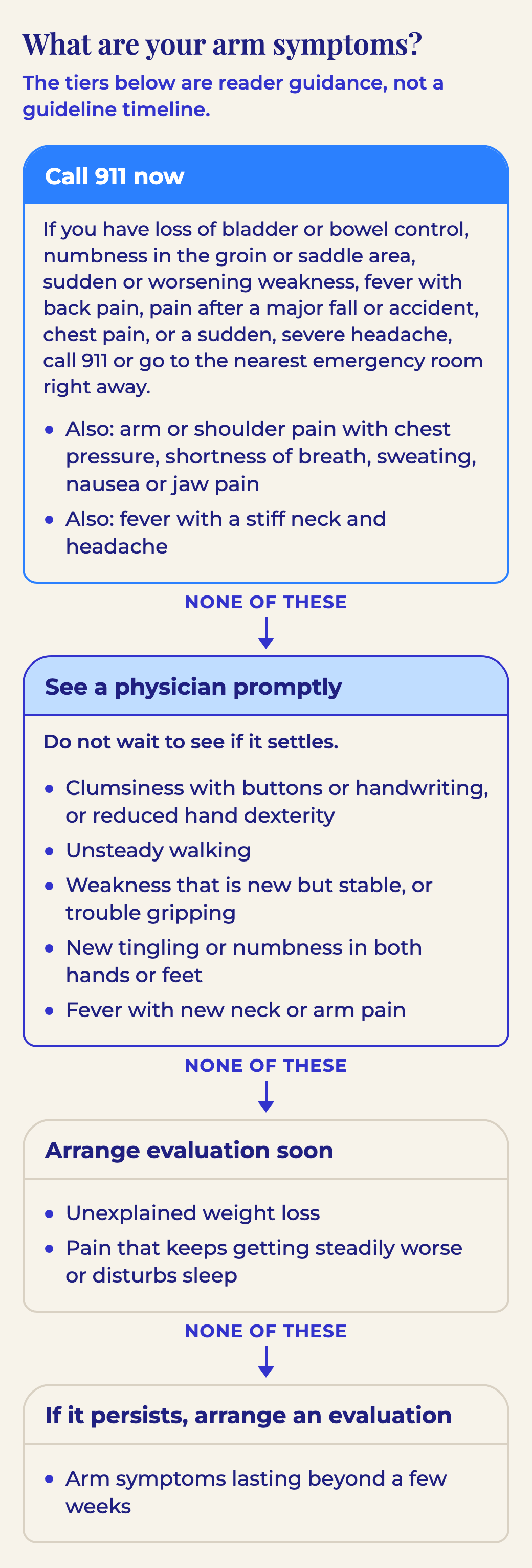
If you have loss of bladder or bowel control, numbness in the groin or saddle area, sudden or worsening weakness, fever with back pain, pain after a major fall or accident, chest pain, or a sudden, severe headache, call 911 or go to the nearest emergency room right away.
Which signs are specific to neck and arm pain?
The tiers below are reader guidance, not a guideline timeline.
- Emergency, call 911 or go to the emergency room now: the signs above, including sudden or worsening weakness. Also arm or shoulder pain with chest pressure, shortness of breath, sweating, nausea or jaw pain, which the CDC describes as heart attack signs. Also fever with a stiff neck and headache, which the CDC says needs a healthcare provider right away.
- Urgent, see a physician promptly and do not wait to see if it settles: clumsiness with buttons or handwriting, reduced hand dexterity, or unsteady walking. The UK primary-care review says these can signal pressure on the spinal cord itself (cervical myelopathy) and warrant immediate referral. Also weakness that is new but stable, trouble gripping, new tingling or numbness in both hands or feet, or fever with new neck or arm pain, which that review lists as a feature making infection more likely.
- Soon, arrange an evaluation rather than waiting: unexplained weight loss, or pain that keeps getting steadily worse or disturbs sleep. The same review lists these as features that make cancer or infection more likely, which are reasons to be seen sooner.
- If it persists, arrange an evaluation: arm symptoms lasting beyond a few weeks. That review suggests considering referral after 4 to 6 weeks (one article, not a guideline).
What is the bottom line, and what should you do next?
A common explanation is an irritated nerve root in the neck, and most people improve without surgery. Still, uncertainty remains: scans do not always explain pain, no non-surgical treatment stood out in the trials reviewed, and the evidence for neck injections is thin and short-term.
If arm symptoms are disrupting sleep, flights or training, or have lasted beyond a few weeks, an individual evaluation is the next step. For that visit, bring any recent imaging and notes. Until then, know the emergency signs above. You can also browse the conditions Gramercy Center treats.
Schedule a consultation with Dr. Preet Patel.
Sources
Causes and how often it happens
- Cervical radiculopathy and cervical myelopathy: diagnosis and management in primary care. British Journal of General Practice. 2018. https://pmc.ncbi.nlm.nih.gov/articles/PMC5737310/
- Epidemiology of cervical radiculopathy: a population-based study from Rochester, Minnesota, 1976 through 1990. Brain. 1994. https://pubmed.ncbi.nlm.nih.gov/8186959/
Heart attack and meningitis warning signs
- Heart Attack Symptoms, Risk, and Recovery. CDC. 2024. https://www.cdc.gov/heart-disease/about/heart-attack.html
- About Meningitis. CDC. 2025. https://www.cdc.gov/meningitis/about/index.html
Diagnosis and imaging
- Value of physical tests in diagnosing cervical radiculopathy: a systematic review. The Spine Journal. 2018. https://pubmed.ncbi.nlm.nih.gov/28838857/
- ACR Appropriateness Criteria: Cervical Neck Pain or Cervical Radiculopathy. American College of Radiology. 2024. https://acsearch.acr.org/docs/69426/Narrative/
- Abnormal findings on magnetic resonance images of the cervical spines in 1211 asymptomatic subjects. Spine. 2015. https://pubmed.ncbi.nlm.nih.gov/25584950/
Recovery and non-surgical treatment
- The course and prognostic factors of symptomatic cervical disc herniation with radiculopathy: a systematic review. The Spine Journal. 2014. https://pubmed.ncbi.nlm.nih.gov/24614255/
- The effectiveness of conservative treatment for patients with cervical radiculopathy: a systematic review. Clinical Journal of Pain. 2013. https://pubmed.ncbi.nlm.nih.gov/23446070/
- National clinical guidelines for non-surgical treatment of patients with recent onset neck pain or cervical radiculopathy. European Spine Journal. 2017. https://pubmed.ncbi.nlm.nih.gov/28523381/
- The effect of exercise on cervical radiculopathy: a systematic review and meta-analysis. Medicine (Baltimore). 2019. https://pubmed.ncbi.nlm.nih.gov/31702624/
- Cervical collar or physiotherapy versus wait and see policy for recent onset cervical radiculopathy: randomised trial. BMJ. 2009. https://pubmed.ncbi.nlm.nih.gov/19812130/
- Oral prednisolone in the treatment of cervical radiculopathy: a randomized placebo controlled trial. Journal of Research in Medical Sciences. 2013. https://pubmed.ncbi.nlm.nih.gov/23961284/
Epidural steroid injections
- Epidural Steroids for Cervical and Lumbar Radicular Pain and Spinal Stenosis: Systematic Review Summary, Report of the AAN Guidelines Subcommittee. Neurology. 2025. https://pmc.ncbi.nlm.nih.gov/articles/PMC12289388/
- Systematic review and meta-analysis of fluoroscopically guided cervical transforaminal epidural steroid injection for radicular pain. Pain Medicine. 2020. https://pubmed.ncbi.nlm.nih.gov/31181148/
- FDA Drug Safety Communication on epidural corticosteroid injections (Spanish-language page). U.S. Food and Drug Administration. 2014. https://www.fda.gov/drugs/drug-safety-and-availability/comunicado-de-la-fda-sobre-la-seguridad-de-los-medicamentos-fda-requiere-cambios-en-la-etiqueta-para-0
Surgery
- A clinical practice guideline for the management of patients with degenerative cervical myelopathy. Global Spine Journal. 2017. https://pubmed.ncbi.nlm.nih.gov/29164035/
- A 5- to 8-year randomized study on the treatment of cervical radiculopathy: ACDF plus physiotherapy versus physiotherapy alone. Journal of Neurosurgery: Spine. 2017. https://pubmed.ncbi.nlm.nih.gov/27564856/
- Cervical radiculopathy: pain, muscle weakness and sensory loss in patients treated with surgery, physiotherapy or cervical collar. European Spine Journal. 1997. https://pubmed.ncbi.nlm.nih.gov/9294750/
- The incidence of adjacent segment pathology after cervical disc arthroplasty compared with ACDF. World Neurosurgery. 2022. https://pubmed.ncbi.nlm.nih.gov/35085804/
This content is for general education only and is not medical advice. It does not create a doctor-patient relationship. Treatment decisions should be made with a qualified physician after an individual evaluation. Results vary, and not everyone is a candidate for every treatment.