

Often, yes, and it depends on which ankle problem you have. The American Academy of Orthopaedic Surgeons (AAOS) says nearly all isolated low ankle sprains (the common ligament sprain, with no fracture or high ankle injury) are treated without surgery, and a 2018 Dutch guideline reserves surgery for cases that do not respond to thorough exercise-based treatment. But others, such as unstable fractures, are better answered with surgery.
An ankle that keeps rolling or will not settle costs training time, and the right first step depends on which structure is hurt. What is uncertain: the best choice for a complete Achilles rupture (a full tear of the heel tendon) is a real shared decision, and platelet-rich plasma (PRP) did not do better than placebo in the Achilles and ankle-arthritis trials.
Disclosure: Gramercy Center offers platelet-rich plasma and ultrasound-guided joint injections.
Key takeaways
- Sprains, Achilles tendinopathy, stable fractures and ankle arthritis usually start without surgery.
- Clinicians usually judge a non-surgical plan over weeks to months, with a planned reassessment.
- Unstable fractures, some Achilles ruptures and persistent instability are where surgery may be the better answer.
- In randomized trials, PRP did not beat placebo for Achilles tendinopathy or ankle arthritis.
Which ankle problems usually improve without surgery?
This is a general map. A clinician has to examine and image your ankle to say which group it belongs in.
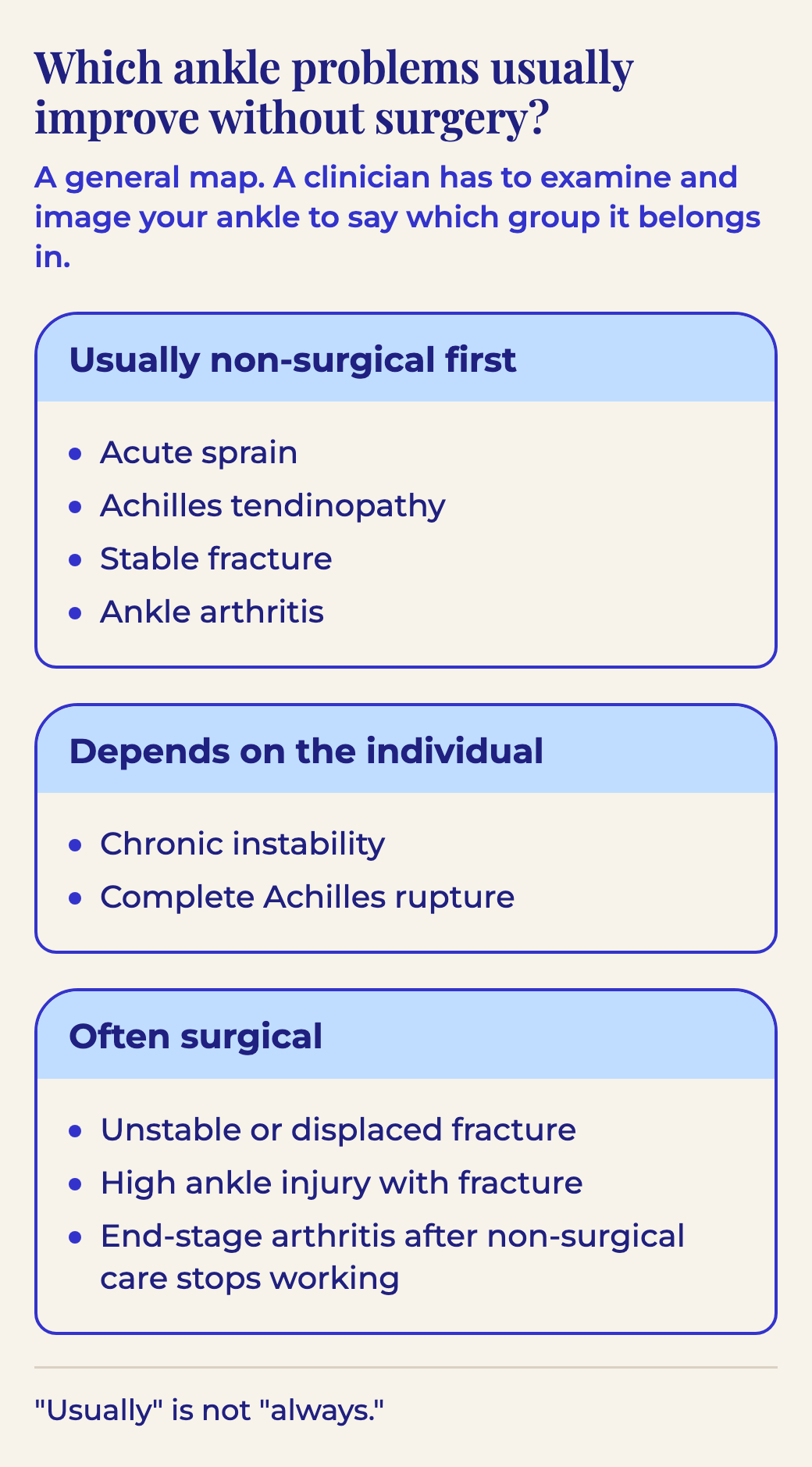
Usually non-surgical first. Acute sprains (ligament injuries) lead the list: AAOS says even complete (grade 3) tears can recover with immobilization and rehabilitation. Achilles tendinopathy (a painful, overloaded tendon) starts with activity change, physical therapy and calf strengthening. Stable fractures are also often treated with a cast or walking boot. Ankle arthritis options start with activity changes, physical therapy, bracing and sometimes cortisone.
Depends on the individual. Chronic ankle instability means an ankle that keeps giving way or re-sprains. In a small trial of 56 people, 3 months of balance (proprioceptive) training and surgery both improved function. Training was followed by earlier recovery of sports function, while surgery’s biomechanical effects (movement patterns) were more persistent. A complete Achilles rupture is also a real choice between two paths, covered below.
Often surgical. Unstable or displaced fractures, a high ankle injury that comes with a fracture, and end-stage ankle arthritis (all covered below).
“Usually” is not “always.” In a review of 31 studies of conventionally treated sprains, 5% to 33% of people still had pain after one year, and re-sprain risk ranged from 3% to 34%.
How do you know whether an ankle injury needs an X-ray first?
After a fresh twist, clinicians use the Ottawa ankle rules to decide whether an X-ray is needed: pain near the ankle bones plus tenderness at the back edge or tip of either ankle bone (the malleoli), or being unable to take four steps. In a review of 27 studies, nearly all fractures were caught, though many people who screen positive have none; these are a clinician’s screening rules, not a self-test.
For an older injury that keeps flaring, AAOS describes MRI after symptoms beyond 6 to 8 weeks despite conservative care or questions about soft tissue.
What does the evidence say about rehabilitation, injections and PRP for the ankle?
Exercise-based rehabilitation. For an acute ligament tear, the 2018 guideline found people benefit most from tape or a brace plus an exercise program. An overview of 46 systematic reviews also found strong support for early mobilization, and for bracing to prevent recurrence.
Loading programs for Achilles tendinopathy. In a trial of 58 people with symptoms for over 3 months, eccentric training (lengthening the calf under load) and heavy slow resistance training both improved pain and function over 12 weeks. Gains still held at 52 weeks. But neither was compared with doing no exercise.
Complete Achilles rupture. Both routes work. The trade-off is a lower chance of re-rupture with surgery against a higher chance of complications such as infection or nerve injury. In a Norwegian trial of 526 adults, function at 12 months was similar with and without surgery, and re-rupture was more common without it (6.2% versus 0.6%). However, nerve injury was reported at 0.6% without surgery versus 2.8% to 5.2% with it. A BMJ meta-analysis of 29 studies (10 randomized trials, 19 observational) found complications, mostly infection, in 4.9% with surgery versus 1.6% without. These figures come from different designs, so they are not directly comparable. In the BMJ analysis, studies that used early movement after non-surgical treatment found a re-rupture difference that could have been due to chance.
What about cortisone and PRP injections?
Cortisone. AAOS lists cortisone among options for an arthritic ankle, though its effect is often temporary, and a 2025 review found insufficient trial evidence (two small trials, neither of the ankle joint itself). AAOS advises against cortisone injection into the Achilles tendon because it can cause the tendon to rupture.
PRP, condition by condition. For the four conditions with randomized trials, PRP did not do better than placebo or comparison treatment. Knee results do not carry over to the ankle.
- Achilles tendinopathy: no benefit in a 2025 meta-analysis of six trials.
- Acute Achilles rupture: no functional gain in a trial of 230 adults whose ruptures were treated without surgery.
- Ankle arthritis: no difference from saline at 26 weeks in a 100-person trial.
- Acute sprain: no difference on main outcomes in a small blinded emergency department trial (33 people analyzed).
- Cartilage and bone lesions of the talus: early research. Mostly preclinical; a few small, low-quality human studies tested PRP as a surgical add-on.
In foot and ankle trials, PRP caused more post-injection pain than comparison injections.
How long is a fair trial of non-surgical care before reassessing?
No guideline gives one number, because each source measured something different, in a different group of people.
- Sprains: the NHS says most sprains and strains (any joint) feel better after about 2 weeks. AAOS also says pain beyond 4 to 6 weeks may indicate a chronic sprain.
- Achilles tendinopathy: AAOS considers surgery only after 6 months of non-surgical care. The 12-week figure is the length of the programs in one trial, not a deadline.
- Chronic instability: in a 2018 survey of 30 foot and ankle surgeons (expert opinion, not a trial), they considered surgery after 3 to 6 months of non-surgical treatment, earlier when the joint is mechanically loose on examination (ligament laxity) or in high-level athletes.
As a reading of these sources, not a guideline: a fresh sprain that is not clearly better by 4 to 6 weeks usually warrants a reassessment. A tendon problem warrants a structured trial of up to 6 months, and an ankle that keeps giving way warrants 3 to 6 months (sooner for high-level athletes or a mechanically loose joint), each with the review date set at the start.
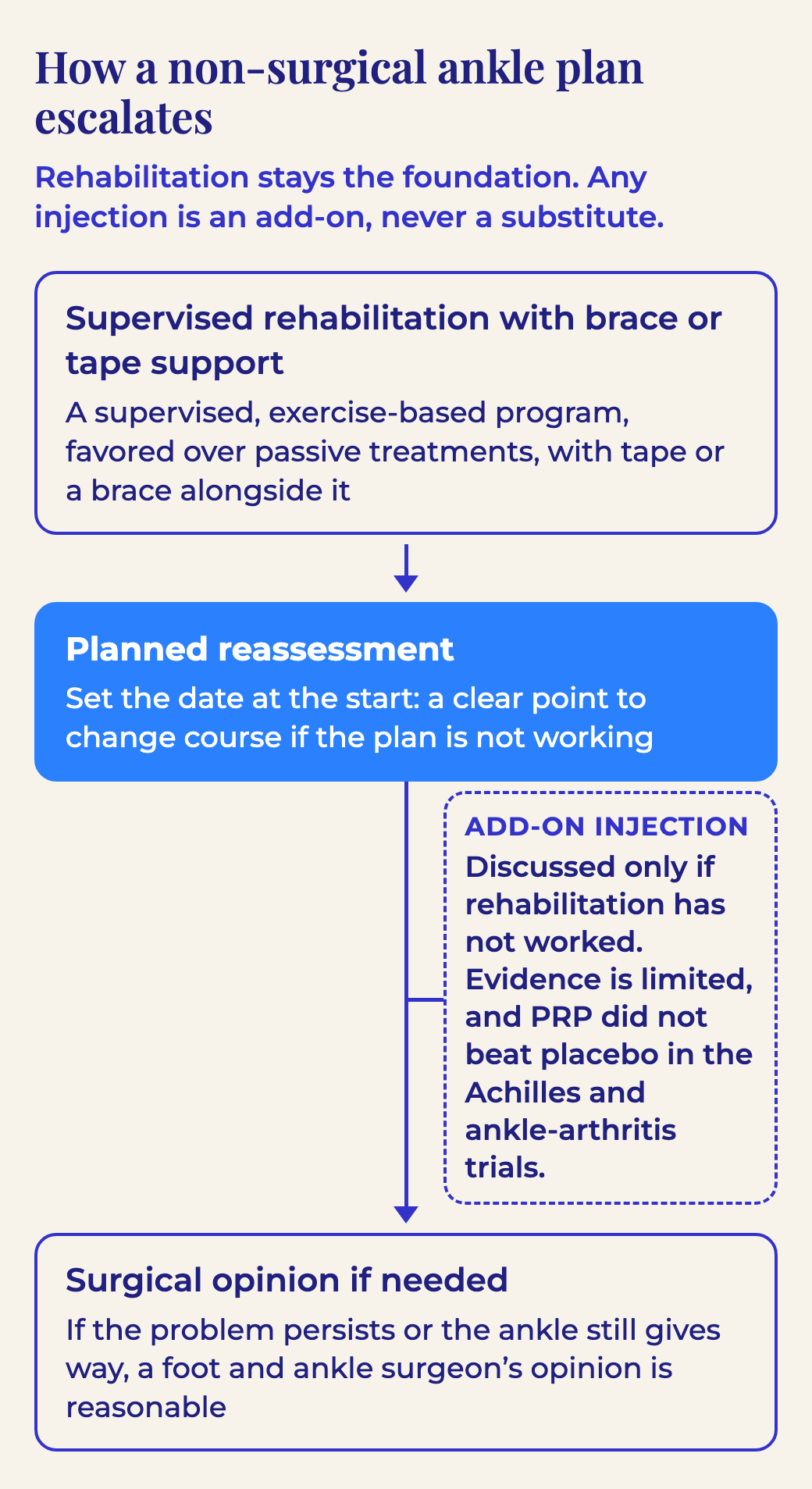
For instability, a proper course is the supervised, exercise-based program the 2018 Dutch guideline favors over passive treatments, with tape or a brace. Balance training also has moderate review-level support for preventing recurrence, per the overview above. If the ankle still gives way after that, a foot and ankle surgeon’s opinion is reasonable. Your clinician and physical therapist set return-to-sport timing.
When is surgery the better answer?
Surgery is the better answer in specific situations.
- Unstable or displaced fractures. AAOS says most fractures involving both ankle bones, and most with a dislocation, need surgery, as do syndesmosis (“high ankle”) injuries, damage to the ligaments binding the two lower-leg bones, that come with a fracture.
- Some complete Achilles ruptures. AAOS notes surgery may be recommended for competitive athletes and when push-off, the drive off the ball of the foot in running or jumping, is critical. Repair lowers the chance of a re-tear, though AAOS notes the choice is debated, and function was similar at 12 months in the trial above.
- Instability that persists after thorough rehabilitation. However, trials comparing surgical techniques are small and not rigorously designed.
- End-stage ankle arthritis. Fusion or replacement is considered when pain causes disability and non-surgical care does not relieve it.
The benefits are specific: most unstable or displaced fractures need it, per AAOS, and repair of an Achilles rupture lowers re-rupture. The risks are real too. AAOS lists fracture-fixation risks of infection, bleeding, damage to nerves, vessels or tendons, hardware problems and later arthritis, with higher risk in smokers, people with diabetes and older adults. Fusion can also fail to knit together or reduce motion, and a replacement may loosen over the years.
A foot and ankle surgeon makes the surgical call, and a second opinion is reasonable.
How does Dr. Preet Patel approach ankle pain?
The first step is a precise diagnosis. Dr. Preet Patel reviews your records and imaging in advance, examines you, and often uses ultrasound in the room. That is how Gramercy works; the research cited in this post did not test it.
Rehabilitation stays the foundation, and any injection is an add-on to strength, mobility and loading work, never a substitute. The aim is a plan with a clear reassessment point and a clear point to change course if it is not working.
Both are available here: platelet-rich plasma (PRP, made from your own blood) and ultrasound-guided joint injections. Given the trial results above, PRP is not an evidence-backed answer for the ankle problems where it has been tested, and results vary. It is offered at Dr. Preet Patel’s physician judgment, as an adjunct after a proper rehabilitation trial has not settled a tendon or joint problem. Risks include soreness, infection, bleeding and no improvement, and not everyone is a candidate.
If surgery is the better answer, Dr. Preet Patel says so and connects you with a surgeon from his network of vetted providers.
When should you seek care for an ankle problem?
Call 911 or go to the nearest emergency room right away after a major fall or accident, or for:
- a crack heard at the time of injury
- an ankle that has changed shape or points at an odd angle
- numbness, tingling or pins and needles
- skin that turns blue or grey or feels cold
The NHS (reviewed April 23, 2024) lists the last four as reasons to call emergency services.
Get urgent in-person care for:
- being unable to put weight on the ankle or walk more than a few steps
- severe or worsening pain
- large or increasing swelling
- a high temperature, or feeling hot, cold or shivery
A sudden pop with severe pain and not being able to walk on the leg can mean an Achilles rupture and needs prompt in-person assessment.
Book an evaluation if pain or giving way lasts beyond a few weeks, or keeps coming back.
So can your ankle pain be treated without surgery?
Most ankle problems start without surgery, and the structure involved decides the path.
Uncertain: PRP did not beat placebo in the Achilles and ankle-arthritis trials, and a complete Achilles rupture is a close call that depends on your goals and risks.
Ask your clinician three things: what the diagnosis is, on what date the plan will be reassessed, and what result would make surgery the better answer. A trial that fails is a reason to change course with your clinician, not wasted time.
Schedule a consultation with Dr. Preet Patel. You can also call (310) 439-8009.
Sources
Sprain guideline, AAOS pages, sprain and instability studies, X-ray rules
- Sprained Ankle. AAOS OrthoInfo. Accessed 2026. https://www.orthoinfo.org/diseases–conditions/sprained-ankle/
- Diagnosis, treatment and prevention of ankle sprains: update of an evidence-based clinical guideline (Vuurberg et al.). British Journal of Sports Medicine. 2018. https://pubmed.ncbi.nlm.nih.gov/29514819/
- Ankle Fractures (Broken Ankle). AAOS OrthoInfo. Accessed 2026. https://www.orthoinfo.org/en/diseases–conditions/ankle-fractures-broken-ankle/
- Achilles Tendinitis. AAOS OrthoInfo. Accessed 2026. https://www.orthoinfo.org/en/diseases–conditions/achilles-tendinitis/
- Arthritis of the Foot and Ankle. AAOS OrthoInfo. Accessed 2026. https://www.orthoinfo.org/en/diseases–conditions/arthritis-of-the-foot-and-ankle/
- Proprioceptive training vs modified Broström-Gould surgery for chronic ankle instability: RCT (Hou et al.). Orthopaedic Journal of Sports Medicine. 2024. https://pubmed.ncbi.nlm.nih.gov/39291124/
- What is the clinical course of acute ankle sprains? A systematic literature review (van Rijn et al.). American Journal of Medicine. 2008. https://pubmed.ncbi.nlm.nih.gov/18374692/
- Ottawa Rules Simplify the Management of Ankle Injuries (Walling). American Family Physician. 2003. https://www.aafp.org/pubs/afp/issues/2003/0815/p745a.html
- Accuracy of Ottawa ankle rules to exclude fractures of the ankle and mid-foot: systematic review (Bachmann et al.). BMJ. 2003. https://pubmed.ncbi.nlm.nih.gov/12595378/
Rehabilitation, Achilles rupture, cortisone and PRP studies
- Treatment and prevention of acute and recurrent ankle sprain: an overview of systematic reviews with meta-analysis (Doherty et al.). British Journal of Sports Medicine. 2017. https://pubmed.ncbi.nlm.nih.gov/28053200/
- Heavy slow resistance versus eccentric training as treatment for Achilles tendinopathy: an RCT (Beyer et al.). American Journal of Sports Medicine. 2015. https://pubmed.ncbi.nlm.nih.gov/26018970/
- Nonoperative or surgical treatment of acute Achilles’ tendon rupture (Myhrvold et al.). New England Journal of Medicine. 2022. https://pubmed.ncbi.nlm.nih.gov/35417636/
- Operative vs nonoperative treatment of Achilles tendon ruptures: systematic review and meta-analysis (Ochen et al.). BMJ. 2019. https://pubmed.ncbi.nlm.nih.gov/30617123/
- Intra-articular corticosteroid injections for foot and ankle osteoarthritis: a systematic review (Jones et al.). Rheumatology Advances in Practice. 2025. https://pubmed.ncbi.nlm.nih.gov/40124974/
- Is platelet-rich plasma effective in treating Achilles tendinopathy? A meta-analysis of RCTs (Barreto et al.). Clinical Orthopaedics and Related Research. 2025. https://pubmed.ncbi.nlm.nih.gov/39745256/
- PRP injection for acute Achilles tendon rupture: PATH-2 RCT (Keene et al.). BMJ. 2019. https://pubmed.ncbi.nlm.nih.gov/31748208/
- Effect of PRP injections vs placebo on ankle symptoms and function in ankle osteoarthritis: RCT (Paget et al.). JAMA. 2021. https://pubmed.ncbi.nlm.nih.gov/34698782/
- Double-blind RCT of PRP for acute ankle sprains in the emergency department (Rowden et al.). Journal of Emergency Medicine. 2015. https://pubmed.ncbi.nlm.nih.gov/26048069/
- The role of PRP in treating osteochondral lesions of the talus: a systematic review of clinical and preclinical evidence (Halayqeh et al.). JBJS Reviews. 2025. https://pubmed.ncbi.nlm.nih.gov/41379984/
- PRP injections for foot and ankle pathologies have significantly more complications than comparators: a systematic review (Fucaloro et al.). Arthroscopy. 2025. https://pubmed.ncbi.nlm.nih.gov/40209826/
NHS advice, a surgeon survey, the AAOS Achilles tears page and a surgical review
- Sprains and strains. NHS. Reviewed April 23, 2024. https://www.nhs.uk/conditions/sprains-and-strains/
- Searching for consensus in the approach to patients with chronic lateral ankle instability: ask the expert (Michels et al.). Knee Surgery, Sports Traumatology, Arthroscopy. 2018. https://pubmed.ncbi.nlm.nih.gov/28439639/
- Achilles Tendon Tears. AAOS OrthoInfo. Accessed 2026. https://www.orthoinfo.org/diseases–conditions/achilles-tendon-rupture-tear/
- Surgical management of chronic lateral ankle instability: a meta-analysis. Journal of Orthopaedic Surgery and Research. 2018. https://pmc.ncbi.nlm.nih.gov/articles/PMC6019311/
This content is for general education only and is not medical advice. It does not create a doctor-patient relationship. Treatment decisions should be made with a qualified physician after an individual evaluation. Results vary, and not everyone is a candidate for every treatment.