
Evidence status as of October 14, 2026.
Do peptides help tendon, muscle or joint injuries heal? For BPC-157 and TB-500, two peptides often discussed for injuries, that is not established yet, and for most tissues the evidence is animal-only. A 2025 systematic review of BPC-157 in sports medicine included 35 preclinical studies and one clinical study. A 2026 review of six peptides found about two-thirds of the publications it identified used animal models, mostly rats.
If an injury is keeping you out of training and someone has suggested a peptide, this is what is known: animal results, a few small human reports and early trials with no results. What is uncertain: whether any of it carries over to people, and long-term safety. Gramercy does not prescribe or supply peptides. Dr. Preet Patel advises and refers out.
Key takeaways
- Recovery depends on the injury’s severity, the tissue, the load and your rehabilitation plan.
- Ask what a study measured, in whom, and whether it measured what you feel.
What does the research show for tendon, ligament, muscle, bone and knee joint pain?
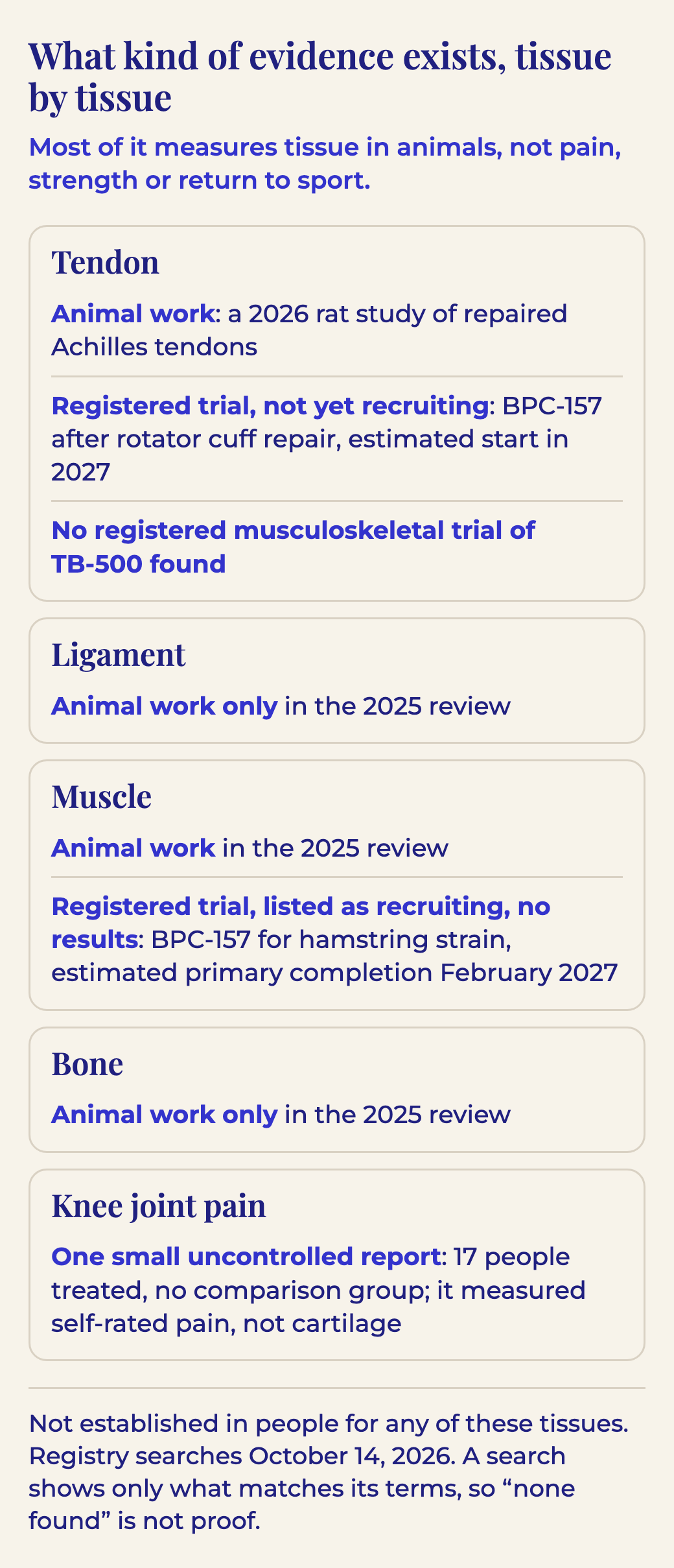
Most of it measures tissue in animals, not pain, strength or return to sport. Registry searches below were run on October 14, 2026. A search shows only what matches its terms, so “none found” is not proof.
Tendon. We found animal work only so far. In a 2026 rat study of cut and repaired Achilles tendons (eight rats per group), TB-500 made the repaired tendon hold more weight before it tore. BPC-157’s difference could not be told apart from chance. A registered rotator cuff repair trial of BPC-157 against a comparison group is not yet recruiting, with an estimated start in 2027. We found no registered musculoskeletal trial of TB-500.
Ligament and bone. Animal work only in the 2025 review, whose search ended in June 2024. It reported improvements in animal muscle, tendon, ligament and bone injuries, and no clinical safety data.
Muscle. One registered hamstring strain trial compares BPC-157 with a matching dummy injection. It is industry-sponsored. It is listed as recruiting (status last verified February 2026), has no results, and estimates its primary completion in February 2027.
Knee joint pain. One small knee report was an uncontrolled chart review at one clinic. Of 17 people treated, 16 were reached by phone and 14 rated their pain as relieved; four also received thymosin beta-4. There was no comparison group, and it measured self-rated pain, not cartilage.
What does recovery depend on, and what would change the answer?
Wanting something that shortens time out of training is reasonable. Recovery depends on the injury’s severity, the tissue, and the load you put through it. Load is the stress a tendon or muscle takes, from lifting to walking. AAOS gives up to 6 months for a severe hamstring strain. The NHS says severe sprains and strains can take months, and advises moving again once movement is possible without pain stopping you. We did not find a sourced human timeline for tendon healing, so we give none.
If you are having or have had surgery, the plan comes from your surgeon. For hamstring injuries, AAOS notes that return to sports follows the doctor’s go-ahead. Tell your surgeon and anesthesiologist about any peptide or supplement before the operation. The American Society of Anesthesiologists says certain supplements can interact with anesthesia and asks people having surgery to list them. Its advice covers supplements generally, not peptides specifically.
Sellers and social feeds often pitch a peptide as “faster healing,” while studies ask narrower questions. Example (illustrative): a tendon that holds more weight in a rat’s lab test says little about whether a runner can race again in ten weeks. What would change the answer is a controlled human trial, one that compares the peptide with a dummy treatment and measures return to sport, pain and function.
Where do regulatory status and drug testing stand?
Our overview of peptides for inflammation and pain covers regulation, product quality and safety in more detail.
BPC-157 is not approved for human clinical use by the FDA or any other global health authority, according to USADA. For TB-500, FDA has identified no human exposure data for products containing it. Both are research-stage and are not available in California. USADA lists BPC-157 as prohibited under the WADA list for athletes in tested sport.
What established options exist for injury recovery?
Clinical guidelines for rehabilitation exist for Achilles tendinopathy and rotator cuff tendinopathy. The NHS tendonitis page says physiotherapy may be offered if pain is severe or long-lasting, steroid injections are sometimes offered in severe cases for short-term relief, and surgery may be recommended if physiotherapy does not help.
Medicines, injections and surgery all carry risks, and benefits depend on the person. Surgery is the right answer when a structural problem needs it.
What can you reasonably expect, and what should you ask a physician?
Evidence-based rehabilitation and time remain the established path. Peptides are research-stage. Questions to bring to any qualified physician:
- What is the evidence for my injury, and was it in people?
- What did the study measure, and does it match what I feel?
- Is the product approved for this use, compounded (made to order by a pharmacy), or sold as “research use only”?
- How does it fit with my surgeon’s plan and my medicines?
- If I compete, how does drug testing apply?
How Dr. Preet Patel approaches peptide questions
Disclosure: Gramercy does not prescribe or supply peptides.
A consultation with Dr. Preet Patel starts with the cause of the pain. He reviews your records and imaging and what you currently take, examines you and explains your options in plain language, including what the research does and does not show. Any prescribing and management happens through a referral to trusted specialists.
When to seek care
See a physician if pain persists or worsens, or if you react to any product or supplement.
Call your surgeon or physician promptly, per the NHS and MedlinePlus, for:
- pus or drainage, a bad smell, redness, heat, fever or chills at a surgical wound (MedlinePlus: “contact your surgeon”)
- inability to bear weight, severe or worsening pain, or a high temperature after an injury
- leg swelling that does not improve when the leg is raised, a possible blood clot per AAOS, which lists injury and surgery as risk factors
Call 911 or go to the nearest emergency room right away for:
- a crack heard at the injury, a changed shape, numbness or tingling, or skin that looks blue or grey or feels cold (NHS)
- sudden chest pain or shortness of breath (AAOS: a clot can reach the lungs)
So do peptides speed injury recovery?
Not established in people for any of these tissues. The one registered controlled trial we found lists an estimated primary completion of February 2027, and it will speak to one injury only.
A good next step is to bring the questions above to your surgeon or treating physician and check the dated sources below. If you would also like Dr. Preet Patel to look at the cause of your injury, you are welcome to schedule a consultation.
Schedule a consultation with Dr. Preet Patel. You can also call (310) 439-8009.
Sources
- Emerging Use of BPC-157 in Orthopaedic Sports Medicine: A Systematic Review. HSS Journal. 2025. https://pubmed.ncbi.nlm.nih.gov/40756949/
- Peptide Supplements and Their Therapeutic Applications in Sports Medicine. American Journal of Sports Medicine. 2026. https://pubmed.ncbi.nlm.nih.gov/42578445/
- Effects of BPC-157 and TB-500 on Achilles tendon healing in rats. Joint Diseases and Related Surgery. 2026. https://pubmed.ncbi.nlm.nih.gov/42542926/
- ClinicalTrials.gov record NCT07803250. U.S. NIH/NLM. Retrieved October 14, 2026. https://clinicaltrials.gov/study/NCT07803250
- ClinicalTrials.gov record NCT07487363 (TB-500). U.S. NIH/NLM. Retrieved October 14, 2026. https://clinicaltrials.gov/study/NCT07487363
- ClinicalTrials.gov record NCT07437547. U.S. NIH/NLM. Retrieved October 14, 2026. https://clinicaltrials.gov/study/NCT07437547
- Intra-Articular Injection of BPC 157 for Multiple Types of Knee Pain. Alternative Therapies in Health and Medicine. 2021. https://pubmed.ncbi.nlm.nih.gov/34324435/
- Muscle Strains in the Thigh. AAOS OrthoInfo. https://www.orthoinfo.org/en/diseases–conditions/muscle-strains-in-the-thigh/
- Sprains and strains. NHS. Last reviewed April 23, 2024. https://www.nhs.uk/conditions/sprains-and-strains/
- Hamstring Muscle Injuries. AAOS OrthoInfo. https://www.orthoinfo.org/en/diseases–conditions/hamstring-muscle-injuries/
- 8 Things to Tell Your Physician Anesthesiologist Before Surgery. American Society of Anesthesiologists. 2019. https://www.asahq.org/about-asa/newsroom/news-releases/2019/03/psaw
- BPC-157: Experimental Peptide Creates Risk for Athletes. USADA. Undated; accessed October 14, 2026. https://www.usada.org/spirit-of-sport/bpc-157-peptide-prohibited/
- Certain Bulk Drug Substances for Use in Compounding that May Present Significant Safety Risks. U.S. FDA. Content current as of April 22, 2026. https://www.fda.gov/drugs/human-drug-compounding/certain-bulk-drug-substances-use-compounding-may-present-significant-safety-risks
- Midportion Achilles Tendinopathy Revision, JOSPT clinical practice guideline. 2024. https://pubmed.ncbi.nlm.nih.gov/39741455/
- Rotator Cuff Tendinopathy Diagnosis, Nonsurgical Medical Care, and Rehabilitation: A Clinical Practice Guideline. JOSPT. 2025. https://pubmed.ncbi.nlm.nih.gov/40165544/
- Tendonitis. NHS. Last reviewed June 9, 2023. https://www.nhs.uk/conditions/tendonitis/
- Surgical wound infection – treatment. MedlinePlus. Reviewed September 30, 2024. https://medlineplus.gov/ency/article/007645.htm
- Deep Vein Thrombosis. AAOS OrthoInfo. https://www.orthoinfo.org/en/diseases–conditions/deep-vein-thrombosis/
This content is for general education only and is not medical advice. It does not create a doctor-patient relationship. Treatment decisions should be made with a qualified physician after an individual evaluation. Results vary, and not everyone is a candidate for every treatment.