

If knee or hip arthritis is limiting your golf, your travel or your stairs, you may be wondering whether it is time for a specialist. Consider one when osteoarthritis (OA, in which joint tissue breaks down over time) still limits what you want to do after a fair trial of first-line care: the starting treatments, such as exercise, physical therapy and anti-inflammatory medicine.
However, the guidelines from the American College of Rheumatology (ACR) and the American Academy of Orthopaedic Surgeons (AAOS) do not define a “fair” trial. The closest anchor is AAOS’s general patient education, which lists pain lasting more than 3 months among reasons to start with an orthopedic specialist. Also consider a specialist when your symptoms change or you want a clearer diagnosis or second opinion. In addition, several kinds of doctors take part in osteoarthritis care, and their roles can overlap; the specialist comparison table sets them side by side.
A hot, red, swollen joint, or being unable to put weight on it? That needs emergency care, not a scheduled consultation. Go to the emergency signs.
This post covers knee and hip OA only; spine and neck problems have different emergency signs.
What is known: major US guidelines strongly recommend exercise. What is uncertain: which injections help, since the evidence for some is divided or limited.
Key takeaways
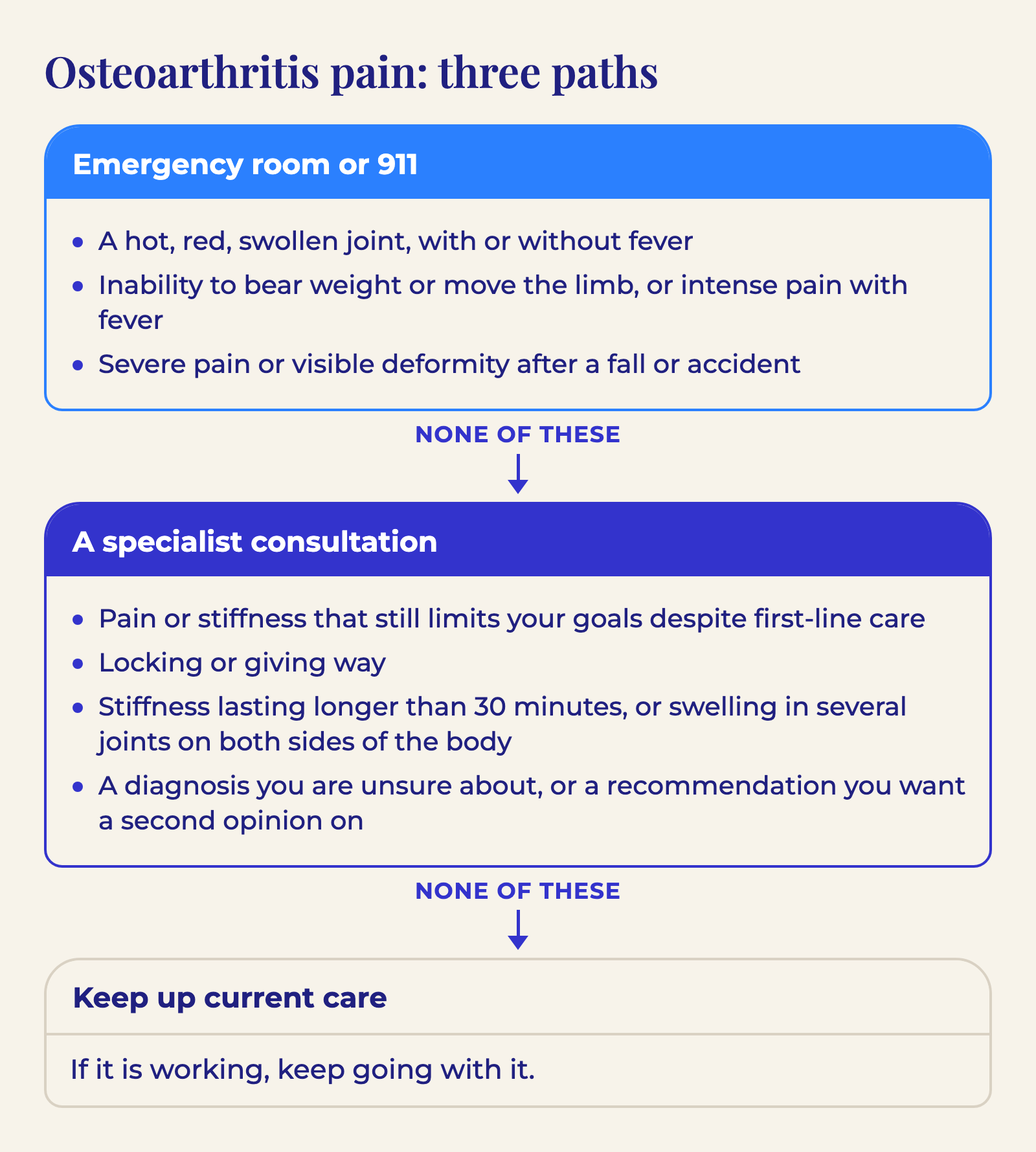
- Emergency care (call 911 or go to the nearest emergency room): a hot, red, swollen joint, with or without fever; inability to bear weight; or severe pain or visible deformity after a fall or accident.
- Book a specialist consultation: pain that still limits your goals despite first-line care, locking or giving way, stiffness lasting longer than 30 minutes or swelling in several joints on both sides of the body (a hot, red, swollen joint is an emergency sign; see the emergency signs), or a recommendation you want a second opinion on.
- Keep going with current care if it is working.
- Who to see: a primary care doctor is a reasonable first stop, and an orthopedic surgeon fits when surgery is on the table.
In this post
- How do you know your current osteoarthritis care is no longer enough?
- Which signs warrant a non-urgent specialist consultation?
- Which kind of specialist should you see?
- What happens at a specialist consultation?
- What treatments might a specialist discuss, and how strong is the evidence?
- What should you bring and ask?
- What a first consultation with Dr. Preet Patel involves
- When does osteoarthritis pain need emergency care?
- What should you do next?
How do you know your current osteoarthritis care is no longer enough?
Your current care may no longer be enough when pain or stiffness still limits the activities that matter to you after a fair trial of first-line care. Both the ACR’s 2026 update and the AAOS knee guideline strongly recommend exercise.
Which signs warrant a non-urgent specialist consultation?
These signs are not emergencies but are good reasons to book. However, they come from government and society resources, not guidelines.
- Pain or stiffness that still limits your goals (stairs, golf, an airplane seat) despite first-line care.
- Locking or giving way, worth evaluating because the National Institute of Arthritis and Musculoskeletal and Skin Diseases (NIAMS) says MRI helps evaluate a joint that is locking or giving out.
- Stiffness lasting longer than 30 minutes, or swelling in several joints on both sides of the body. OA stiffness after rest usually lasts less than 30 minutes. In contrast, NIAMS describes rheumatoid arthritis, an inflammatory arthritis, this way. However, these signs do not mean you have it, and only a physician can tell.
- A diagnosis you are unsure about, or a recommendation you want a second opinion on, such as a surgeon’s suggestion of a replacement. Still, OrthoInfo notes that seeing a surgeon does not mean you will have surgery.
Does “bone on bone” on an X-ray mean surgery is the only option?
Not automatically. “Bone on bone” describes how an X-ray looks. Also, in the knee, X-ray findings and pain match only loosely. For example, a 2008 review of 20 papers found 15% to 76% of people with knee pain had X-ray signs of OA. In addition, 15% to 81% of people with X-ray knee OA had pain. Those figures cover X-ray OA of any severity, so they do not show how often a severe-looking X-ray goes with few symptoms. Overall, the authors concluded that knee X-rays should not be used alone to judge an individual’s knee pain.
Example (illustrative): two 70-year-olds have the same knee X-ray report showing arthritis. One plays nine holes of golf. However, the other can no longer manage hotel stairs. So symptoms, function and exam explain the difference, not the report. It alone neither makes surgery automatic nor rules it out.
Which kind of specialist should you see?
In fact, several kinds of doctors treat osteoarthritis. According to AAOS OrthoInfo, a primary care doctor is a good first stop.
| Specialist | What they do | May be a good fit when |
|---|---|---|
| Primary care doctor | Coordinates your care | You want a first evaluation, imaging or a referral. |
| Rheumatologist | Specializes in arthritis and related conditions | The diagnosis is unclear, or an inflammatory cause is possible. |
| Orthopedic surgeon | A medical doctor trained in the musculoskeletal system. Treatment may include medicine, injections, bracing or surgery. | Surgery is being considered, or you want a surgical opinion. |
| Physical medicine and rehabilitation (PM&R) physician, or physiatrist | Oversees exercise programs. The American Academy of Physical Medicine and Rehabilitation (AAPM&R) lists ultrasound-guided procedures and joint injections. | Your question is about exercise, function or rehabilitation. |
| Interventional pain physician (pain specialist) | The American Society of Interventional Pain Physicians (ASIPP) defines the field as diagnosing and treating pain-related disorders. That is general, so ask what a given doctor offers for your joint. | Your question is about treating pain. Dr. Preet Patel is in this group (see the Gramercy section below). |
Weighing an orthopedist against a pain specialist? Roles overlap, and many people see more than one.
What happens at a specialist consultation?
A standard OA evaluation, as AAOS describes it for the hip, includes a discussion of your symptoms and medical history, a physical exam and possibly X-rays, with MRI or CT only occasionally needed. After that, the plan may be to continue or adjust current care, add a procedure, or refer you for a surgical opinion.
What treatments might a specialist discuss, and how strong is the evidence?
Note that these are options a specialist might raise, not a ranking. Gramercy offers some of them (see the Gramercy section below).
Cortisone (corticosteroid) injections
Cortisone is a strong anti-inflammatory medicine injected into the joint (intra-articular). The ACR’s 2026 update strongly recommends it for knee and hip OA but rates the evidence behind that as low certainty. In other words, the panel was confident in its decision even though the studies are limited. In addition, the AAOS knee guideline says it “could provide short-term relief.” The ACR’s 2019 guideline called a possible cartilage-loss risk from repeated injections uncertain.
Hyaluronic acid injections
A gel-like substance injected into the joint. The ACR conditionally recommends against it for knee and hip OA (a weaker recommendation than “strongly”). Similarly, the AAOS knee guideline does not recommend it for routine use in the knee.
Platelet-rich plasma (PRP)
PRP is made from a sample of your own blood, concentrated to contain more platelets, and injected into the joint. In short, the research does not agree, so ask what it shows for your joint. Guideline positions differ, partly because they cover different stages of disease:
| Body and document | Scope | Position |
|---|---|---|
| ACR, 2026 update summary (full paper not yet published) | Knee and hip | Strongly recommends against PRP, a strong recommendation resting on low-certainty evidence. |
| AAPM&R, April 2026 guidance statement | Mild to moderate knee OA | Recommends considering PRP if symptoms continue despite conservative care, based on a literature review and expert consensus. |
| AAOS knee guideline, 2021 | Knee | PRP “may reduce pain and improve function.” Strength of recommendation: limited. The evidence search ended in April 2020. |
| American Association of Hip and Knee Surgeons (AAHKS) position statement | Advanced hip and knee OA | Cannot currently be recommended for routine treatment. |
AAHKS also notes limited evidence that PRP may work better than placebo (an inactive injection) or hyaluronic acid in mild to moderate knee OA. It lists injection-site pain, bleeding into the joint, an inflammatory reaction and joint infection as reported complications of biologic injections such as PRP and bone marrow aspirate. It also says recent trials reported no major adverse effects under rigorous safety protocols, though safety must be fully established before routine use. In knee OA, for example, two 2025 meta-analyses (which pool many trials) of placebo-controlled trials disagree. One found a weak, short-lived benefit over placebo, while the other reported gains the authors judged clinically meaningful.
Bone marrow aspirate (BMA)
BMA is a sample drawn from your own bone marrow and concentrated for injection into the joint (research papers call it BMAC). For knee OA, however, the evidence is emerging and limited: no guideline above recommends it. In addition, AAHKS says it cannot currently be recommended for routine treatment of advanced hip or knee OA. A 2024 review of eight randomized trials found pain and function improved from baseline, but BMA’s edge over other injections was too small for people to notice. These studies assess the injection, so also ask about the bone marrow draw.
Joint replacement
AAOS says knee replacement is considered when pain and disability limit everyday activities and non-surgical care no longer helps enough, not based on age. In a randomized trial of 100 adults with moderate-to-severe knee OA, replacement plus non-surgical care gave a larger improvement at 12 months than non-surgical care alone. However, it came with more serious adverse events (24 versus 6, in groups of about 50). In addition, AAOS gives general guidance, not a promise, that light daily activities usually resume in 3 to 6 weeks after hip replacement or knee replacement.
What should you bring and ask?
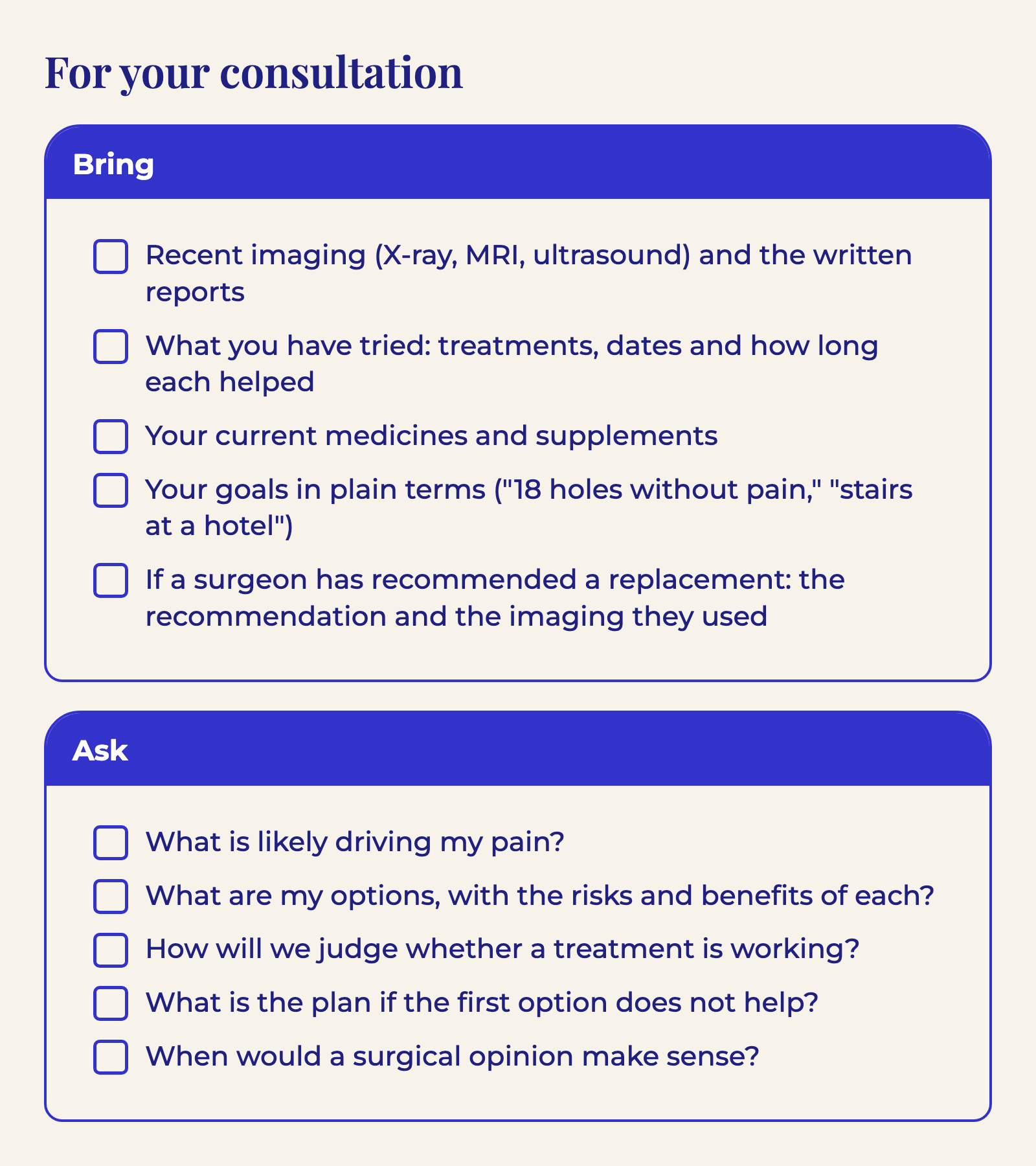
Bring:
- Recent imaging (X-ray, MRI, ultrasound) and the written reports
- What you have tried: treatments, dates and how long each helped
- Your current medicines and supplements
- Your goals in plain terms (“18 holes without pain,” “stairs at a hotel”)
- If a surgeon has recommended a replacement: the recommendation and the imaging they used
Ask:
- What is likely driving my pain?
- What are my options, with the risks and benefits of each?
- How will we judge whether a treatment is working?
- What is the plan if the first option does not help?
- When would a surgical opinion make sense?
If a surgeon has already suggested a replacement, a second opinion is a reasonable step. It can also confirm the recommendation. Also ask what the recommendation is based on, and which non-surgical options remain for your joint.
What a first consultation with Dr. Preet Patel involves
Gramercy Center offers platelet-rich plasma (PRP), bone marrow aspirate (BMA) and intra-articular joint injections. Its knee pain treatment page has more on knee pain.
Dr. Preet Patel is board-certified by the American Board of Anesthesiology and an ACGME fellowship-trained interventional pain management specialist. The first consultation is a full diagnostic consultation, not a five-minute triage. He reviews your records and imaging beforehand, then examines you and explains your options in plain language.
Note that this describes Gramercy’s approach, not research evidence. With the mixed evidence above in view, including the ACR’s recommendation against PRP, Dr. Preet Patel tells you honestly whether you are a good candidate (not everyone is, and results vary) and what the research shows for your condition. If surgery is the right answer, he will refer you to a trusted surgeon in his network.
At the consultation, Dr. Preet Patel goes over candidacy, recovery and what to expect for each procedure, including any bone marrow draw. If needles or time away from activity worry you, say so at the start. Most Gramercy clients describe ultrasound-guided injections as brief pressure or discomfort once a local anesthetic numbs the area.
When does osteoarthritis pain need emergency care?
These signs can signal more than an ordinary OA flare. Call 911 or go to the nearest emergency room for any of these:
- A hot, red, swollen joint, with or without fever. This can be a joint infection (septic arthritis), which MedlinePlus says usually comes on quickly. An emergency medicine review says the joint can be damaged within days without treatment, and that no fever does not rule infection out. Do not wait to see whether it settles.
- Inability to bear weight or move the limb, or intense pain with fever. AAOS advises going to the nearest emergency room for these.
- Severe pain or visible deformity after a fall or accident. Being able to walk on a painful hip does not rule out a fracture.
Ordinary OA usually builds gradually: NIAMS says OA damage usually develops over years, although it can worsen quickly in some people. A joint that is achy or mildly swollen, like your usual flare, is a different picture from a hot, red, swollen one. If none of the signs above apply but you have severe pain that starts suddenly, pain that is getting worse quickly, or a change you are unsure about, call your doctor’s office.
What should you do next?
Book a consultation when current care no longer lets you do what matters to you, when your symptoms change, or when you want a clearer diagnosis or a second opinion. Still, knee research on PRP and bone marrow aspirate is mixed or limited. Also, the ACR and AAOS guidelines set no timer for seeing a specialist. So gather your imaging and treatment history, write down your goals, and match the specialist to your question. It is a way to find out where you stand, so you can decide what comes next on your own terms.
Schedule a consultation with Dr. Preet Patel.
Sources
First part of the sources
- Orthopaedics (includes “When to See an Orthopaedic Surgeon”). AAOS OrthoInfo. https://www.orthoinfo.org/treatment/orthopaedics/
- 2026 Update of the American College of Rheumatology Recommendations for the Management of Osteoarthritis of the Knee, Hip, and Hand (Guideline Summary). American College of Rheumatology. 2026. https://assets.contentstack.io/v3/assets/bltee37abb6b278ab2c/bltb3d12c34020da842/oa-guideline-summary-2026.pdf
- Management of Osteoarthritis of the Knee (Non-Arthroplasty) Evidence-Based Clinical Practice Guideline. American Academy of Orthopaedic Surgeons. 2021. https://aaos.org/oak3cpg
- Osteoarthritis: Diagnosis, Treatment, and Steps to Take. NIAMS, NIH. Reviewed September 2023. https://www.niams.nih.gov/health-topics/osteoarthritis/diagnosis-treatment-and-steps-to-take
- Osteoarthritis (health topic overview). NIAMS, NIH. Reviewed September 2023. https://www.niams.nih.gov/health-topics/osteoarthritis
- Rheumatoid Arthritis. NIAMS, NIH. Reviewed November 2022. https://www.niams.nih.gov/health-topics/rheumatoid-arthritis
- The discordance between clinical and radiographic knee osteoarthritis: a systematic search and summary of the literature. Bedson J, Croft PR. BMC Musculoskeletal Disorders. 2008. https://pmc.ncbi.nlm.nih.gov/articles/PMC2542996
- What is a Physiatrist? American Academy of Physical Medicine and Rehabilitation. https://www.aapmr.org/about-physiatry/about-physical-medicine-rehabilitation/what-is-physiatry
Second part of the sources
- About ASIPP. American Society of Interventional Pain Physicians. https://www.asipp.org/about-asipp
- Osteoarthritis of the Hip. AAOS OrthoInfo. https://www.orthoinfo.org/en/diseases–conditions/osteoarthritis-of-the-hip/
- 2019 American College of Rheumatology/Arthritis Foundation Guideline for the Management of Osteoarthritis of the Hand, Hip, and Knee. Kolasinski SL et al. Arthritis & Rheumatology. 2020. https://assets.contentstack.io/v3/assets/bltee37abb6b278ab2c/blt6aa092f0134cac9a/63320f4750c8e90e3bf512c2/osteoarthritis-guideline-2019.pdf
- AAPM&R Guidance Statement on PRP for Knee Osteoarthritis Released. AAPM&R. April 16, 2026. https://www.aapmr.org/members-publications/newsroom/member-news/2026/04/16/aapm-r-guidance-statement-on-prp-for-knee-osteoarthritis-released
- AAPM&R guidance statement on platelet rich plasma for knee osteoarthritis (abstract). Borg-Stein J et al. PM&R. 2026. https://pubmed.ncbi.nlm.nih.gov/41989317/
- Position Statement on Biologics for Advanced Hip and Knee Arthritis. American Association of Hip and Knee Surgeons. https://www.aahks.org/wp-content/uploads/2025/06/AAHKS-Position-Statement-on-Biologics-2025.pdf
- Efficacy of intra-articular platelet-rich plasma compared with placebo in knee osteoarthritis: a systematic review and meta-analysis. Auroux M et al. Joint Bone Spine. 2025. https://pubmed.ncbi.nlm.nih.gov/40653151/
- PRP Injections for the Treatment of Knee Osteoarthritis: The Improvement Is Clinically Significant and Influenced by Platelet Concentration: A Meta-analysis of Randomized Controlled Trials. Bensa A et al. American Journal of Sports Medicine. 2025. https://pubmed.ncbi.nlm.nih.gov/39751394/
Third part of the sources
- Bone Marrow Aspirate Concentrate Injections for the Treatment of Knee Osteoarthritis: A Systematic Review of Randomized Controlled Trials. Han JH et al. Orthopaedic Journal of Sports Medicine. 2024. https://pubmed.ncbi.nlm.nih.gov/39640186/
- Total Knee Replacement. AAOS OrthoInfo. https://www.orthoinfo.org/en/treatment/total-knee-replacement/
- A Randomized, Controlled Trial of Total Knee Replacement. Skou ST et al. New England Journal of Medicine. 2015. https://pubmed.ncbi.nlm.nih.gov/26488691/
- Total Hip Replacement. AAOS OrthoInfo. https://www.orthoinfo.org/en/treatment/total-hip-replacement/
- Septic arthritis (MedlinePlus Medical Encyclopedia). MedlinePlus, National Library of Medicine, NIH. Reviewed May 12, 2025. https://medlineplus.gov/ency/article/000430.htm
- Evaluation and Management of Septic Arthritis and its Mimics in the Emergency Department. Long B, Koyfman A, Gottlieb M. Western Journal of Emergency Medicine. 2019. https://pmc.ncbi.nlm.nih.gov/articles/PMC6404712
- Hip Fractures. AAOS OrthoInfo. https://www.orthoinfo.org/en/diseases–conditions/hip-fractures/
This content is for general education only and is not medical advice. It does not create a doctor-patient relationship. Treatment decisions should be made with a qualified physician after an individual evaluation. Results vary, and not everyone is a candidate for every treatment.